

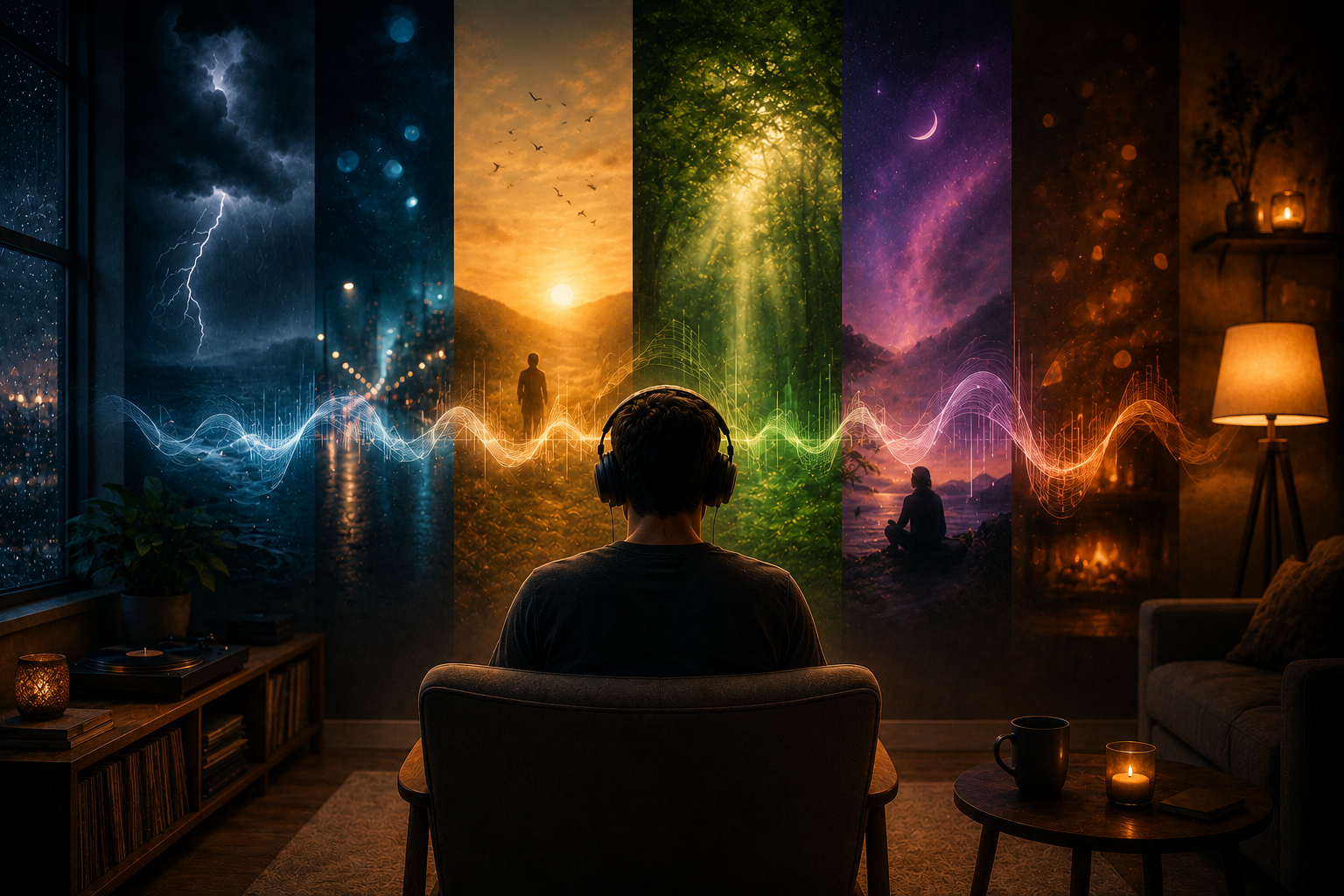
You did not choose silence today. Almost nobody does. There was a playlist while you answered email, a café hum behind a hard conversation, a low track you reached for when the afternoon went flat. You probably called all of it background. Your nervous system did not. The truth about background music and focus is that it has very little to do with taste. It has everything to do with what your body is doing while you believe you are ignoring the sound.
I am a music psychologist, and most of my work examines this exact gap: the distance between the sound we think we have tuned out and the effect it is still having on us. I call your daily audio your emotional wallpaper, the sensory surface you live inside without looking at it. Once you can see it, you stop being a passive listener and start designing the room.
There is no such thing as background sound to your brain. There is only sound you have stopped noticing.
The short version, if you’re skimming
- Your brain never fully tunes audio out. It keeps scanning the room for meaning and threat, even while you work.
- Lyrics are the usual reason a light day still leaves you fried: the words in the song compete with the words in your head.
- Tempo works like a dial on your body. Faster music nudges heart rate and arousal up; slower, simpler music lets them settle.
- The fix is not more silence or louder hype. It is matching the sound to the task in front of you.
- This is about attention and stress, not a cure for anything. Sound is information your body is already acting on.
Quick gut check: is your background music working for you, or against you?
- ☐ You finish focused work feeling oddly drained, even on a light day.
- ☐ You reread the same paragraph because a lyric keeps pulling your eye.
- ☐ You keep nudging the music louder than the task really needs.
- ☐ Total silence makes you restless, so you fill it with anything.
- ☐ You pick hype music for work because it feels productive, not because it helps.
Hold your answers. We will come back to them.
What “Background Music and Focus” Really Means for Your Brain
Vision is easy to close. You shut your eyes and the visual world goes away. Hearing has no eyelid. Your auditory system stays on, all night and all day, because for most of human history the relevant question carried by sound was simple: is that safe, or is that coming for me. So your brain keeps a low-level monitor running on the room, and sound reaches emotion-related regions like the amygdala fast, often before the thinking part of you has named what you heard. That is why a sudden noise spikes your pulse before you know what made it.
This monitor does not switch off because you are busy. It just gets quieter. And here is the part most productivity advice misses: whether background music helps or hurts depends almost entirely on the task and the track. In one study of sustained attention, the right background music actually reduced mind-wandering and held people on task during low-demand work, the kind of stretch where boredom is the real enemy. On demanding verbal work, the same audio can do the opposite. So when people ask me does background music help you focus, the honest answer is: it can, and it can wreck it, and the difference is not random.
Your playlist is not the soundtrack to your work. It is a second task your brain is quietly running.
The Lyrics Problem: Why Words Wreck Deep Work
If you do anything with language, writing, reading, coding, thinking in sentences, lyrics are usually the saboteur. Your brain cannot fully wall off speech. While you are trying to produce words, the song is feeding it other words, and the two streams collide. Researchers find that music with lyrics tends to worsen reading comprehension compared with silence, while instrumental music is gentler on focus. It is the same reason a quiet conversation two desks away is so much harder to ignore than a fan: meaningful speech demands processing whether you invited it or not.
There is a personality wrinkle worth knowing. Pop music during a reading task has been shown to hurt introverts more than extroverts, so the friend who swears they write best to lyrics may genuinely be wired to tolerate more stimulation than you are. Their setup is not your setup. The practical rule survives all of it: for verbal or deep cognitive work, go instrumental. Save the lyrics for tasks that do not use language, like tidying, exercise, or email triage.
Tempo Is a Dial on Your Body
Tempo is the lever almost nobody adjusts on purpose. Your heart rate and breathing shift with the speed of what you are hearing. Faster music reliably pushes heart rate, blood pressure, and arousal upward, while slower music lets them ease back toward baseline. This is not mystical brainwave reprogramming, and I want to be careful here: music does not lock your brain into a “healing state.” What it does is more grounded and more useful. It shifts your physiological arousal, and arousal is the thing that makes focus either possible or impossible.
That is why aggressive gym music at your desk can leave you wired and scattered. You have prepared your body for a sprint that is not coming. Slower, simpler, low-percussion music does the reverse, and there is some evidence it can lower cortisol, one of the body’s stress markers. I phrase that carefully on purpose. Music may support a calmer state; it is not a treatment, and it does not replace rest, care, or a therapist. A good target for focused work sits around the pace of a resting heartbeat, roughly 60 to 80 beats per minute.
Three Kinds of Emotional Wallpaper
Across the people I work with, the same three audio environments keep showing up. See which one you have been living in.
1. The Dissonant Room (the burnout pattern)
Fast, lyric-heavy, percussion-driven music playing under work that needs concentration. Your brain spends the day in a split: processing the song’s language while trying to produce your own. The cost is rarely dramatic in the moment. It shows up at 6 p.m. as that scraped-out, fried feeling on a day that, on paper, was not even hard.
2. The Static Room (the sensory void)
Total silence or thin, clinical white noise. For many people this is ideal, and if silence works for you, protect it. But for some, an empty audio field gives looping thoughts nothing to push against, and attention drifts inward into overthinking rather than forward into the task. If that is you, the answer is not noise. It is the right structure.
3. The Resonant Room (the container)
Carefully chosen instrumental sound, steady, low on percussion, near that resting-heartbeat tempo. It masks sudden distracting noises without demanding anything from you, which gives your attention a container to sit inside. This is where the pleasant time-dilation of flow tends to show up, the hours that pass like minutes. It is the everyday version of something I wrote about in Music Psychology in Daily Life: the quiet ways sound steers stress and focus before you ever decide anything.
Run a Wallpaper Audit: a 60-Second Self-Check
Pull up your most-played work playlist and ask three honest questions.
- Does this match the person I need to be three hours from now? If you are doing careful work to aggressive music, your soundtrack and your task disagree.
- Am I using this music to numb the stress or to work through it? Numbing has its place. Just know which one you are doing.
- Is there room for my own thoughts in here? If the audio fills every gap, you may be drowning out the very thinking you sat down to do.
Now look back at your gut-check answers from the top. The boxes you ticked are usually pointing at one specific room you have been stuck in.
Sound Hygiene: What to Actually Do
You do not need new gear. You need a few defaults.
- Make instrumental your work setting. Lyrics off whenever the task uses language. This single switch undoes most of the damage.
- Match tempo to the task. Deep focus: slow, steady, low-percussion tracks near 60 BPM. Busy admin work: brighter, upbeat instrumentals are fine. Decompression: natural sound, like water or rain, which tends to feel restorative without pulling at your attention.
- Try a 30-minute reset. When your shoulders climb toward your ears, switch to pure instrumental with no strong beat for half an hour and let your arousal come back down to baseline.
- Keep one silent gap. Fifteen minutes of deliberate quiet after a high-stress meeting lets the wallpaper come off so you can see the walls of your own mind again.
If this is the kind of thing you want to get better at noticing, the subscribe box at the bottom of the page is where I send these breakdowns first.
Most of this works because your body responds to sound faster than your reasoning does, a pattern I unpack in Why Your Body Reacts to Music Before Your Mind Understands It. Sound hygiene is just working with that head start instead of against it.
From Passive to Purposeful
You are not only a consumer of music. You are a responsive system that sound is constantly informing, and your background audio is quietly training you in one direction or another, toward restlessness or toward steadiness. That is the heart of the framework I work from: sound is not decoration sitting on top of your day. It is behavioral information your body is already using.
So the question is not whether your emotional wallpaper is affecting you. It is. The question is whether you chose it.
What is on your focus playlist right now, and is it actually helping, or just keeping you company? Tell me in the comments. I read them.
Keep reading: the sound and behavior series
- Music Psychology in Daily Life: Sound, Stress, and Focus
- The Acoustic Anatomy: How to Architect a Peaceful Mind with 5 Audio Anchors
- Why Your Favorite Music Suddenly Feels Irritating
- Why Your Body Reacts to Music Before Your Mind Understands It
Frequently Asked Questions
Does background music help you focus?
It depends on the task and the track. On low-demand or repetitive work, steady instrumental music can reduce mind-wandering and keep you on task. On demanding verbal work, music with lyrics usually hurts more than it helps. The reliable setting is instrumental, moderate tempo, low percussion.
Why do I feel so tired after working with music on all day?
Most often it is lyrics. When the song is feeding your brain words while you are trying to produce your own, you spend the day in a quiet split-focus that drains you even when the workload was light. Switching to instrumental usually fixes the afternoon crash.
Is silence better than music for concentration?
For demanding language-based work, silence is often best. But total silence does not suit everyone. Some people focus better with steady instrumental sound that masks sudden noises and gives looping thoughts something to settle against.
What is the best background music for deep work?
Instrumental, steady, low on percussion, and around the tempo of a resting heartbeat, roughly 60 to 80 BPM. The goal is to remove the language load and gently lower your arousal so attention can settle, not to pump you up.
Can background music reduce stress while I work?
Slow, simple music can lower physiological arousal and has been linked to reduced cortisol, so it may support a calmer state. It is genuinely helpful, but it is supportive, not a treatment, and it is not a substitute for rest or professional care.
Does the type of music matter more than the volume?
Both matter, but type usually costs you more. Lyrics and fast, loud tracks tend to take the biggest bite out of focus, regardless of how quietly you play them.

About the author
Dr. Shveata Mishra
Begin with the ritual
Get the free 5-Minute Sound Ritual.
A research-informed listening practice designed to help your nervous system settle, sent to your inbox as a PDF. You will also receive new writing on sound, emotion, and identity whenever an article is published.