

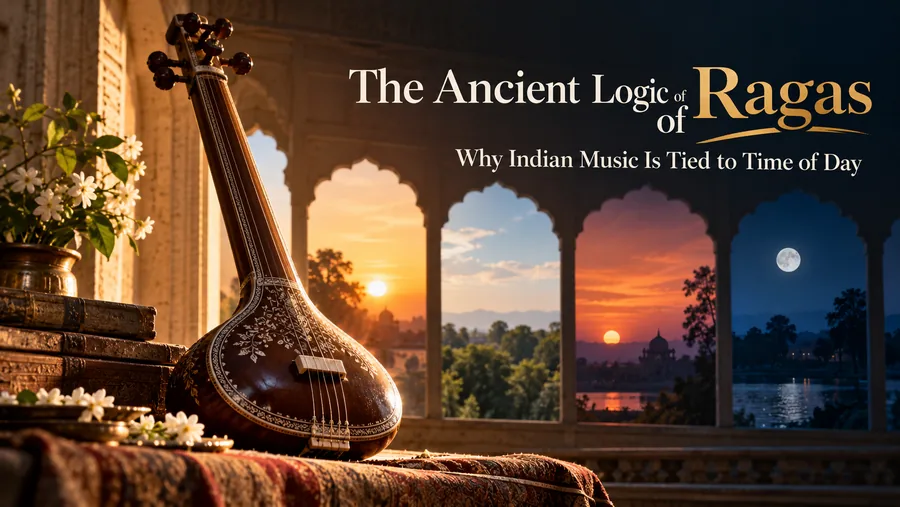
Play Raga Bhairav at nine in the evening to someone who grew up with this music and watch their face. Not offense exactly. Something closer to the feeling of being served breakfast at a funeral.
Hindustani classical music assigns ragas to times of day, and the assignment is not loose. The day is divided into eight prahars, four of daylight and four of night, each about three hours, and ragas belong to them. Performers observe it. Listeners notice when it is broken. The system has survived centuries of everything else changing.
So the question worth asking about ragas and time of day is not whether the tradition is real, because it plainly is. It is what the tradition is tracking. And the honest answer, once you look at what has actually been measured, is more interesting than either the romantic version or the dismissive one.
The tradition is unquestionably real. What it is real about is the open question.
The short version, if you’re skimming
- Hindustani practice divides the day into eight prahars and assigns ragas to them.
- A study of 65 raga performances found that pitch-related features predicted traditional time-of-day classification.
- Strikingly, features you would expect to track circadian arousal, such as tempo, did not covary with the time assignments.
- So the system appears to be organized around tonal material rather than around arousal, which undercuts the simplest physiological story.
- Ragas and time of day may work mostly through enculturated expectation, and that is not a lesser explanation.
Quick gut check: which of these is true for you right now?
Tick whatever fits. We come back to these.
- ☐ A piece of music has felt wrong for the hour without my being able to say why.
- ☐ I have morning music and evening music and never decided this consciously.
- ☐ I grew up around Indian classical music and can hear when a raga is out of place.
- ☐ I did not grow up with it and cannot hear the difference at all.
- ☐ I assume there is a physiological reason behind old musical rules.
Ragas and time of day: what the system actually is
A raga is not a scale, and the difference matters for this discussion.
A raga specifies which notes are available, but also how they must be approached, which are emphasized, which are ornamented and in what way, which phrases are characteristic, and which movements are forbidden. It is closer to a grammar with a personality than to a set of pitches.
The time assignment sits on top of that. Each prahar carries its ragas: Bhairav belongs to the early morning, Marwa to the late afternoon, Bageshri to the late night. Beyond the prahar scheme there are organising principles about which tonal material belongs where, so the system has internal logic rather than being a list to memorise.
This is a serious, consistent, centuries-old body of practice. Any explanation that waves ragas and time of day away as arbitrary is not taking the evidence seriously.
Try this: play something you consider morning music at eleven at night. The wrongness arrives before any reasoning does.
The finding that complicates the romantic story
Here is where it gets genuinely interesting.
The appealing explanation is physiological: ragas were matched to the body’s daily rhythm, so morning ragas suit morning arousal and night ragas suit night. It is a lovely story and it makes a testable prediction. If ragas track circadian arousal, then musical features associated with arousal should line up with the time assignments.
Researchers tested exactly that, examining associations between traditional time-of-day classifications and musical features across 65 Hindustani raga performances. The result was split.
Pitch-related features did predict the time-of-day classification. The tonal material genuinely differs by prahar in a way a model can detect.
Non-pitch features known to correlate with arousal, such as tempo, did not covary with the time assignments. The thing you would most expect to track circadian arousal was not doing so.
That is an awkward result for the physiological account, and it should be reported rather than skipped. The system is organized, but it appears to be organized around which notes, not around how activating the music is. Ragas and time of day is a tonal scheme before it is a physiological one.
Work on listener responses is similarly unsettled. A pilot study on the contemporary relevance of the time theory found varied preferences, with participants favouring different times depending on the raga. Meanwhile a meta-analysis of EEG studies found that listening to ragas was associated with increased alpha activity and attention scores, which supports ragas doing something measurable without speaking to the ragas and time of day question at all.
Keep reading
Why enculturation is the stronger explanation
If it is not arousal, what is it?
I think the best available account is expectation, and I do not consider that a downgrade.
Listeners who grow up inside this tradition acquire an extremely detailed internal model of it: which tonal material belongs to which part of the day, absorbed the way any native listener absorbs the regularities of their own musical culture. Once that model exists, a morning raga at night violates a learned prediction, and prediction violation is a large part of how music produces feeling in the first place.
That makes the effect real, strong, and genuinely located in the listener rather than in the clock. It also makes a clean prediction: ragas and time of day should affect listeners without the enculturation far less. Which, anecdotally, is exactly what people report.
I wrote about the general mechanism in How Temperature and Environment Change the Way You Feel Music, where context and expectation shape perception rather than merely colouring the judgment afterwards.
There is likely a second, humbler contributor: the ragas were assigned to the hours at which they were historically performed, and association does the rest. A body of music heard only at dawn for several centuries acquires dawn as part of its meaning, regardless of whether its intervals have anything to do with cortisol. Ragas and time of day would then be a record of performance history as much as anything else.
A rule does not have to be physiological to be real. It only has to be learned by enough people for long enough.
What this changes about listening
The practical upshot is not that the tradition should be abandoned. It is that the reason to observe it is different from the reason usually offered.
Observing time theory gives you a set of pre-built associations of extraordinary depth. Centuries of listeners have attached specific tonal material to specific hours, and stepping into that is stepping into a shared frame that will shape your experience whether or not you believe in its physiological basis. That is how ritual works generally, and it is not a lesser thing.
What I would resist is the version that claims ragas were reverse-engineered from the nervous system. The measured evidence does not support it, and overstating it makes the whole tradition easier to dismiss, which would be a genuine loss.
What to actually do about it
Look back at your gut-check ticks. Whichever way they fell, the practical advice is similar.
- Try the system properly before judging it. Listen to morning ragas in the morning for a fortnight. You are building a model, and it will not exist on the first day.
- Expect enculturation, not chemistry. If the effect arrives, it is most likely learned expectation doing its work. That is still a real effect on a real listener.
- Notice your own private version. Most people already have morning and evening music they never consciously chose. Ragas and time of day is the same instinct, codified and refined over centuries.
- Test the wrongness. Deliberately play something out of its hour. The discomfort tells you how much of a model you have built.
- Do not demand a physiological reason. The research does not currently support the arousal story, and the practice does not need it.
- Let the unfamiliar be unfamiliar. If you did not grow up with this, the time assignments will feel arbitrary for a while. That is the model being absent, not the system being empty.
- Treat it as a frame, not a prescription. Ragas and time of day gives you centuries of shared association to step into, which is worth more than a mechanism.
If this kind of writing on sound, culture and perception is useful to you, the subscribe form at the bottom of the page will send new pieces your way.
The reframe: a very long experiment in attention
It is tempting to treat the time theory as either ancient wisdom that science is slowly confirming, or charming superstition. I do not think it is either.
What it looks like to me is something rarer: a centuries-long, culturally maintained experiment in attaching specific sound to specific hours. Nobody designed it from physiology. It accumulated, it was refined by people who listened extremely carefully, and it produced a shared structure in which a particular set of notes at a particular hour means something to millions of people.
That structure is real and it does real work. Ragas and time of day is better understood as a monument to collective listening than as a discovery about the body.
People don’t just hear sound. They recognize themselves in it, and part of what a tradition like this offers is the chance to recognize yourself at the same hour as everyone who came before.
So I would like to know, especially if you did not grow up with this. What is your morning music, and when did you last examine why?
Keep reading: the sound and culture series
- The Sound Science of Temple Bells and Mental Reset
- How Temperature and Environment Change the Way You Feel Music
- Slow Music: The Hidden Way It Shifts Your Sense of Time
- How Background Music Quietly Changes Human Decisions
Frequently Asked Questions
What is the time theory of ragas?
Hindustani classical practice divides the day into eight prahars, four daytime and four night, each roughly three hours, and assigns ragas to them. Ragas and time of day is a structured, centuries-old system with internal organising principles rather than an arbitrary list.
Is there scientific support for raga time assignments?
Partly. The evidence on ragas and time of day is genuinely mixed. A study across 65 Hindustani performances found pitch-related features predicted the traditional time-of-day classification. But features known to correlate with arousal, such as tempo, did not covary with the assignments, which complicates the physiological explanation.
So is the tradition wrong?
No. The system is clearly organized and the effect on enculturated listeners is real. What the evidence does not currently support is the claim that ragas were matched to the body’s circadian arousal.
Why does a raga feel wrong at the wrong hour?
Most plausibly because it violates a learned expectation. Listeners raised in the tradition acquire a detailed model of which tonal material belongs to which part of the day, and prediction violation is a major source of musical feeling.
Does it work if I did not grow up with this music?
Much less, at first. The effect appears to depend on enculturation, so the assignments will feel arbitrary until you have built the model. Listening consistently for a few weeks is the only way to find out.
Do ragas have any measurable effect at all?
Yes, independent of the time question. A meta-analysis of EEG studies found listening to ragas was associated with increased alpha activity and attention scores, which is about the music rather than the hour.

About the author
Dr. Shveata Mishra
Begin with the ritual
Get the free 5-Minute Sound Ritual.
A research-informed listening practice designed to help your nervous system settle, sent to your inbox as a PDF. You will also receive new writing on sound, emotion, and identity whenever an article is published.