

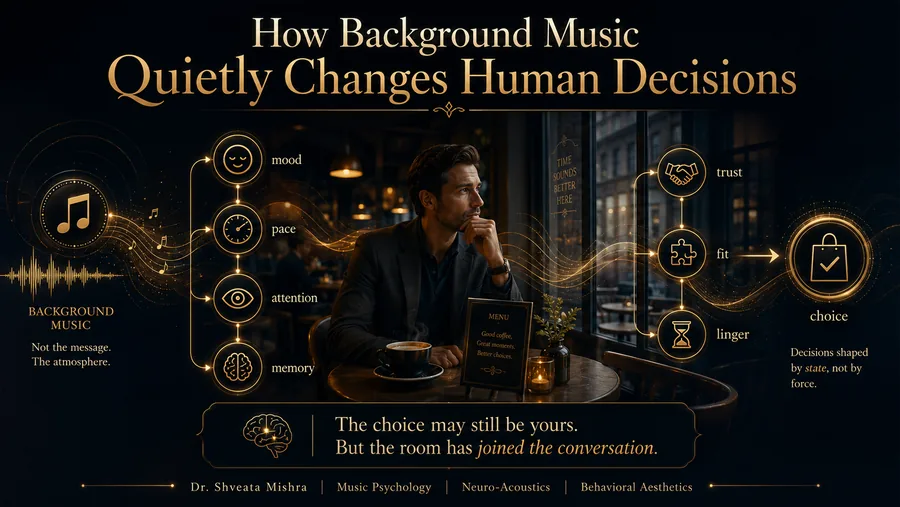
You may not remember the song that was playing when you chose the table by the window, ordered one more coffee, lingered in a store longer than you planned, or felt strangely calm in a waiting room. The music did not tell you what to do. It changed the air you decided in.
That is the quiet relationship between background music and decisions. Most of the time it works below direct attention. Not sinister, not magical. More like weather. We still make our own choices, but the atmosphere around the choice has shifted.
A room with music does not feel like a room without music. A memory made with music is not stored in the same emotional color as a memory made in silence. The choice may still be yours. But the room has joined the conversation.
Humans do not just hear sound. They recognize themselves in it.
The short version, if you’re skimming
- Background music and decisions are linked through mood, pace, attention, memory, and a sense of fit, not through control.
- Classic field studies found that slower tempo can slow shoppers and diners, and that musical style can nudge what people buy.
- The effect is real but modest, and it shifts with culture, age, taste, volume, and setting.
- The honest version is simple: sound changes perception, and perception shapes behavior.
- Once you can hear the room, you get some of the choice back.
Quick gut check: which of these is true for you right now?
Tick the ones that fit. Hold on to your answers, we will come back to them.
- ☐ You have stayed somewhere longer partly because the music felt good.
- ☐ You have left a shop or cafe because the sound felt too loud or just wrong.
- ☐ A song in a public place pulled you straight back to another time in your life.
- ☐ You shop, work, or eat differently depending on what is playing.
The Quiet Part Of Decision-Making
Most of us like to believe our decisions begin in thought. We compare, calculate, reason, then choose. Sometimes that is true. But many everyday decisions begin earlier, in the body.
Before we can explain why a place feels expensive, relaxed, rushed, warm, serious, playful, or safe, the nervous system has already started reading cues. Lighting, scent, space, texture, temperature, and sound all contribute to context.
Background music is one of the most emotionally efficient parts of that context, because it enters through attention and feeling at the same time. It can make time feel slower or faster, soften waiting, and give a space a sense of intimacy, energy, ceremony, or trust.
This is the real mechanism behind background music and decisions. It does not mean music controls people. That would be an exaggerated and irresponsible claim. It means music can influence the state in which people decide, and human beings rarely decide from a neutral state.
Try this: in the next place you walk into, name the feeling the sound is asking of you before you look at a single price.
Why Sound Changes The Room Before It Changes The Choice
The science of background music and decisions is most convincing when we resist overclaiming. Background music tends to shape decisions through modest but meaningful pathways: mood, arousal, attention, memory, social meaning, and fit.
Mood matters because people often use their feelings as information. When we feel comfortable or welcomed, we may read the environment more positively. When we feel overstimulated or hurried, we may turn defensive or impatient.
Arousal matters because music can change the pace of the body. Faster tempos may lift energy and movement. Slower tempos may invite lingering. Loud music can feel exciting in one setting and intrusive in another.
Attention matters because background music can either support focus or compete with it. Predictable instrumental music may help some people stay with a task. Lyrical or highly variable music may pull attention away. That side of the story has its own piece, linked a little further down.
Memory matters because music is sticky. It attaches itself to place, period, people, and identity. A song can make a store feel familiar even if you have never set foot in it before. It can make a restaurant feel like a first date, a childhood kitchen, a holiday, a city, or a version of yourself you have been missing.
Fit matters most of all. Music influences us most responsibly when it feels congruent with the space and the person. Classical music in a wine shop, soft acoustic music in a wellness studio, or regional music in a cultural setting can communicate meaning before anyone reads a sign.
The brain is not simply asking, “What am I hearing?” It is asking, “Where am I, who am I here, and what kind of behavior belongs in this place?”
What Research Says About Background Music And Decisions
Consumer psychology has studied background music for decades, especially in retail and hospitality. In a now-classic field study, Ronald Milliman found that slower music in a supermarket was associated with slower shopper movement and notably higher sales, and a few years later that slower restaurant music was linked with longer stays and more spending at the bar (Milliman, 1982 and 1986). In another well-known experiment, Adrian North and colleagues showed that playing French or German music in a shop changed which wine people actually bought, with the musical style accounting for a striking share of the choice.
These findings are memorable, but they are not universal rules. Music effects vary by culture, age, musical preference, brand, task, volume, setting, and personal history. A song that signals sophistication in London may not carry the same meaning in Delhi, Toronto, New York, or Nairobi.
Good science does not say, “Play this song and people will buy.” Good science says, “Sound changes perception, and perception shapes behavior.” That distinction keeps the conversation honest. Music can make people feel more at ease, energized, socially connected, or emotionally receptive. It can also do the opposite. The real question is whether the sound is serving the human being in the space, or only trying to extract something from them. That is the ethical core of background music and decisions.
Keep reading
Everyday Places Where Background Music Changes Decisions
When we talk about background music and decisions, the retail floor is where it shows up most plainly. Think about a grocery store on a weekday evening. If the music is gentle and familiar, shopping may feel less like a chore. You may move a little slower. You may notice items you would normally pass. If it is too loud, too fast, or too repetitive, the same store can feel like one more demand after a long day.
Think about a restaurant. Music shapes how private a conversation feels, how expensive the food seems, and how comfortable people are ordering another round. A silent restaurant can feel exposed. A noisy one can feel exhausting.
Think about a medical waiting area. Soft background sound cannot remove uncertainty, pain, or fear. But it can soften the harshness of silence. It can make waiting feel less abandoned. In those moments, sound is not decoration. It is part of care.
Think about an office, a co-working space, or a home desk. Music can become a boundary between the self and the noise of the world. For some people it helps initiate work. For others it becomes another layer of cognitive load. The best sound for thinking depends on the person, the task, and the emotional state they bring into the room. If this resonates, I wrote a whole piece on it: Background Music and Focus: Your Emotional Wallpaper.
Even when a screen is silent, brands now reach us through ads, reels, podcasts, events, apps, and social feeds. A short audio signature can make a brand feel modern, nostalgic, safe, premium, playful, or local. In each case, music does not replace choice. It frames it.
The Emotional Shift: We Are Contextual Beings
The deeper truth about background music and decisions is not only that sound changes what people buy. The deeper truth is that human beings are profoundly contextual. We are not isolated minds choosing in empty space. We are bodies moving through atmospheres, memories walking into rooms, nervous systems asking, often without words, “Can I settle here? Do I belong here? Is this for me?”
This is why background music can feel so personal even when it was chosen for a crowd. A song in a shop may pull you toward a decade. A rhythm in a cafe may slow your breath. A voice in a hotel lobby may make a foreign city feel briefly familiar.
Sound does not only decorate experience. It helps us locate ourselves inside it. And when people feel located, they decide differently. They may linger because the space feels generous. They may trust because the brand feels coherent. They may leave because the sound feels invasive. They may buy not because music manipulated them, but because the room helped them imagine a version of themselves inside the story.
Consumer psychology becomes more humane when it remembers this: a decision is not just an outcome. It is an emotional event.
For Brands, The Ethical Question Is Fit
For businesses, designers, clinicians, educators, and hospitality teams, the question should not be, “How can music make people do what we want?” The better question is, “What emotional condition are we creating for the people who enter this space?”
If music is too loud, too repetitive, culturally careless, or disconnected from the setting, it becomes friction. It quietly tells people the space was designed at them, not for them.
But when background music is chosen with care, it can support belonging. It can protect privacy. It can reduce perceived waiting. It can express cultural identity. It can help a brand feel consistent without explaining itself loudly. The ethics of background music and decisions come down to one word: fit. Ethical sound design respects agency, and it understands that people arrive with different nervous systems, histories, and thresholds for stimulation.
A powerful playlist is not always the one people notice. Sometimes it is the one that lets them feel more like themselves.
What To Actually Do About It
You do not need a degree to put background music and decisions to work for you instead of on you. The next time you walk into a shop, restaurant, clinic, gym, hotel, airport lounge, or workspace, slow down for a second and ask:
- What is this sound asking my body to do? Hurry, settle, spend, leave, or stay.
- Do I feel held, or handled? One feels like care. The other feels like a tactic.
- Does the music match the space, or is it trying too hard? Mismatch is a friction you can feel.
- Would I make the same decision in silence? If not, the room is part of the choice.
These questions are not meant to make you suspicious of every playlist. They are meant to return awareness to the listener. We are not weak for being moved by atmosphere. We are human. We are shaped by cues, and we are also capable of noticing them.
If you like reading the quiet psychology of sound this way, the subscribe form at the bottom of the page sends new pieces straight to you.
The Choice Was Always Emotional
Background music changes human decisions quietly because it changes the emotional room those decisions happen in. It can alter pace, mood, memory, attention, trust, and a sense of belonging. It can support care, deepen a brand, or turn into noise when chosen without sensitivity.
The responsible conclusion is not that music controls us. The more interesting one is that the link between background music and decisions reveals how human our choices have always been. We choose with thought, yes. But we also choose with breath, memory, rhythm, association, fatigue, longing, and the quiet sense of whether a place recognizes us.
Not because the music tells us who to be, but because, for a moment, it changes who we feel allowed to become.
So here is my question for you: where were you, and what was playing, the last time a room clearly changed your mind? Tell me in the comments.
Keep reading: the sound and behavior series
- Background Music and Focus: Your Emotional Wallpaper
- How Voice Shapes Trust: The Hidden Tempo Behind Authority and Decision-Making
- Why We Trust Calm People: Behavioral Dissonance and the Sound of Composure
- Sound and the Nervous System: 5 Audio Anchors for a Steadier Mind
Frequently Asked Questions
How are background music and decisions connected?
Background music and decisions are connected through state, not command. Music shifts your mood, pace, attention, and sense of fit, and those small shifts quietly color the choices you make in a space.
Can background music really influence consumer decisions?
Yes, but influence is not control. Research suggests background music can shift mood, pace, attention, perceived time, and product associations, which then shape everyday decisions. The effect is real, modest, and dependent on context.
What kind of background music affects people most?
There is no universal best type. Tempo, volume, familiarity, lyrics, genre, cultural meaning, and fit all matter. Music tends to work best when it supports the space and respects the listener rather than overwhelming them.
Does slow music make people spend more?
Some classic studies linked slower music with slower movement, longer stays, and sometimes higher spending. But the result depends on the audience, setting, product, and volume, so it is a tendency, not a guarantee.
Why does music make a place feel more trustworthy or expensive?
Music carries social and emotional meaning. A matched soundscape can make a space feel coherent, premium, familiar, calm, or culturally grounded, and when the sound fits, the place tends to feel more intentional and easier to trust.
Is using music in marketing manipulative?
It can be, if the goal is to overwhelm or pressure people. But thoughtful music design can also be humane. It can protect privacy, soften waiting, support cultural identity, and make a space feel more emotionally comfortable.
How do I tell if background music is affecting my decisions?
Pause and notice your body. If you feel hurried, soothed, or pulled to stay, ask whether you would make the same choice in silence. That single question is usually enough to hand the decision back to you.

About the author
Dr. Shveata Mishra
Begin with the ritual
Get the free 5-Minute Sound Ritual.
A research-informed listening practice designed to help your nervous system settle, sent to your inbox as a PDF. You will also receive new writing on sound, emotion, and identity whenever an article is published.