

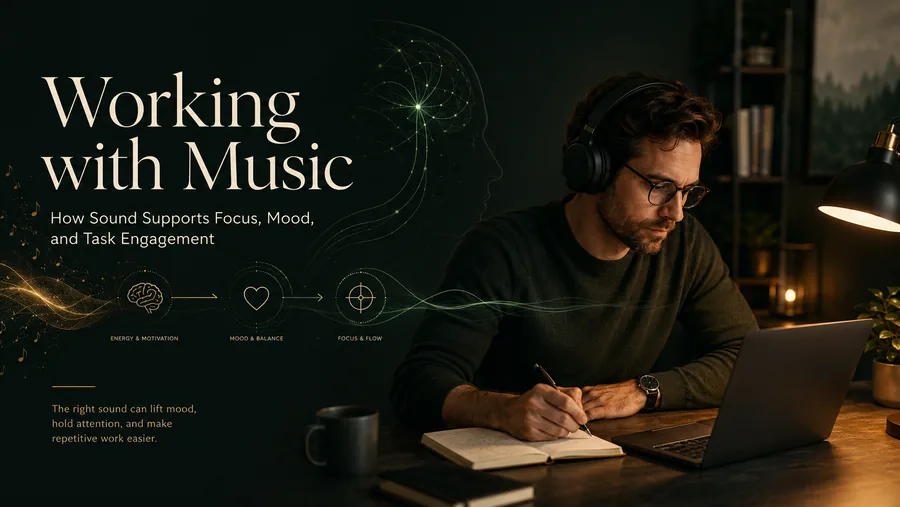
You sit down to work, and almost without thinking, you reach for headphones. A playlist, a familiar album, a wall of lo-fi beats. For a lot of us, music for focus has become the quiet ritual that tells the brain it is time to begin. The interesting part is not whether sound helps. It is when it helps, what kind, and for which task, because the same song that carries you through a pile of email can quietly sink you while you are trying to write.
Music does not make you smarter. It changes how you feel, and how you feel decides what your attention can do.
The short version, if you’re skimming
- Music for focus mostly works indirectly, by lifting mood and arousal, not by some special “brain frequency.”
- Lyrics compete for the same language circuits you use to read and write, so they cost you most on verbal work.
- For boring, repetitive tasks, music helps the most. For hard, novel thinking, silence often wins.
- Familiar, mid-tempo, low-surprise sound holds attention better than something new and exciting.
- The honest answer is personal, so the article ends with a way to test your own mix.
Quick gut check: which of these is true for you right now?
Tick the ones that fit. Hold on to your answers, we’ll come back to them.
- ☐ I cannot start a task until the right playlist is on.
- ☐ I keep skipping tracks instead of working.
- ☐ I read the same paragraph three times when a song has words.
- ☐ Music makes the dull parts of my job bearable.
Why music for focus works on your mood first
Here is the finding that reframes everything. The famous “Mozart effect,” the idea that classical music makes you measurably smarter, did not survive scrutiny. When Glenn Schellenberg and his colleagues looked closely, the boost was not coming from Mozart at all. It was coming from enjoyment. Children performed better after listening to pop music they liked than after Mozart they did not. The effect was arousal and mood wearing a tuxedo.
That is the arousal-and-mood hypothesis, and it is the most useful thing to understand about music for focus. Sound rarely sharpens cognition directly. It shifts your emotional state, your alertness lifts, a little dopamine arrives, and that better state is what lets your attention settle. Norepinephrine tracks the arousal side, dopamine the pleasure side. So the right music is not the “smartest” music. It is the music that puts you in the mood to do the thing.
Try this: before your next work block, notice your mood for ten seconds. Pick sound to move it where you need it, calmer or more awake, not just by habit.
Lyrics are the hidden tax on focus
Now the part most playlists get wrong. Words.
Your brain processes language with a specific set of circuits, and reading, writing, and editing lean on those same circuits. When a song has lyrics, especially lyrics you understand, the singing quietly elbows its way into the same workspace. Researchers call the broad version of this the irrelevant sound effect, and the verbal version is well documented: music with lyrics interferes with cognitive tasks that involve language. You are not weak-willed when you reread a sentence over a great chorus. You are running two language streams at once.
This is why the “does music help” debate stays unsettled. It depends on the task. For language-heavy work, instrumental music for concentration is almost always the safer choice. For spreadsheets, design, or anything non-verbal, lyrics cost you far less.
If this resonates, I went deeper into the ambient version of this in Background Music and Focus: Your Emotional Wallpaper.
Keep reading
Match the sound to the task, not the mood you wish you had
The cleanest way to use music for focus is to stop asking “what do I like” and start asking “what am I doing.” Music for focus is not one setting, it is a choice you remake with each kind of work.
A large review of background music and cognitive performance found the effect is not one number, it swings with the task, the music, and the person. Pull those apart and a simple map appears.
Is it your ears, or your task?
- Boring and repetitive work (data entry, filing, inbox triage, formatting). Music helps most here. It relieves monotony, lifts mood, and keeps you moving. Reach for something you enjoy, lyrics are fine.
- Verbal and language work (writing, reading, editing, learning new material). Lyrics hurt. Go instrumental, or go quiet. What helps: ambient, classical, film scores, or familiar music you barely notice.
- Hard, novel problem-solving (the thing you have never done before). Silence often wins. Several studies on demanding memory and reasoning tasks found quiet beat sound. What helps: save the playlist for the easy stretch and protect the hard part.
- Low energy, low motivation (you cannot get started). Use arousal on purpose. An upbeat, familiar track can raise your state enough to begin, then you switch to something calmer once you are moving.
Why familiar and a little boring beats new and exciting
There is a twist that surprises people. The best music for focus is often slightly dull.
Anything new pulls attention. A song you have never heard makes your brain track it, predict it, react to it. A song you know by heart asks for almost nothing, so it can sit underneath the work like soft lighting. That is also why a track with sudden dynamics, a drop, a key change, a spoken sample, breaks concentration more than a steady one. You want predictable harmonic ground, not surprises.
There is even a catch in the comfort. One study following people over a month found that the focus benefit of a favorite piece faded by roughly half after thirty days of repetition. Habituation works both ways. Once a track stops moving your mood, it stops doing the job, which is a quiet argument for rotating a small set rather than wearing one playlist to the bone.
The goal is not music you love. It is music that disappears.
What to actually do about it
- Sort by task first. Words for dull work, instrumental for verbal work, silence for the hardest thirty minutes.
- Build a “disappearing” set. Three or four instrumental albums you half-know, mid-tempo, low surprise, and rotate them so they keep working.
- Use a track to start, not to think. One energizing song to break inertia, then drop to something quieter.
- Watch the skip button. If you are choosing songs, you are not working. Queue it once and leave it.
- Protect silence on purpose. Quiet is a tool too, not a failure to find the right playlist.
If you like this way of paying attention to sound, the free 5-minute sound ritual at the bottom of the page is a gentle place to start.
The deeper point: sound is information your behavior is already using
Step back and something larger comes into view. You are not really choosing a playlist. You are managing your own state, using sound the way you use coffee or a walk, as a lever on attention and mood. That is the lens my work keeps returning to, that sound is not background, it is behavioral information. We act on it long before we explain it.
So the real skill is not finding the perfect focus track. It is noticing what a given sound does to you, on this task, today, and choosing on purpose. People don’t just hear sound. They recognize themselves in it, and that includes recognizing how they work.
So, what is the one track that genuinely puts you in the zone, and what kind of work does it actually carry you through? Tell me in the comments, I read them.
Keep reading: the sound and attention series
- Background Music and Focus: Your Emotional Wallpaper
- Music Psychology in Daily Life: Sound, Stress, and Focus
- How Background Music Quietly Changes Human Decisions
- You Are Not Just Seen or Heard, You Are Neurologically Perceived
Frequently Asked Questions
Does music for focus actually improve concentration?
Sometimes, and mostly indirectly. Music for focus tends to lift mood and alertness, and that better state is what supports attention. The size of the effect depends on the task, the music, and you, so it helps on some work and gets in the way on other work.
Is instrumental music better than songs with lyrics for working?
For anything language-based, yes. Lyrics tap the same brain circuits you use to read and write, so they compete for attention. For non-verbal or repetitive tasks, lyrics matter far less and a song you enjoy can keep you motivated.
What kind of music is best for concentration?
Familiar, mid-tempo, low-surprise, and usually instrumental. Ambient, classical, and film scores work well because they are predictable and stay in the background. The aim is music that disappears rather than music that grabs you.
Is silence better than music for hard tasks?
Often, yes. For demanding, novel problem-solving and tasks that load memory, several studies find quiet outperforms sound. A good rule is to use music for the easy stretches and protect silence for the hardest thirty minutes.
Why does my favorite focus playlist stop working?
Habituation. Research following people over a month found the focus benefit of a favorite piece dropped by about half after thirty days of repetition. Once a track no longer shifts your mood, it stops doing its job, so rotate a small set instead of overplaying one.
Does music help with boring or repetitive work?
This is where it helps most. For monotonous tasks like data entry or inbox triage, music relieves boredom, lifts mood, and keeps you moving, and here even music with lyrics is usually fine.

About the author
Dr. Shveata Mishra
Begin with the ritual
Get the free 5-Minute Sound Ritual.
A research-informed listening practice designed to help your nervous system settle, sent to your inbox as a PDF. You will also receive new writing on sound, emotion, and identity whenever an article is published.