

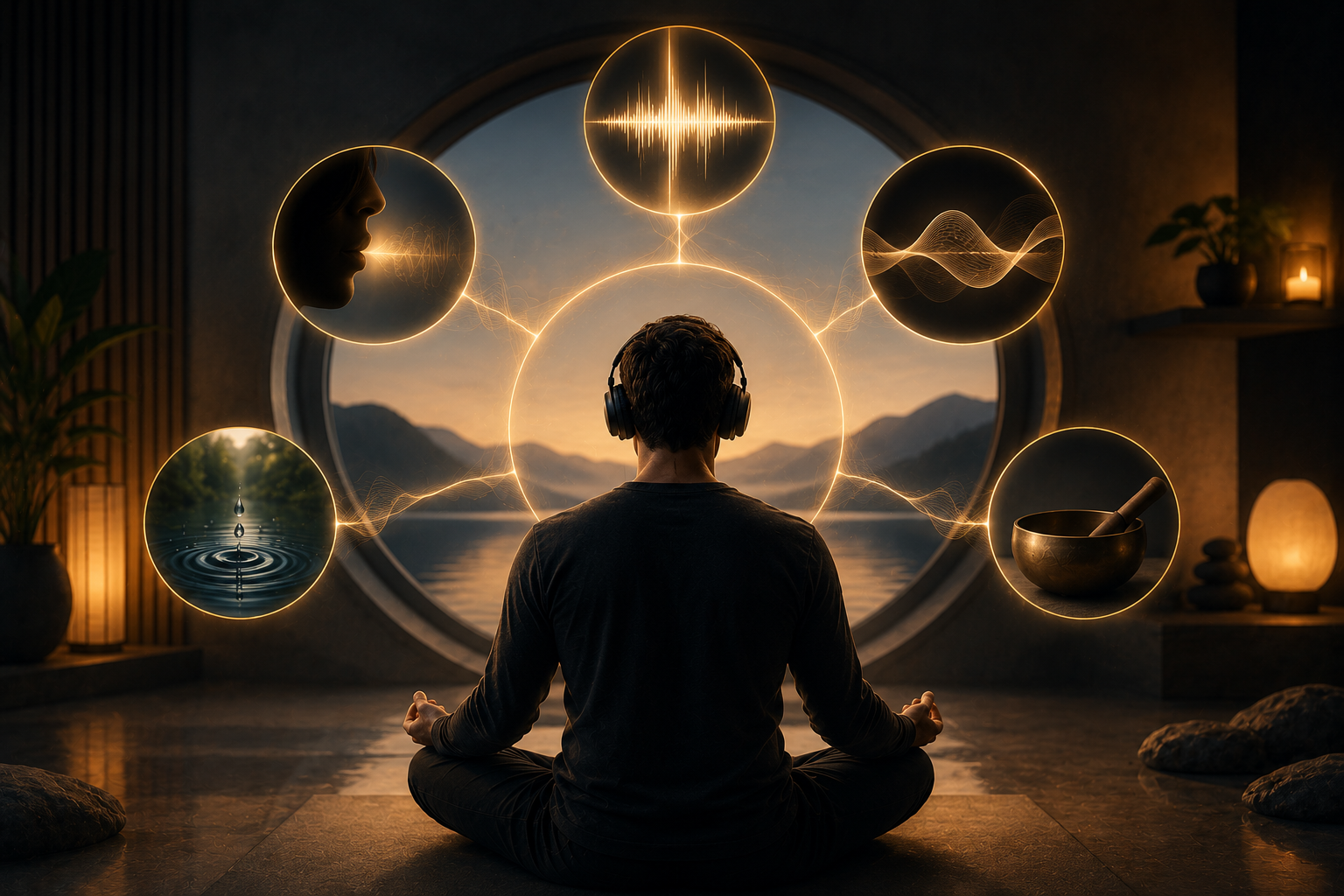
It is 9pm. The laptop is finally shut. The notifications have stopped, more or less. And yet your shoulders are still up near your ears, your jaw is tight, and your mind keeps replaying a sentence from a meeting that ended six hours ago. You are tired. You are also, somehow, wired. What if part of the fix has less to do with willpower and more to do with sound and the nervous system?
Here is something most calm-and-wellness advice skips: that state is not a personality flaw, and it is not random. It is partly acoustic. The relationship between sound and the nervous system runs deeper and faster than we usually give it credit for, and once you understand it, the sound around you stops being background. It becomes a dial you can actually turn.
I want to be careful with my words here, because this is where a lot of writing online overpromises. Music does not cure anything. It does not rewire you. But it does something quieter and more reliable: it nudges. The right sound, chosen on purpose, gently invites your body toward a state it already knows how to reach.
Your brain does not fall calm by accident. It tunes to whatever you keep feeding it.
The short version, if you are skimming
- Sound reaches the emotional brain through a fast, almost pre-conscious route, which is why a sudden noise can rattle you before you know why.
- Your nervous system tends to entrain, to loosely sync, with steady rhythms and frequencies around it.
- Music encourages a state, it does not force one. That is the honest version, and it is also the useful one.
- I have grouped sound into 5 “audio anchors,” each matched to a different system: focus, safety, grounding, deep rest, and flow.
- You do not need special equipment. You need to choose on purpose instead of letting the room choose for you.
Quick gut check: which of these is true for you right now?
Tick the ones that fit. Hold on to your answers, we will come back to them.
- ☐ I cannot switch off the mental chatter, even when nothing urgent is happening.
- ☐ Small sounds, a chair scraping, a phone buzzing, feel disproportionately irritating.
- ☐ I feel restless and “up in my head,” like I cannot land in my body.
- ☐ I am foggy and drained, and concentrating feels like pushing a stalled car.
How sound and the nervous system actually talk to each other
Start with speed. Visual information takes a relatively scenic route through the back of the brain before you consciously register it. Sound does not wait that long. Auditory signals have a fast track to the amygdala, the brain’s threat-and-salience detector, through a direct subcortical pathway. In plain terms, your body can flinch at a sound a beat before your thinking mind has named it. The smoke alarm gets you out of the chair before you have finished the thought “is that the smoke alarm.”
That speed is the whole reason sound has such a grip on mood. It is also why I keep returning to this idea in my work: we do not just hear sound, we react to it as information about whether we are safe.
The second piece is entrainment. Your heart rate, your breath, even your brainwave rhythms tend to drift toward the patterns they are steeped in. Researchers studying music and the cardiovascular system have shown that breathing and heart rate track the tempo of what you are listening to, with slower pieces easing the body down and faster ones revving it up. In one careful study of musical tempo and physiology, the most relaxing moment of all was not a particular song. It was the silence between tracks. Hold that thought, it matters later.
So here is the honest mechanism, the one I would stake my name on: sound and the nervous system are in constant, low-level conversation. Music encourages a direction. It does not override your biology, and anyone selling a frequency that “cures” something is overstating a real but gentle effect.
Try this: tonight, before bed, sit in genuine silence for two minutes before you reach for any sound at all. Notice where your body lands on its own.
If the speed-of-reaction part fascinates you, I went deeper into it here: Why Your Body Reacts to Music Before Your Mind Understands It.
The 5 audio anchors
Think of these less as a playlist and more as a small pharmacy of states, each one aimed at a different need. None of them is magic. Each is a way to stack the odds in your favour. I have paired a Western option with one from the Indian classical tradition I grew up inside, because the principle is universal even when the music is not.
Anchor 1: Alpha focus, for the overthinking mind
- What is going on: When the prefrontal cortex, the brain’s planner, is flooded with stress, focus frays into that loop of decision fatigue and rumination. Calm-but-alert states are associated with alpha-range brain activity, the gear between wired and drowsy.
- What to play (West): Slow Baroque adagios and unhurried classical pieces without sudden dynamic jolts. A note on the famous “Mozart effect”: the claim that a Mozart sonata boosts your IQ has largely failed to replicate, so do not expect a miracle. Use this music because it steadies attention, not because it makes you smarter.
- What to play (India): Raga Yaman, long associated in the tradition with a settled, contemplative evening mind, or the grounding sweetness of Raga Bhairavi.
- The aim: Quiet the chatter enough to think one clear thought at a time.
Anchor 2: The 60 to 80 BPM heart-sync, for the anxious body
- What is going on: The amygdala reads unpredictable, jumpy rhythms as a reason to stay on guard. A steady pulse in the range of a resting heartbeat sends a different signal. Slow-tempo music in roughly the 60 to 80 BPM band has been linked to a gentle drop in heart rate and a calmer breathing pattern.
- What to play (West): Soft, consistent “pink noise,” the even hush that sounds like steady rain, which masks jarring distractions without spiking the system. Slow instrumental pieces with a clear, unhurried beat work too.
- What to play (India): Raga Darbari Kanada, a deep, slow night raga long used to settle a heavy, unquiet mind.
- The aim: Tell the body, through rhythm, that nothing here needs defending right now.
Anchor 3: Low-frequency grounding, for restlessness
- What is going on: Deep, low-frequency sound gives the body something solid to settle onto. It pairs naturally with slow exhales, which is the lever that actually engages the calming, “rest and digest” side of your nervous system. In Ayurveda, the ears are linked with Vata, the principle of movement and restlessness, which is a poetic way of saying that an unanchored mind often wants weight.
- What to play (West): Bach’s cello suites for rich, low resonance. “Brown noise,” deeper and rumblier than pink noise, for plain physiological grounding.
- What to play (India): Raga Ahir Bhairav at daybreak for a solemn, settled start. Slow vocal toning, the long drawn “A-U-M,” where the point is less the mysticism and more the simple fact that extended humming lengthens the exhale and gives the body a low, steady vibration to ride.
- The aim: Come down out of your head and back into something that feels grounded.
Anchor 4: Theta-leaning deep rest, for genuine downshifting
- What is going on: The slowest restful brain rhythms, in the theta range, show up in deep relaxation and the edge of meditation. This is the anchor I am most cautious about, because it attracts the biggest claims.
- What to play (West): Vocal-free ambient soundscapes that swell and recede slowly. Theta binaural beats are an option, and the evidence is real but modest: a meta-analysis of binaural beats found a small-to-moderate effect on anxiety and attention, not a switch that flips you into bliss. Use headphones, and treat it as a nudge.
- What to play (India): Raga Hansadhwani for a bright, clear mood, or the long resonant tone of a conch (sankha). In yogic tradition these are tied to clarity (Tejas) and sustained attention (Dharana). I offer that as cultural context, not as a medical claim.
- The aim: Give an overworked mind real permission to slow down.
Anchor 5: Fractal nature sound, for fog and flow
- What is going on: The hippocampus, central to memory, gets overloaded by demanding input like lyrics you cannot help parsing or rhythms you cannot predict. Nature sounds, water, wind, rain, carry a “fractal” quality: stimulating but non-demanding, the kind of input the brain can ride without effort. That is the texture of flow.
- What to play (West): Continuous waterfall or forest-wind soundscapes, ideally without birdsong, which the brain tends to track and follow.
- What to play (India): Raga Malhar, the monsoon raga, all cleansing and renewal, or the soft continuous line of the bansuri (bamboo flute).
- The aim: Lift the fog without adding a single thing for your mind to manage.
Sound hygiene: how to actually use this
Here is the shift I want for you. Most of us treat sound as weather, something that happens to us. The whole premise of working with sound and the nervous system is that you get to be the one choosing.
It starts with one honest question before you press play: what does my system actually need right now? Look back at your gut check from earlier.
- If you ticked the chatter or irritability boxes, you are likely overloaded up top. Reach for Anchor 1 or 2. Steady before you try to focus.
- If you ticked the restless, “up in my head” box, you want weight. Anchor 3. Low and slow.
- If you ticked the foggy, drained box, do not push harder. Anchor 5, and let flow do the work that force cannot.
And remember the finding I asked you to hold: in that tempo study, plain silence was the most relaxing sound of all. So this is not about filling every moment with audio. Sometimes the most precise choice is to turn it all off.
If this way of paying attention to sound is useful to you, the subscribe form at the bottom of this page is where I send new pieces like it.
The deeper point: sound is information, not decoration
I think the reason this matters is bigger than any single playlist. When you start choosing sound on purpose, you are no longer just consuming it. You are using sound and the nervous system together, as a feedback loop you can actually steer. The room stops setting your mood by default.
None of this replaces rest, support, or care when you need it. It is not therapy and I would never frame it that way. It is something humbler and, honestly, more in your hands day to day: a way to stop letting the loudest thing in the room decide how you feel.
So I will leave you with the question I keep coming back to. When your nervous system is finally quiet, what is the sound that gets you there, and have you ever chosen it on purpose? Tell me in the comments.
Keep reading: the sound and the nervous system series
- Why Your Body Reacts to Music Before Your Mind Understands It
- Music Psychology in Daily Life: Sound, Stress, and Focus
- Why Certain Voices Instantly Calm Your Nervous System
- The Emotional Wallpaper: Why Your Background Music Matters
Frequently Asked Questions
Can sound really change my nervous system?
It can nudge it, not command it. Sound and the nervous system are in constant conversation: steady, slow input tends to ease heart rate and breathing, while sudden or jarring sound puts you on alert. The effect is real but gentle, so think of it as influence, not a cure.
What kind of music is best for focus?
Slow, predictable instrumental music without lyrics or sudden changes, such as Baroque adagios or a calm raga like Yaman. The goal is a calm-but-alert state, not stimulation. Skip anything with words you will end up following.
Do binaural beats actually work?
The evidence is modest rather than dramatic. A meta-analysis found a small-to-moderate effect on anxiety and attention, so binaural beats can be a mild nudge toward relaxation when used with headphones, but they are not a magic switch.
Is the Mozart effect real?
Not in the way it was sold. The idea that listening to Mozart makes you measurably smarter has largely failed to replicate. Slow classical music can still help you settle and concentrate, just do not expect an IQ boost.
Is pink noise good for sleep?
It can help mask disruptive sounds, which many people find soothing. The stronger lab results for pink noise improving deep sleep come from setups that time the sound precisely to brainwaves, and playing it on a loop from a phone all night shows weaker, more mixed results. Treat it as a helpful mask, not a guaranteed sleep aid.
What is “sound hygiene”?
It is the practice of choosing the sound around you on purpose, the way you might choose lighting, rather than letting the room decide your state. You notice what your nervous system needs, calm, grounding, or flow, and you select sound to match.

About the author
Dr. Shveata Mishra
Begin with the ritual
Get the free 5-Minute Sound Ritual.
A research-informed listening practice designed to help your nervous system settle, sent to your inbox as a PDF. You will also receive new writing on sound, emotion, and identity whenever an article is published.