

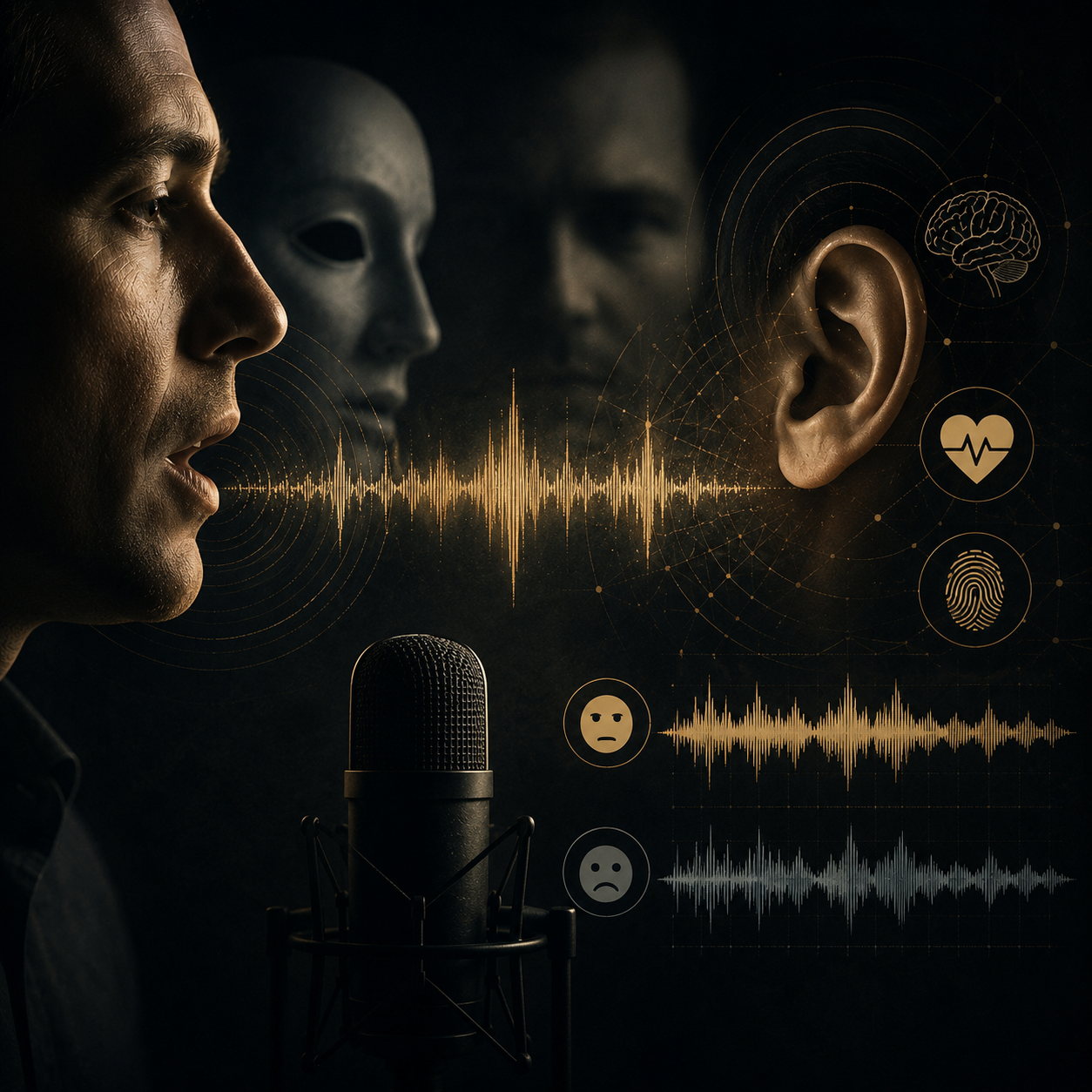
Think about the last time someone’s voice made you uneasy. Not because of what they said, but how they said it. The words were fine. The logic held. And yet something in you registered a signal your intellect could not name.
That signal was not intuition in the mystical sense. It was your nervous system doing exactly what it evolved to do: processing acoustic information faster than conscious thought.
We are taught to listen to what people say. We are rarely taught to listen to how the nervous system speaks through sound. In high-stakes spaces, courtrooms, boardrooms, the hard conversations inside a relationship, the most consequential moments are not carried by words alone. They are carried by frequency, rhythm, micro-pauses, and tonal congruence. Because the human voice is not a social instrument first. It is a neurological output. The vocal cues of deception, and of honesty, live in that output, not in the script.
You do not hear a lie. You hear the effort it takes to hold one.
The short version, if you are skimming
- Integrity is internal coherence: what a person says, feels, and intends running the same signal. It tends to sound grounded, not polished.
- Deception is rarely loud or shaky. In practiced speakers it often sounds too smooth, too controlled, too rehearsed.
- What you sense as “off” is usually cognitive effort, the cost of managing an impression, leaking into the voice.
- A confident voice is not an honest one. Confidence and congruence are different things, and we constantly confuse them.
- No single cue proves a lie. Vocal cues of deception are probabilistic signals that earn a closer, calmer kind of attention.
Quick gut check: which of these have you felt?
- ☐ Someone said all the right words, yet you left the conversation unsettled.
- ☐ You trusted a smooth, authoritative voice and later could not explain why you missed the signs.
- ☐ A message and its tone did not match: the words warm, the delivery flat.
- ☐ You “knew” something was wrong before you had a single reason for it.
Hold on to whichever ones are true. By the end, you will have language for what your body already registered.
The Voice Is Behavior, Not Decoration
From a music psychology and neuro-acoustic standpoint, the voice is an extension of the autonomic nervous system. Breath regulation, vagal tone, emotional load, and cognitive effort all shape it in real time. You can polish your language. You can rehearse your answers. You can even train your facial expressions. What you cannot fully disguise are the acoustic signatures of your internal state.
This connects directly to Polyvagal Theory, proposed by the neuroscientist Stephen Porges, which describes how the ventral vagal complex in the brainstem coordinates vocal prosody, facial expression, and heart rhythm as a single social engagement system (Porges, on the neurophysiological foundations of emotion and communication). When we feel safe and internally coherent, those systems move together. When we are managing a performance, they fall out of sync, and that desynchrony has a sound.
This is why the voice has long been studied across forensic psychology, clinical diagnostics, trauma research, and interrogation science. Not because the voice “tells the truth” in any simple way, but because it reflects the alignment, or the dissonance, between cognition, emotion, and intent.
What Integrity Sounds Like
Integrity is not moral perfection. It is internal coherence: the state in which what a person says, feels, and intends are running the same signal.
When someone speaks from that congruent state, certain vocal qualities tend to show up:
- Stable, natural rhythm: pacing without forced urgency or theatrical pauses.
- Micro-variation in pitch: emotional flexibility without instability, a voice that moves because the person is present.
- Breath-voice alignment: speech that rides the exhale instead of fighting it.
- Unforced resonance: sound that emerges from the body rather than being pushed from the throat or managed at the larynx.
Notice that none of these signal calmness or charisma. An integrated voice can carry nervousness, grief, even urgency. What it does not carry is the effort to conceal. Integrity sounds grounded, not because the person is composed, but because the voice is not compensating for anything.
What Vocal Cues of Deception Actually Sound Like
Contrary to popular belief, deception does not always sound nervous. In high-functioning people, those who are intelligent, powerful, or media-trained, it often sounds the opposite: too controlled.
Research on lying points less to drama and more to the residue of mental work. Sustaining a false account is cognitively demanding, and that load tends to leave traces in timing and tone (speech-timing studies find that liars often pause longer and more often, and shift their tempo). The vocal cues of deception worth noticing include:
- Excessive smoothness: a polished, flattened tone with unusually little organic variation.
- Delayed micro-responses: tiny timing gaps where cognition overrides instinct before the words arrive.
- Over-structured cadence: speech that feels scripted rather than lived, with rehearsed rhythm.
- Tonal-content mismatch: emotional language delivered without the acoustic qualities that genuine emotion carries.
- A rise in fundamental frequency (F0): pitch tends to climb under the arousal of high-stakes lying. Treat this as a probabilistic signal, not proof, since the same rise can come from fear, anger, or plain nerves (Ekman Group, on how the voice can betray lies).
So what are you actually detecting when something feels “off”? Not dishonesty itself. You are detecting cognitive effort. When the brain is managing an impression rather than simply telling the truth, the voice carries the cost of that management. Effort has a sound.
Next time you are with someone you trust completely, listen to the texture of their voice for thirty seconds. That ease is your baseline. Deception gets easier to hear once you know what coherence sounds like.
Why a Polished Voice Is Not the Same as an Honest One
Modern culture systematically rewards vocal confidence: strong delivery, controlled tone, articulate phrasing. We hear a smooth, authoritative voice and quietly assign it integrity. This is one of the most consequential misreadings in human social life.
Confidence is not the same as congruence.
A well-trained voice can command a room while masking internal fragmentation. It is why some of the most trusted voices later leave people confused, betrayed, or unable to explain how they missed the signs. The signs were not absent. They were misread as competence.
True listening is not admiration. It is attunement. And attunement asks for a different kind of attention, one that tracks acoustic quality rather than content alone. If you have ever wondered how voice shapes trust before a single argument is made, this is the mechanism running underneath it.
What Music Psychology Adds That Language Science Cannot
Music psychology offers a distinction that behavioral science alone tends to miss: speech carries meaning; sound carries state.
Before a single word is semantically decoded, the auditory system is already weighing frequency, amplitude, tempo, and harmonic balance. These elements are processed for safety, authenticity, and alignment in milliseconds, well below the threshold of conscious thought.
That is the neuro-acoustic basis for why you can feel something is off before you can explain it. Your nervous system has already processed the acoustic data. Your intellect is simply slower to translate it into language.
In my own research, and in the work I do through the Behavioral Audit, this is where the most important data lives: not in what people choose to say, but in the acoustic signature of the state they are speaking from. That state is very hard to rehearse.
What This Means for You, Beyond Detection
This is not an invitation to suspicion or to a life of hypervigilance. It is about developing discernment without paranoia.
Understanding the vocal cues of deception, and of integrity, does quiet, practical things:
- It helps leaders communicate with genuine coherence instead of performed authority.
- It helps therapists and clinicians hear distress underneath composed language.
- It helps professionals weigh credibility without an unconscious bias toward whoever is simply more polished.
- It helps you trust your own nervous system’s data without shame, second-guessing, or the need to justify it.
The goal is not to catch anyone. The goal is to listen accurately, to others and to yourself.
If this is the kind of question you keep circling, the subscribe form at the foot of this page is where pieces like it land first.
If you want to take this further and examine what your own voice reveals about your internal state, or learn to listen more accurately in the high-stakes moments of your life, the Mind & Wellness sessions and Signature Packages are built for exactly this depth of work.
Learning to Listen Past the Performance
Words persuade the mind. Sound reveals the nervous system. Once you have heard the difference between a voice that is coherent and a voice that is working to seem coherent, you cannot quite unhear it. That is not cynicism. It is literacy.
Words persuade the mind. Sound reveals the nervous system.
So here is what I will leave you with. Think of the last time your body knew something before your mind agreed. Whose voice was it, and what was it that you actually heard? Tell me in the comments. The voice is only one channel the nervous system leaks through; the eyes are another.
Keep reading: the voice and behavior series
- How Voice Shapes Trust: The Hidden Tempo Behind Authority
- Why Certain Voices Instantly Calm Your Nervous System
- What Your Eyes Reveal About You: The Neuroscience of the Gaze
- Why We Trust the Wrong People: The Psychology of Misplaced Trust
Frequently Asked Questions
Can you really tell if someone is lying from their voice?
Not with certainty. No single vocal cue proves deception. What vocal analysis reveals is congruence or dissonance in someone’s internal state. A voice that is acoustically inconsistent with its content signals cognitive or emotional effort, which simply earns closer attention. Context always matters.
What are the vocal cues of deception to listen for?
The most reliable ones are timing and texture: longer or more frequent pauses, a flattened or over-smooth tone, rehearsed-sounding cadence, a mismatch between emotional words and emotional sound, and sometimes a rise in pitch. Read them as probabilities, not proof, and always against the person’s normal baseline.
What does a deceptive voice actually sound like?
Counter-intuitively, in practiced communicators deception often sounds too smooth: flattened emotional variation, over-structured cadence, or tiny timing delays where cognition overrides instinct. It is the absence of natural acoustic irregularity, not obvious nervousness, that tends to signal managed communication.
What is vagal tone, and why does it affect the voice?
Vagal tone refers to the activity of the vagus nerve, which helps regulate the autonomic nervous system. Higher vagal tone supports emotional regulation and produces a more flexible, resonant voice. When vagal tone drops under stress or concealment, the voice tends to narrow in range, climb in pitch, and lose its breath-body alignment.
How is music psychology relevant to detecting deception?
Music psychology studies how sonic qualities (frequency, tempo, rhythm, harmonic coherence) carry and express internal states. The nervous system processes these acoustic elements before language is decoded, which gives music psychologists and neuro-acoustic researchers a framework for reading vocal behavior that goes beyond what linguistic or purely forensic analysis captures alone.
Do I need a baseline before I read someone’s voice accurately?
Yes. Deception is a deviation, not a fixed sound, so the useful signal is change from a person’s normal speech, not an absolute. Listen for how their voice moves when they are relaxed and honest, then notice where it tightens, smooths, or stalls. Without that baseline, you are guessing.

About the author
Dr. Shveata Mishra
Begin with the ritual
Get the free 5-Minute Sound Ritual.
A research-informed listening practice designed to help your nervous system settle, sent to your inbox as a PDF. You will also receive new writing on sound, emotion, and identity whenever an article is published.