

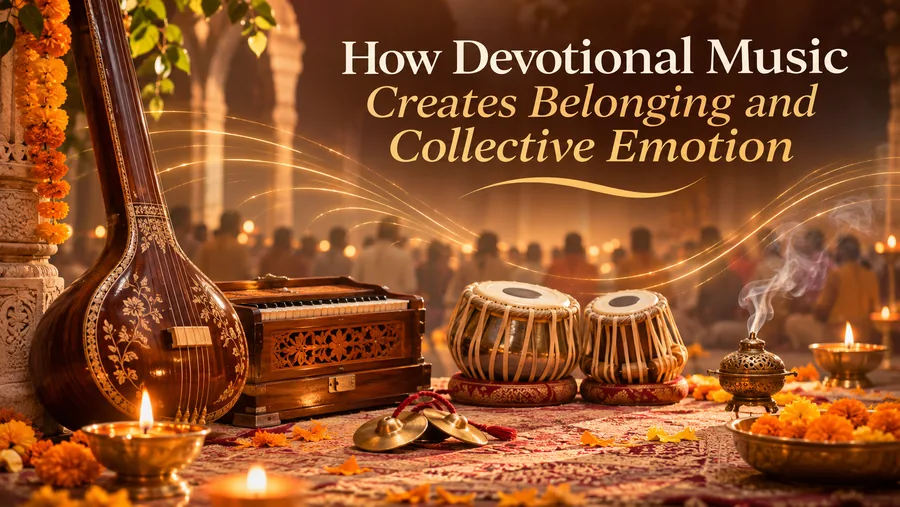
Forty minutes into a kirtan, something happens that nobody organized. The room stops being a collection of people who arrived separately and becomes a single thing doing one thing. You are not performing belonging. You are simply in it, and when it ends you feel closer to strangers whose names you still do not know.
That experience is reported across traditions, in languages that share nothing, by people who disagree about everything else. Which suggests the mechanism is not theological. Something about doing this together is doing the work, and the theology is what the group happens to be singing about.
Devotional music and belonging turn out to be connected by something fairly specific: coordinated effort, in time, with other bodies. The content matters less than almost anyone expects.
You did not decide to feel part of it. You breathed in time with sixty people for forty minutes, and that was sufficient.
The short version, if you’re skimming
- Coordinated music-making appears to trigger endorphin release, comparable to the social bonding grooming produces in other primates.
- Synchrony amplifies the effect. Moving in time with others raises pain thresholds and intensifies felt closeness.
- Singing produces unusually fast bonding between strangers, an effect researchers have called the ice-breaker effect.
- The proposed function is scale: grooming bonds two individuals, singing can bond a hundred at once.
- Devotional music and belonging are linked by participation, not by doctrine, which is why the effect crosses traditions.
Quick gut check: which of these is true for you right now?
Tick whatever fits. Hold your answers, we come back to them.
- ☐ I have felt close to strangers after singing with them.
- ☐ Group singing has moved me more than the same music heard alone.
- ☐ I have stayed for the music at a service whose beliefs I do not hold.
- ☐ I find joining in uncomfortable and would rather listen.
- ☐ I have felt entirely outside a room that everyone else seemed inside.
Devotional music and belonging: why singing bonds so fast
Start with the finding that reframes the subject.
In research on group singing, singers bonded substantially faster than people in comparable non-singing groups. The researchers described this as an ice-breaker effect: evidence that singing promotes rapid cohesion between unfamiliar individuals, rather than merely deepening bonds that already exist.
Speed is the interesting variable. Ordinary social bonding is slow and pairwise, built from conversation, repetition and accumulated small exchanges. Singing short-circuits it. A room of strangers who sing together for an hour report closeness that would normally take considerably longer to arrive. Devotional music and belonging are connected by speed as much as by depth.
The proposed mechanism is neurohormonal. Coordinated music-making appears to produce endorphin release comparable to that seen in social grooming in other primates, alongside a self-other merging effect. Grooming bonds primates effectively but has a hard constraint: it occupies two individuals at a time.
Singing has no such constraint. That is the argument for why it would have been selected for, and it is the clearest account I know of why devotional music and belonging are so reliably found together.
Try this: notice whether you feel differently about people you have sung with. Most people find the answer is yes, and that they never consented to it.
Synchrony is the active ingredient
If it were simply the sound, listening to devotional music together would do it. It does not, not nearly as much. The variable that matters is doing the same thing at the same time.
Sharing rhythmic synchronization, in movement, speech or music, is associated with an increased sense of belonging, trust and willingness to cooperate. And synchrony appears to exaggerate the endorphin effect specifically, though exactly how it does so is not settled.
That is why the forms devotional music takes are so consistent across traditions that never met. Call and response. Repeated refrains short enough for anyone to join by the third repetition. A steady pulse. Phrases that require everyone to breathe at the same points. These are not aesthetic preferences. They are the minimum requirements for a large group of untrained people to achieve synchrony quickly, and every tradition arrived at them independently. Devotional music and belonging converge on the same musical forms for engineering reasons.
I wrote about the non-devotional version of this in Rhythm and Connection: Why Moving in Sync to Music Bonds Strangers. What ritual adds is not a different mechanism, it is repetition, scale, and a reason to come back next week. That is the whole distance between dancing and devotional music and belonging.
Keep reading
Why group size matters, and the uncomfortable corollary
There is a detail here that sharpens the whole picture.
Research on singing and social bonding has examined how effects change as a function of group size, looking at connectedness and pain thresholds. The scale question is not incidental, it is the point of the whole argument: synchronous singing was plausibly the technology that let human groups grow beyond what pairwise bonding could support.
Which has a corollary worth stating plainly, because celebratory accounts of collective singing tend to skip it. A mechanism that bonds a group efficiently is also a mechanism that defines an outside. The same forty minutes that made you feel part of that room made the room more distinct from everyone not in it. Collective emotion is not inherently benign, and devotional music has been used to consolidate communities in both directions throughout history.
I am not raising that to sour the experience. I am raising it because a mechanism you understand is one you can use deliberately, and the first thing to understand about devotional music and belonging is that belonging and exclusion are produced by the same process.
Anything strong enough to make you feel inside something is strong enough to make someone else feel outside it.
Why participation beats listening
The practical implication is the one most people get wrong, and it is worth being direct about.
Attending devotional music as an audience member gives you a fraction of the effect. You get the aesthetic experience, which can be considerable, and almost none of the bonding, because you are not synchronizing with anyone. You are receiving.
Joining in badly gives you more than listening well. This is counter-intuitive for anyone self-conscious about their voice, and it is the single most useful thing in this article. The mechanism does not assess your pitch. It responds to coordinated effort in time with others, and a tuneless person singing the refrain is participating in a way that a trained listener sitting silently is not.
Which also explains the loneliest version of this experience: being in the room, moved by the music, and still feeling outside it. If you are not joining, you are not in the mechanism, and devotional music and belonging will stay a thing you watched rather than a thing you had. I wrote about the general shape of that in Why You Can Feel Lonelier in a Crowd Than When Alone.
What to actually do about it
Look back at your gut-check ticks. If the fourth or fifth were true, the advice below is specifically for you.
- Join in badly. The mechanism responds to coordination, not competence. Your voice quality is irrelevant to it.
- Choose repetition over beauty. In devotional music, a simple refrain repeated thirty times will do more for belonging than an exquisite piece you cannot join.
- Go more than once. The bonding effect appears quickly, but the community it attaches you to is built by returning.
- Watch the breath, not the words. Breathing at the same points as everyone else is a large part of the synchrony. You can do it in a language you do not speak.
- Notice the boundary it draws. Enjoy the belonging and stay aware that the same process defines an outside. Both are real.
- Do not require belief first. Devotional music and belonging run on participation. Whether the content is true for you is a separate question, and the next piece in this series is about exactly that.
- Treat it as a skill, not a mood. Devotional music and belonging respond to turning up repeatedly, which is unglamorous and reliable.
If this kind of writing on sound, ritual and connection is useful to you, the subscribe form at the bottom of the page will send new pieces your way.
The reframe: a technology for making a group
We tend to read devotional music as an expression of a community that already exists: these people believe the same things, so they sing together.
The evidence points the other way round, or at least in both directions. The singing is part of what makes them a community. Coordinated, repeated, synchronized effort produces the neurochemistry and the felt closeness, and the shared belief is reinforced by the bonding rather than only causing it. Devotional music and belonging run in a loop rather than a line.
That is a far more interesting claim than devotional music usually gets credit for. It means these traditions discovered, without any of the vocabulary, one of the most efficient social technologies available: a way to make a hundred strangers into a group in under an hour, repeatable weekly, requiring no equipment and no skill.
People don’t just hear sound. They recognize themselves in it, and in collective singing what they recognize is not themselves alone but themselves as part of something, which is a different experience and much harder to come by.
So I am curious about yours. When did you last sing with other people, and did you feel different about them afterwards?
Keep reading: the sound and connection series
- Rhythm and Connection: Why Moving in Sync to Music Bonds Strangers
- Live Music: Why It Feels More Powerful Than Recorded
- Why You Can Feel Lonelier in a Crowd Than When Alone
- Rhythmic Entrainment: Why Your Heartbeat Syncs to Music
Frequently Asked Questions
How does devotional music create belonging?
Devotional music and belonging are linked through coordinated participation rather than content. Group music-making appears to trigger endorphin release comparable to social grooming in other primates, and synchrony amplifies the effect, producing felt closeness between people who were strangers an hour earlier.
What is the ice-breaker effect?
Research on group singing found singers bonded much faster than non-singers, which was described as evidence for an ice-breaker effect: singing promotes rapid cohesion between unfamiliar individuals rather than only deepening existing bonds.
Why does synchrony matter so much?
Because shared rhythmic synchronization in movement, speech or music is associated with increased belonging, trust and willingness to cooperate, and appears to exaggerate the endorphin effect specifically. Doing the same thing at the same time is the active ingredient.
Does listening work as well as joining in?
No, and this is the most useful practical point. Listening gives you the aesthetic experience and little of the bonding, because you are not synchronizing with anyone. Joining in badly does more than listening well.
Why would humans evolve this?
The proposed function is scale. Grooming bonds primates effectively but occupies two individuals at a time, while singing can bond a large group at once, which plausibly allowed human groups to grow beyond what pairwise bonding supports.
Is collective emotion always a good thing?
Not inherently. A mechanism that bonds a group efficiently also defines an outside, and devotional music has been used to consolidate communities in both directions historically. Belonging and exclusion are produced by the same process.

About the author
Dr. Shveata Mishra
Begin with the ritual
Get the free 5-Minute Sound Ritual.
A research-informed listening practice designed to help your nervous system settle, sent to your inbox as a PDF. You will also receive new writing on sound, emotion, and identity whenever an article is published.