

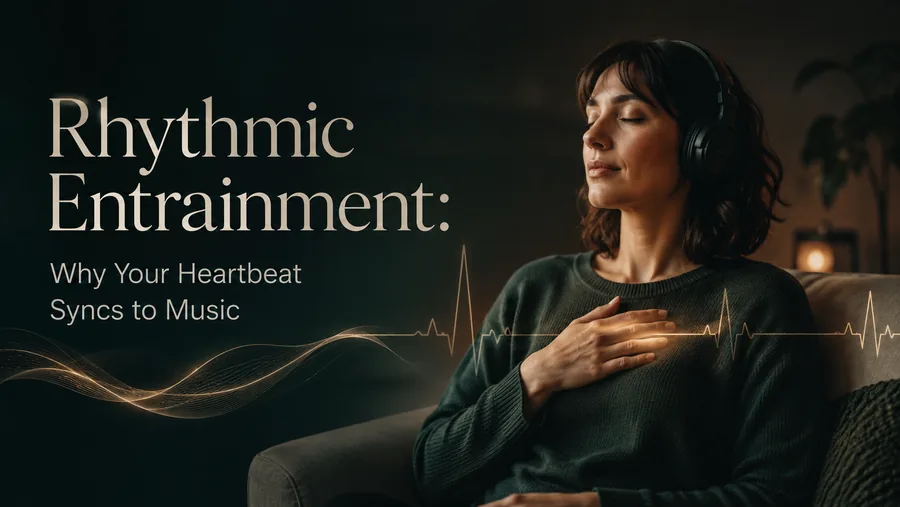
Put on a slow, aching ballad and something in you settles. Switch to a fast, driving track and, within a minute or two, you feel revved, restless, ready to move. That is not only mood or memory. Some of it is measurable, happening in your chest. Your heartbeat syncs to music more than you might think, following the tempo and the swells of what you are hearing, often before you have decided to feel anything at all.
This is one of my favorite corners of the work I do, because it is so physical. We treat music as an emotional or cultural thing, and it is. But it is also a rhythm meeting a rhythm. You are a body full of oscillations, a pulse, a breath, waves of blood pressure, and when a strong external rhythm arrives, your internal ones respond. Let me show you what science actually supports here, and, just as important, where the popular version overstates it.
You are a rhythm listening to a rhythm, and the two are not indifferent to each other.
The short version, if you’re skimming
- Your heartbeat syncs to music mainly by tracking its tempo and dynamics: faster, louder passages tend to lift heart rate, and slower, gentler ones let it fall.
- This is a form of rhythmic entrainment, where one oscillating system is pulled toward the timing of another.
- It is not a strict metronome lock. Your heart does not fire one beat per drum hit; it drifts with the music’s overall pace and intensity.
- Landmark research by Bernardi and colleagues found cardiovascular measures rise with faster tempo, regardless of personal taste.
- You can use this on purpose, choosing tempo to steer your body up or down instead of leaving it to chance.
Quick gut check: which of these is true for you right now?
Tick the ones that fit. Hold on to your answers, we will come back to them.
- ☐ A calm song can slow me down faster than telling myself to relax.
- ☐ Upbeat music makes a workout feel easier and my pulse feel higher.
- ☐ I have felt my chest “pick up” when a song builds.
- ☐ I reach for specific tempos to change my energy, without knowing why it works.
What “your heartbeat syncs to music” actually means
Let me define the real term, then translate it.
Entrainment is what happens when two rhythmic systems, left to interact, begin to align their timing. Old pendulum clocks on the same wall drift into step. Fireflies flash together. Your body is full of oscillators too, and rhythmic entrainment is the tendency for those internal rhythms to be pulled toward a strong external one. When people say your heartbeat syncs to music, this is the mechanism they are pointing at.
But precision matters, and this is where I want to slow down. The evidence for a tight, beat-for-beat lock between your pulse and a song’s beat is weak. Your heart is not a drum machine slaving to the track. What the research supports is looser and, honestly, more interesting: your heart rate tends to follow the music’s tempo and its swells in loudness, rising and falling with the overall shape of the sound.
Try this: play one slow track and one fast one back to back, hand on your chest, and just notice the difference in pace.
Keep reading
What the research shows about tempo and the heart
Here is the study I keep coming back to.
Luciano Bernardi and colleagues had people listen to very different pieces, opera, orchestral works, a Bach cantata, simple rhythmic phrases, while recording heart rate, breathing, and blood pressure. Two findings stand out. First, cardiovascular measures rose with faster tempo, and the effect held whether or not the listener liked the music. Your body was responding to the pace itself, not just to preference. Second, the music’s envelope, the rise and fall of its loudness, appeared to entrain the slow spontaneous oscillations of the cardiovascular system. The shape of the sound was pulling on the shape of the physiology.
There was a third detail I love. When the researchers slipped short silences between the pieces, heart rate, breathing, and blood pressure often dropped below where they started. The pause was more relaxing than any single track. So your heartbeat syncs to music, yes, and it also answers to the space between the music.
If you want the emotional and social side of this, I went into it here: Rhythm and Connection: Why Moving in Sync to Music Bonds Strangers.
Why this is a feature, not a quirk
Why would a body be built to let sound move its pulse at all?
Part of the answer is that rhythm is one of the oldest ways humans coordinate. When your heartbeat syncs to music in a room full of other people whose hearts are doing the same, you get a shared physical state, which is part of why concerts, dances, and rituals feel bonding rather than merely entertaining. And part of it is efficiency. If the environment has a strong beat, matching it is often cheaper than fighting it. Your nervous system, always looking to conserve effort, tends to go with the rhythm on offer.
This is also why the “feel” of low, physical sound matters so much. If you have ever felt bass land in your chest, that is your body meeting the sound at the level of vibration, not just melody. I wrote about that here: Why the Bass You Feel Matters More Than the Notes You Hear.
What to actually do about it
Look back at your gut-check ticks. If you already reach for tempo to change your state, you can do it more deliberately. The fact that your heartbeat syncs to music is only useful once you start choosing the tempo on purpose.
- Pick tempo for the destination, not the mood you are in. To wind down, choose music slower than your current pulse and let your body drift toward it, rather than matching your agitation.
- Use the build. For energy or a workout, tracks that climb in tempo and loudness give your heart rate a rising target to follow.
- Do not forget the silence. A short pause after music can settle you below where you began. Let a song end before you queue the next.
- Notice, do not force. Your heart follows the overall pace, not each beat, so the goal is a general direction, not a metronome match.
If this kind of body-and-sound writing is useful to you, the subscribe form at the bottom of the page will send new pieces your way.
The reframe: you are always in a duet
We talk about listening as something the ears do. But the body is listening too, in its own slow language of pulse and breath and pressure. Every time you press play, you start a quiet duet between the rhythm out there and the rhythms in here. Your heartbeat syncs to music not because you are suggestible, but because you are rhythmic, and rhythm answers rhythm.
So the practical question is simply which duet you want to be in. When you need to change how your body feels, what tempo do you reach for first?
Keep reading: the rhythm and the body series
- Rhythm and Connection: Why Moving in Sync to Music Bonds Strangers
- Why the Bass You Feel Matters More Than the Notes You Hear
- Slow Music: The Hidden Way It Shifts Your Sense of Time
- Live Music: Why It Feels More Powerful Than Recorded
Frequently Asked Questions
Does your heartbeat really sync to music?
To a degree, yes. Your heartbeat syncs to music by following the tempo and the rise and fall of loudness, so faster, louder passages tend to raise heart rate and slower ones let it drop. It is a general tracking of the music’s pace, not a beat-for-beat lock.
What is rhythmic entrainment?
Entrainment is when two rhythmic systems interacting with each other drift into aligned timing, like pendulum clocks on the same wall syncing up. With music, your body’s internal rhythms are gently pulled toward the external rhythm of the sound.
Does faster music increase heart rate?
Research by Bernardi and colleagues found that cardiovascular measures, including heart rate, rose with faster tempo, and the effect held regardless of whether the listener enjoyed the music. Slower tempos tend to have the opposite, calming effect.
Is my pulse locked to the beat of the song?
No. Evidence for a strict, beat-for-beat lock between pulse and beat is weak. Your heart rate follows the music’s overall pace and dynamics rather than firing once per beat, so think of it as drifting with the music, not marching to it.
Why does silence after music feel calming?
In the Bernardi study, short silences between pieces lowered heart rate, breathing, and blood pressure, sometimes below baseline. The pause gives your body a break from tracking the sound, which is why letting a song fully end can settle you.
Can I use music tempo to calm down or energize?
Yes. To wind down, choose music slower than your current pulse and let your body follow it. To lift your energy, use tracks that build in tempo and loudness so your heart rate has a rising target.

About the author
Dr. Shveata Mishra
Begin with the ritual
Get the free 5-Minute Sound Ritual.
A research-informed listening practice designed to help your nervous system settle, sent to your inbox as a PDF. You will also receive new writing on sound, emotion, and identity whenever an article is published.