

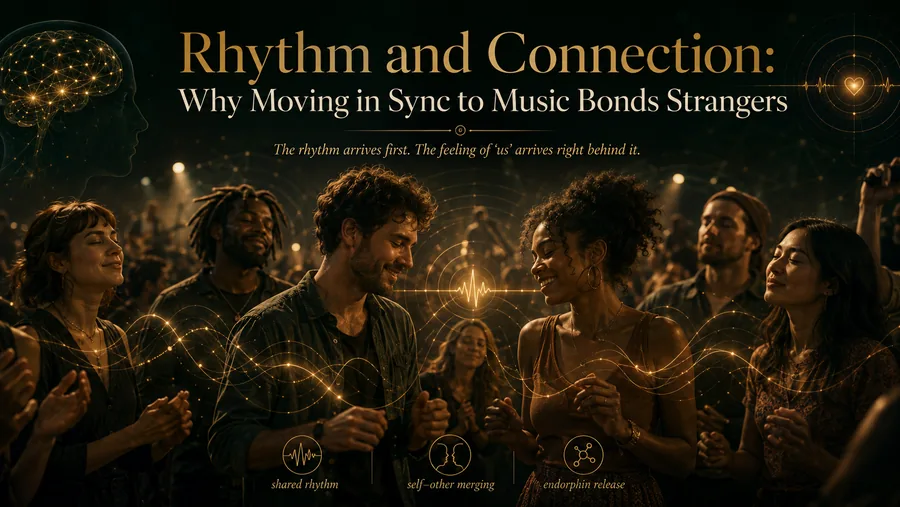
You didn’t come to dance. A friend had a spare ticket, you have work in the morning, and the plan was to leave after the third song. Then the bass settles into a groove your body seems to already know, and the man on your left, a stranger with a beard and a warm beer, starts nodding on exactly the beat you are nodding on. You notice it in your side vision. Neither of you says a word. Yet by the end of the night you feel oddly, unaccountably fond of him. That is not the beer. Moving in sync to music does something specific to human beings, and it does it fast.
The rhythm arrives first. The feeling of “us” arrives right behind it.
The short version, if you’re skimming
- Rhythm reaches your motor system before you consent to it. Listening to a steady beat activates the brain regions that plan movement, even when you sit perfectly still.
- Moving in sync with another person, including one you never speak to, reliably raises how close, cooperative and helpful people feel afterwards.
- Two mechanisms are doing the work: self-other merging, where the line between “me” and “you” softens, and endorphin release during effortful rhythmic movement.
- Music does this better than a metronome, because it supplies the timing and the emotion in one signal.
- Synchrony is not automatically kind. The same mechanism that builds warmth inside a group can harden the wall around it.
Quick gut check: which of these is true for you right now?
Tick the ones that fit. Hold on to your answers, we’ll come back to them.
- ☐ You’ve felt unexpectedly close to people you barely know after a concert, a wedding, or a class.
- ☐ You nod, tap, or sway to music without noticing when you started.
- ☐ A crowd singing together, in a stadium or a temple or around a cake, has made you tearful for no clear reason.
- ☐ You find it faintly unbearable when someone claps off the beat.
Why moving in sync starts before you decide to
Here is the part people underestimate. You do not choose to move to a beat. You catch it.
When you listen to rhythm with a regular pulse, the motor system lights up whether or not you move a muscle. Jessica Grahn and Matthew Brett’s fMRI work found that rhythms with a clear beat produced greater activity in the basal ganglia and the supplementary motor area than rhythms without one, in listeners who were lying still inside a scanner. The basal ganglia sit at the centre of movement initiation and timing. The supplementary motor area is where movements get planned before they happen. Beat perception, in other words, is not really perception. It is a rehearsal.
That rehearsal is predictive. Your brain does not track the beat that just happened, it forecasts the one about to arrive, which is why you can clap on time rather than a fraction late. And a forecast that accurate is shareable. Two people listening to the same groove are running the same prediction on the same clock, which means their bodies are already aligned before either of them has decided to be sociable.
Try this: at the next gathering with music playing, spend one minute watching feet instead of faces. Count how many people are on the beat without knowing it.
This is also why moving in sync feels effortless while coordinating with a person who has no rhythm feels like work. The music is doing the negotiating for you.
What moving in sync does to how you see a stranger
Now the social half, which is where the research gets genuinely surprising.
In a set of experiments published in Psychological Science, Scott Wiltermuth and Chip Heath had participants walk in step or out of step with each other, then play economic games that required personal sacrifice for group benefit. The synchronised groups cooperated more. What makes the finding hard to shrug off is the detail that positive mood was not required. People did not need to enjoy the walking for the effect to appear. Coordination alone shifted their behaviour towards each other.
It shows up long before adulthood. Laura Cirelli and colleagues held fourteen-month-old infants and bounced them to music, facing an adult who bounced either in time or out of time with them. The babies who had been bounced in sync were significantly more likely to help that adult afterwards, picking up objects she had “accidentally” dropped. The effect was targeted, not general. It did not transfer to a neutral stranger who had not moved with them. Before they could speak, these infants were reading rhythm as social information: you match me, so you are mine.
And then there is the silent disco. Bronwyn Tarr, Jacques Launay and Robin Dunbar ran a study in which ninety-four people danced in full synchrony, partial synchrony, or out of sync. Only the fully synchronised dancers showed raised pain thresholds, a standard proxy for endorphin activity, and only they reported feeling notably closer to their partners. Same music. Same room. Different timing, different outcome.
Moving in sync is not a metaphor for closeness. It appears to be one of the mechanisms that produces it.
Keep reading
The two things happening under the surface
Tarr, Launay and Dunbar have argued that music binds people through two mechanisms working together, and the pairing is what makes it powerful.
The first is self-other merging. When your movements and another person’s movements share a timeline, your brain’s representation of “my body” and “that body” starts to overlap. Asked afterwards how close they feel, people literally place themselves in more overlapping circles on the standard closeness scale. Notice what moving in sync has not done here. It has told you nothing new about the stranger. It has only made your model of where you end less certain.
The second is neurochemical. Effortful rhythmic movement, dancing, singing, drumming, rowing, triggers endorphin release, the same system implicated in grooming and bonding across primate species. This is why a shared playlist at your desk is pleasant while dancing to it with forty other people is something else entirely. Exertion is not incidental. It is part of the dose.
If you’ve ever wondered why your body seemed to make its decision about a room before you had formed an opinion, I went deeper into that here: Why Your Body Reacts to Music Before Your Mind Understands It.
Why music does this better than a metronome
A metronome will get people moving on the same beat. It will not get them to feel much about it.
Music adds a second layer on top of timing: affect. It carries emotional contour, cultural memory, and a sense of shared taste, so moving in sync to music delivers both coordination and meaning at once. The research bears this out in a specific way. Studies on cultural familiarity and personal taste found that social closeness rose more strongly when the music was culturally familiar and when people actually enjoyed it. The beat sets the clock. The music decides how much the clock matters.
Individual difference matters too. Work on empathy and self-other integration suggests that people higher in trait empathy bond more strongly when moving in sync with a partner. So if group dance classes leave your friend glowing and leave you merely sweaty, that is a real difference in how the same mechanism lands, not a failure of enthusiasm.
The shadow side nobody mentions
I want to be honest about the other half of this, because the internet tends to sell synchrony as pure warmth.
The mechanism does not check who it is bonding you to, or what that person then does. In one study on synchrony and group moral hypocrisy, participants who had moved in high synchrony with a partner went on to judge that same partner’s unfair behaviour as significantly more fair than participants who had not. Group unity explained the shift. Separate work by Wiltermuth found that people who had walked in step with a leader became more willing to carry out that leader’s requests, including ones they would otherwise have declined. Marching armies, chanting stadiums and synchronised political rallies are not using rhythm by accident.
This is the honest version of the science: moving in sync builds an “us”, and every “us” implies a “them”. Worth knowing, both when you feel the pull of a crowd and when you notice who is designing the rhythm you are being asked to join.
What to actually do about it
- Use it deliberately when you want connection. A shared playlist during a walk, a kitchen dance with a child, a class where everyone moves on the same count. Twenty minutes of moving in sync does more for closeness than an hour of careful conversation.
- Choose music your group actually likes. Familiar and enjoyed music produces a stronger bonding effect than neutral music at the same tempo, so the aux cable is a social decision, not a technical one.
- Add gentle exertion. Dancing, walking briskly, clapping, singing out loud. The endorphin half of the mechanism needs effort, not just listening.
- Notice when it is being used on you. If a room’s rhythm is making you agreeable unusually fast, that is worth registering. Not resisting, necessarily. Registering.
- Give the introverts a rhythm, not a conversation. Synchrony bonds people who have not spoken. That is genuinely useful if talking is the hard part.
If this is the kind of thinking you want more of, the subscribe form at the bottom of this page will send the next piece straight to you.
Rhythm as social information
We tend to describe rhythm as decoration, the pleasant part laid over the melody. It is closer to infrastructure. A beat is a shared prediction, and moving in sync to a shared prediction is the cheapest form of trust two nervous systems can build without a single word of language. Long before we could explain ourselves to each other, we could keep time together, and keeping time together was already saying something.
That is the part of my work I keep returning to. Sound is not only something we consume, it is behavioural information, constantly telling us who is with us and who is out of step. People don’t just hear sound. They recognize themselves in it, and sometimes they recognise each other in it too.
So here is my question for you, and I do read the comments: when was the last time you felt close to someone you had barely spoken to, simply because you were moving to the same thing?
Keep reading: the sound and connection series
- Why Your Body Reacts to Music Before Your Mind Understands It
- The Unseen Relationship Between Music and Self-Identity
- Why Your Playlist May Reveal Your Emotional Regulation Style
- The Power of Music: Why the Best Songs Move Us
Frequently Asked Questions
Why do people start moving in sync to music without meaning to?
Because rhythm engages the motor system directly. A regular beat activates movement planning regions such as the basal ganglia and supplementary motor area even when you are sitting still, and it lets your brain predict when the next beat will land. Two people using the same prediction end up moving on the same clock.
Does moving in sync with someone really make you like them more?
The research consistently points that way. Across studies with adults, and even with fourteen-month-old infants, people who moved in time with a partner cooperated more, helped more, and reported feeling closer than those who moved out of time, often without any conversation taking place.
Is this the same thing as rhythmic entrainment?
They are related but not identical. Entrainment describes a system locking on to an external rhythm. Interpersonal synchrony describes two or more people locking on to the same rhythm at once, which is where the social effects come from.
Why does dancing feel more bonding than just listening together?
Two reasons. Effortful rhythmic movement releases endorphins, which listening alone does not do to the same degree, and visible shared movement strengthens the blurring of self and other. Studies comparing synchronised and unsynchronised dancers found raised pain thresholds and greater closeness only in the synchronised group.
Does the type of music matter?
Yes. Moving in sync to music that is culturally familiar and genuinely enjoyed produces more social closeness than the same tempo in music people feel neutral about. Music supplies emotional meaning on top of timing, which is why it outperforms a plain metronome.
Can synchrony have negative effects?
It can. The same mechanism that builds in-group warmth has been shown to increase compliance with a leader and willingness to act against people outside the group. Synchrony strengthens whatever group it is applied to, which is worth knowing rather than fearing.

About the author
Dr. Shveata Mishra
Begin with the ritual
Get the free 5-Minute Sound Ritual.
A research-informed listening practice designed to help your nervous system settle, sent to your inbox as a PDF. You will also receive new writing on sound, emotion, and identity whenever an article is published.