

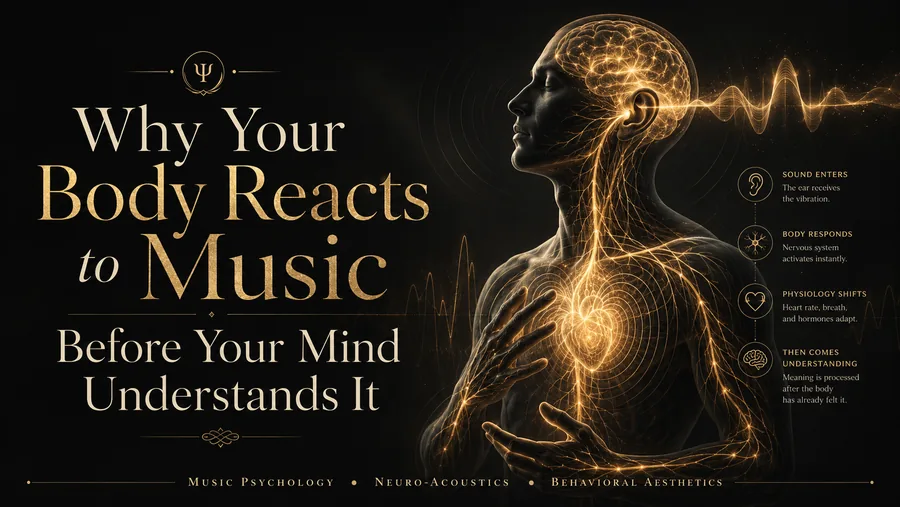
A song begins, and something in your body changes before you have decided what the song means.
Your breathing shifts. Your shoulders soften. Your chest tightens. Your eyes fill. A beat starts moving through your foot before you have even decided to move.
If you have ever wondered why your body reacts to music before your mind understands it, the answer is not simply that music is emotional. It is that sound reaches the nervous system as sensation before it becomes a sentence.
Most people talk about music as if it is mainly a matter of taste. Do I like this song? Do I connect with this artist? Do these lyrics mean something to me?
But music is also a body event. It is felt through rhythm, tone, tempo, silence, volume, memory, and emotional color before the mind has finished building an explanation. That is why a song can move you before you know why.
Sometimes the body recognizes the meaning of a song before the mind has found the words.
The short version, if you are skimming
- Why your body reacts to music before your mind understands it: sound is read as sensation (rhythm, tone, volume, timing) before it is read as meaning.
- Chills, tears, and a racing heart are autonomic arousal. The chills response has a name, frisson, and it is tied to the brain’s reward and prediction systems.
- Rhythm syncs with your own internal timing, an effect called entrainment, which is why a beat can move you before you decide to move.
- Music often does not invent a feeling. It reveals one that was already there, sitting just beneath language.
- This sensitivity is not a flaw. Read as information, it becomes a quiet form of self-knowledge.
Quick gut check: which of these is true for you right now?
- ☐ A song has made you cry before you knew why.
- ☐ A beat started moving your foot before you chose to move it.
- ☐ A song you once loved suddenly feels like too much.
- ☐ An instrumental, with no words at all, has put a lump in your throat.
- ☐ A few notes have pulled back a person, a place, or a whole season of your life in seconds.
Hold your answers. Each one has a reason, and we will get to all of them.
Why Your Body Reacts to Music So Quickly
The body is always reading the world for signals:
- Is this safe?
- Is this intense?
- Is this familiar?
- Is this calming?
- Is this asking me to move?
Music carries many of those signals at once, which is part of why your body reacts to music so quickly.
A soft voice can feel soothing before you understand the words. A sudden loud sound can startle you before you know what caused it. A steady rhythm can make the body feel organized. A rising melody can create anticipation. A slow, spacious sound can invite the breath to settle.
This happens because the nervous system does not wait for a full intellectual explanation. It responds to sound as sensory information, and music is full of it: rhythm, volume, pitch, pace, repetition, tension, release, silence, and emotional tone.
The mind may later say, “This song is sad,” or “This reminds me of someone.” But the body often feels the shift first.
Try this. The next time a song moves you, pause for ten seconds before you name the feeling. Notice what your breath and shoulders did first. That is your body, listening ahead of your mind.
Why Does Music Give You Chills?
One of the most searched questions about music is simple: why does music give you chills?
That shiver up the arms has a name. Researchers call it frisson, and it is one of the most studied physical responses to music. Chills, goosebumps, tears, and a sudden wave of emotion tend to arrive when music creates a powerful mix of expectation, surprise, memory, and reward.
The brain loves pattern. When a song builds toward a chorus, delays a note, changes harmony, drops into silence, or returns to a familiar melody, the brain starts predicting what may happen next. If the music gives us both recognition and surprise, the response can feel physical.
There is real neuroscience under this. In a now classic study published in Nature Neuroscience, Salimpoor and colleagues showed that music releases dopamine, the brain’s reward chemical, and that it does so in two distinct waves: one during the anticipation of a peak musical moment, and another during the moment itself. In plain language, part of the pleasure is the wait. The body responds to where the music is going, not only to where it is.
That is why chills often arrive at musical moments like:
- a sudden vocal lift
- a beat drop
- a key change
- a pause before a powerful return
- a lyric that lands at exactly the right time
- a melody connected to memory
Your mind may only later understand the reason. Your body already felt the arrival. That order, body first and explanation second, is the heart of why your body reacts to music before the mind can keep up.
The Nervous System Hears More Than Lyrics
Lyrics matter, but they are not the whole story.
Instrumental music can make people cry. A film score can make a scene feel dangerous before anything frightening happens on screen. A lullaby can calm a child long before the child understands language.
That tells us something important: music does not need words to carry emotion. The nervous system responds to the shape of sound, the same way it responds to the tone underneath a voice, what researchers call prosody. It is why you can hear that someone is upset before you make out a single word they are saying.
A melody can rise like longing. A low drone can feel heavy. A fast rhythm can feel urgent. A warm tone can feel safe. A sharp sound can feel irritating. A repeated pattern can feel grounding, or, if you are already overstimulated, like too much.
Music has an emotional body of its own. And your body reacts to music fast, reading that emotional shape before a single word has been parsed.
Rhythm Talks to Your Inner Rhythm
Human beings are rhythmic before they are verbal. The heart beats. The lungs breathe. The body walks in steps. Speech has cadence. Sleep has cycles. Even attention has a rhythm.
So when music enters, it meets a body that is already moving through time.
This is one reason rhythm can feel so immediate. You may tap your foot, nod your head, sway, or feel your energy rise without deciding to do it. The body is not being silly. It is synchronizing.
That synchronizing has a name too: entrainment, the tendency of our movement and timing systems to lock onto an external beat. It is why rhythm is used in so many movement-based music interventions, and why a steady pulse can feel like it is physically pulling the body into motion.
Not every rhythm affects every person the same way. A fast beat may energize one listener and overwhelm another. A slow rhythm may calm one person and feel heavy to someone else. But the basic truth holds: rhythm is not only heard. It is felt as timing inside the body, one more way your body reacts to music before you decide to respond.
Keep reading
Why Music Can Make You Emotional Before You Know Why
Music often reaches emotion faster than conversation.
You may not know you are grieving until a song makes you cry. You may not know you are exhausted until even beautiful music feels like too much. You may not know you miss someone until a familiar melody brings them back into the room of your body.
This does not mean music invents emotions out of nowhere. Often, music reveals what is already present. It gives shape to feelings that were sitting just beneath language.
That is why people say things like:
- “This song understands me.”
- “I do not know why this makes me emotional.”
- “This music feels like a memory.”
- “This sound calms something in me.”
- “This song feels like a version of myself.”
Those sentences are not dramatic. They are accurate descriptions of how sound, emotion, memory, and identity meet, and of how the body reacts to music faster than thought and closer than language.
The Brain Predicts Music, and the Body Feels the Prediction
Music is built on expectation.
You hear a rhythm, and the brain begins to anticipate the next pulse. You hear a melody, and the brain starts guessing where it might go. You hear tension, and the body waits for release.
This is why music can feel so alive. It keeps the brain moving between two states:
- I know this.
- I did not expect that.
Too much predictability can become boring. Too much surprise can feel confusing. But the right balance can feel deeply satisfying.
That balance is another reason why your body reacts to music before the mind has time to explain it. The nervous system is tracking pattern, timing, and emotional intensity in real time. This is the same fast, protective reading the body does with any incoming signal, the kind I write about in how the body senses safety or threat before logic catches up. The mind writes the story later. The body is already inside the music.
Why Certain Songs Feel Physically Personal
A song is never just sound once it has lived with you. It may carry a person, a city, a season, a heartbreak, a prayer, a recovery, or a version of yourself you almost forgot.
This is why two people can hear the same song and have completely different reactions. For one person, it is background music. For another, it is a doorway.
The nervous system stores life through association. The same memory and emotion centers that light up during music, the hippocampus and the amygdala, also bind a song to its atmosphere: where you were, who you loved, how your body felt, what you were becoming, and what you were trying to survive.
When a song is connected to an emotionally important time, the body may recognize that emotional world before the mind fully reconstructs the memory. That is why a song from years ago can make your stomach drop in seconds. It is not only memory. It is body memory, and it is one more reason your body reacts to music in a way that can feel almost personal.
When Music Feels Calming, Heavy, or Too Much
Music is powerful because it can steady us, but it can also overwhelm.
A song that calms you on one day may feel irritating on another. A playlist that once motivated you may suddenly feel like pressure. A sad song may feel comforting during grief and draining during burnout.
This does not mean your taste is unstable. It means your nervous system is alive and responsive. (I wrote a whole piece on why music you used to love can suddenly start to grate if that is the one that caught your eye.)
Your response to music depends on:
- stress level
- fatigue
- sensory load
- emotional state
- memory associations
- volume
- environment
- personal meaning
This is why the same piece of music can feel different in the morning, at night, during heartbreak, after recovery, in a crowd, or alone in a quiet room.
Music does not meet the same listener every day. We change. So the music changes with us.
How to Listen More Wisely
If your body reacts to music strongly, that sensitivity can become a form of self-knowledge.
Instead of asking only, “Do I like this song?” ask:
- What is this sound doing to my body?
- Is my breathing changing?
- Do I feel calmer or more charged?
- Does this song belong to a memory?
- Am I using music to feel, to avoid, to release, or to regulate?
- Do I need sound right now, or do I need silence?
This kind of listening is simple, but powerful. It turns music from background noise into emotional information.
If your body relaxes, the sound may be supporting regulation. If your body tightens, the sound may be too intense for your current state. If you feel tears, the music may be touching something that has not yet found language. And if you suddenly need quiet, listen to that too.
Silence is not the opposite of music. Sometimes silence is how the nervous system resets enough to love music again.
For readers who want this way of listening built around their own nervous system rather than a general guide, I do that work one to one, and the discovery consultation is the first step.
If this way of listening is new to you, the free newsletter is where I share more of these small, science-grounded practices. The subscribe box is at the bottom of this page.
What the Research Says, in Plain Language
The science of music supports what many people already feel intuitively.
Research in music psychology and neuroscience shows that music is not processed in one small corner of the mind. It is a whole-system experience. As Harvard Medicine Magazine summarizes the research, music engages the autonomic nervous system (heartbeat and breathing), the limbic system (pleasure, motivation, reward), the hippocampus and amygdala (emotion and memory), and the motor system (movement and timing), often all at once.
In plain language, music can touch emotional arousal, heartbeat and breathing, movement and timing, memory, reward and anticipation, attention, and stress recovery, sometimes in the same few seconds.
This is why the physical response can come first, and why your body reacts to music before any tidy explanation arrives. The body is not waiting for a perfect account of itself. It is already listening.
What This Means for the Way You Listen
Why your body reacts to music before your mind understands it comes down to this: music speaks in rhythm, tone, pattern, memory, and emotion. It reaches systems that are faster than language. It touches the nervous system before the analytical mind has finished naming the experience.
That is why music can give you chills, change your breathing, make you cry, calm your body, or bring back a memory before you understand why.
Humans do not just hear sound. They recognize themselves in it.
And sometimes, the body knows the song before the mind knows the story.
So I will leave you with the question I keep coming back to: which song still moves your body before you have decided how you feel about it? Tell me in the comments. I read them.
Keep reading: the sound and the body series
- Why Your Favorite Music Suddenly Feels Irritating
- Why Do Certain Voices Instantly Calm Your Nervous System
- Sound and the Nervous System: 5 Audio Anchors for a Steadier Day
- Background Music and Focus: Your Emotional Wallpaper
Frequently Asked Questions
Why does my body react to music before my mind understands it?
Your body reacts to music before your mind understands it because rhythm, tone, volume, repetition, and emotional sound patterns interact with the nervous system first. These signals can influence arousal, movement, breathing, and memory before you have fully named what you feel.
Why does music give me chills or goosebumps?
The chills response is called frisson. It tends to arrive when expectation, surprise, emotional intensity, memory, and the brain’s reward system meet, often around a peak musical moment. Research links it to dopamine release during both the anticipation and the experience of that peak.
Why does music make me emotional so quickly?
Music can make you emotional quickly because it reaches emotional and memory networks before full verbal analysis. Sometimes a song does not create the feeling. It reveals one that was already present but not yet clear.
Why do I feel music in my body?
You feel music in your body because sound is physical. Rhythm connects with your movement and timing systems through an effect called entrainment, while tone, volume, and musical tension can shift the nervous system and emotional arousal.
Can music calm the nervous system?
Music may support a calmer state for many people, especially when it is predictable, gentle, and matched to the listener’s emotional state. But music is personal. A sound that settles one person can feel overstimulating to another, so it is worth noticing your own response rather than assuming.
Why can instrumental music feel emotional without lyrics?
Instrumental music can feel emotional because the nervous system responds to melody, harmony, rhythm, tension, release, texture, and pacing, as well as to the emotional tone of sound itself. Words are only one of the ways music carries meaning.

About the author
Dr. Shveata Mishra
Begin with the ritual
Get the free 5-Minute Sound Ritual.
A research-informed listening practice designed to help your nervous system settle, sent to your inbox as a PDF. You will also receive new writing on sound, emotion, and identity whenever an article is published.