

Most people have at least one song they do not treat like a song.
They protect it. They skip it in company. They play it when they need to feel close to themselves again. Sometimes the song is not even objectively remarkable. It may be simple, repetitive, unfashionable, or tied to an artist they no longer follow.
Still, it has a private authority.
Because the song does not only remind them of something. It reminds them of who they were when something was happening.
That distinction sits at the center of the relationship between music and self-identity.
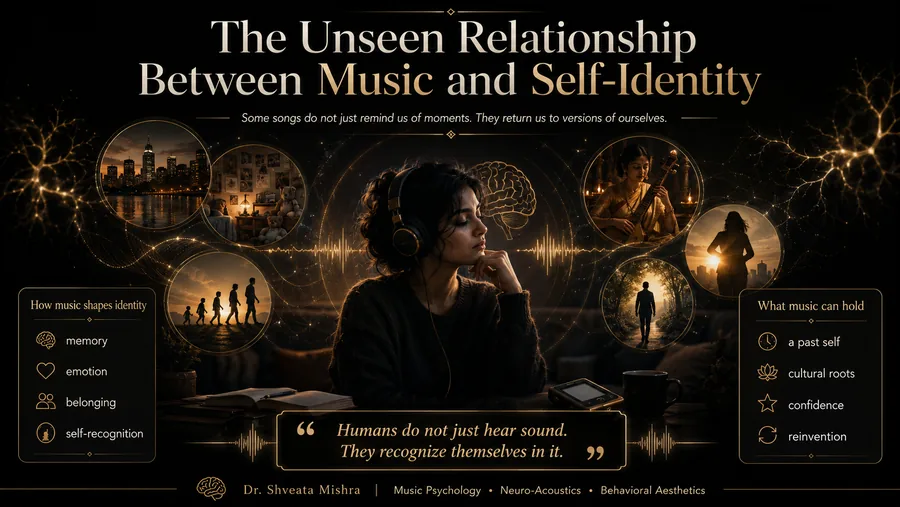
Humans do not just hear sound. They recognize themselves in it.
The short version, if you are skimming
- Music and self-identity meet when a song stops being entertainment and starts acting as recognition: it returns you to a version of yourself.
- We use music to enter, leave, mourn, or rehearse a role, which is closer to identity regulation than to taste.
- Research links personally meaningful music to autobiographical memory, the brain’s reward system, and self-related processing.
- Your playlist is not a diagnosis. It is a living archive of who you have been and who you are becoming.
Why Music Feels Personal Before It Feels Explainable
A song can become personal faster than language can explain. The opening seconds arrive, and the body has already shifted. The shoulders soften. The stomach tightens. A memory comes back before the story is ready. A person, a city, a room, a season, a breakup, a prayer, a friendship, a version of ambition, a version of innocence.
This is not dramatic. It is human. If you have ever felt a reaction in your chest before you could name the reason, that is your body responding first: I examined that head start in Why Your Body Reacts to Music Before Your Mind Understands It.
Music is one of the few everyday experiences that can hold emotion, memory, movement, culture, and social belonging at the same time. It does not ask us to separate the body from the mind, or the private self from the social self. It arrives as sound, but it is processed as meaning.
That is why people rarely say, “I enjoy this track,” when the music has become identity-relevant. They say, “This is me.” Or, “This was my whole life then.” Or, “I cannot listen to this anymore.”
Music becomes self-identity when it stops being only entertainment and starts acting as recognition.
A song becomes powerful when it gives a feeling somewhere honest to stand.
The Behavioral Clue: We Use Music To Manage Who We Are
Look at how people actually use music. A student abroad plays a childhood song because it restores continuity. Someone listens to a teenage favorite before a difficult conversation because it brings back an older confidence. A parent hears a song from early adulthood and remembers the self that existed before responsibility became the dominant rhythm. A person avoids one playlist after a breakup because the songs still carry a shared identity they are not ready to revisit.
These are not random listening habits. They are small acts of identity regulation.
We use music to enter a role, leave a role, mourn a role, rehearse a role, or remember that we are more than the role we are currently performing.
The workout playlist does not only energize the body. It supports an identity of strength and agency. The devotional song may reconnect a listener with faith, ancestry, humility, or belonging. The old pop song may return someone to a freer self. Quiet instrumental music after a long day may help a person stop being available to the world and return to their own interior life.
Music is often where people negotiate the sentence, “Who am I right now?” That negotiation is where music and self-identity quietly meet.
Try this: next time you reach for a specific song on purpose, pause and ask what state you are trying to enter or leave. The answer is usually about identity, not melody.
What Psychology and Neuroscience Can Responsibly Say About Music and Self-Identity
Identity is not a fixed object hidden somewhere inside us. Psychologically, it is closer to an ongoing pattern: memory, values, body state, relationships, culture, language, choices, and the stories we tell about what our life has meant.
Music interacts with that pattern in several plausible ways.
First, music is strongly linked to autobiographical memory. Research on music-evoked autobiographical memories shows that songs can cue vivid memories of people, places, life periods, and specific events, especially when the music is personally meaningful. It is the same reason a few familiar bars can pull back a moment you thought you had lost, something I examined in Why Songs Bring Back Memories You’d Long Forgotten.
Second, music engages emotion and reward systems. Studies in music neuroscience show that pleasurable music can involve brain regions associated with emotion, anticipation, reward, and bodily arousal. One well-known study found that peak emotional moments in music track with dopamine release in the brain’s reward circuitry. This does not mean music magically controls the brain. It means music becomes compelling because it works with prediction, tension, release, memory, and feeling.
Third, familiar music can become self-referential. The same neuroimaging research has linked autobiographically meaningful music with brain regions involved in memory and self-related processing, including medial prefrontal areas. In plain language, personally significant music can help the mind connect sound with the story of “me.”
Fourth, music is social. Research on the psychological functions of music listening often points to self-awareness, mood and arousal regulation, and social relatedness. That combination is exactly why music can feel so close to identity. It helps people feel, regulate, belong, and define themselves.
The responsible conclusion is not that music determines who we are.
The better conclusion is that music participates in how we recognize, organize, and express who we are.
Keep reading
Your Music Taste Is Not a Diagnosis
It is tempting to turn music taste into a personality test. Classical means intelligent. Metal means angry. Pop means shallow. Jazz means complex. Sad songs mean depressed. Dance music means extroverted.
Human beings are not that simple.
Research has found relationships between music preference, personality, social identity, and self-expression, but these relationships are not clean enough to reduce a person to a playlist. A genre can mean rebellion in one culture, family tradition in another, spiritual belonging in another, and pure sensory pleasure in another.
The same song can help one person grieve, another person focus, another person feel attractive, and another person feel less alone.
This is why the most important question is not “What does this genre say about me?”
The better question is, “What part of me does this music help me access?”
Music taste becomes psychologically meaningful through context. Who introduced the song? What age were you? What was happening in your body and life? Did the music help you feel seen, protected, powerful, rooted, free, or understood?
A playlist is not a clinical report. It is a living archive, one of the most honest records we keep of music and self-identity over time.
The Songs From Our Becoming Years
Many people have especially strong attachments to music from adolescence and early adulthood. Memory researchers often describe a “reminiscence bump,” a tendency for older adults to remember a higher number of personally significant experiences from roughly the teenage years into young adulthood.
This is not surprising. Those years often contain first identities: first serious friendships, first separations, first love, first heartbreak, first public self, first private rebellion, first failures that feel defining.
Music heard during those years can become woven into identity because the self is under construction.
A person can discover music at 40 that helps them understand grief. At 55, a song can mark reinvention after divorce, migration, illness, or spiritual change. At 70, new music can still become attached to dignity, memory, companionship, or courage.
The self keeps listening because the self keeps changing. Those becoming years are simply where music and self-identity first fuse.
Culture, Belonging, and the Private Self
Music and self-identity are never only individual. They are also cultural.
A song in a first language can carry emotional meanings that translation cannot fully hold. A festival rhythm can connect a person to community before they consciously think about belonging. A protest song, wedding song, lullaby, hymn, ghazal, bhajan, gospel chorus, folk tune, film song, or club track can place the self inside a larger “we.”
For people living between cultures, music can become an emotional bridge. It may help someone feel close to home while building a life elsewhere. It may create a private room where multiple identities can coexist without needing to argue.
This is one reason music can feel intimate across the US, UK, Canada, India, and global diasporas. It can hold personal memory and collective belonging at once.
When Music Helps You Meet a New Version of Yourself
One quiet sign of change is that old music starts to feel different.
The song you once needed may begin to feel too small. Music that once made you feel alive may now feel exhausting. A playlist that carried you through survival may not fit your recovery. A genre you dismissed may suddenly feel like permission. When a former favorite begins to grate, that is often information, not malfunction: I unpacked it in Why Your Favorite Music Suddenly Feels Irritating.
This can unsettle people. Often, they are not losing themselves. They are updating. It is a reminder that music and self-identity are never fixed, because both keep moving.
Identity growth can change listening. Healing, burnout, parenthood, migration, sobriety, grief, love, spiritual doubt, and professional reinvention can all change what sound feels honest.
Sometimes the music you no longer reach for is not a betrayal of the past. It is evidence that the past no longer has the same job.
A More Honest Way To Listen
The next time a song feels unusually personal, try not to rush into analysis. Start with attention.
Ask yourself:
- What version of me does this music bring forward?
- Does it return me to a memory, a value, a person, a place, or a future?
- Do I feel expanded after listening, or pulled into a loop?
- Is this song helping me process something, or helping me avoid something?
- What would I know about myself if I took my music seriously, without turning it into a diagnosis?
These questions do not make listening clinical. They make it conscious.
Music is not there to solve the self. It is there, sometimes, to reveal where the self has been waiting to be heard.
If this is the kind of question you like to sit with, the subscribe form at the bottom of the page sends new essays on sound, emotion, and identity straight to you.
The Unseen Bond Between Music and Self-Identity
The unseen relationship between music and self-identity is not mysterious because it is supernatural. It is mysterious because it is intimate.
Music enters through the ear, but it does not stay there. It meets memory, the nervous system, culture, grief, belonging, desire, pride, shame, hope, and the private sentences people rarely say out loud.
This is why a song can feel like home, even when home is complicated.
This is why a playlist can become a diary without words.
This is why certain music can feel unbearable after loss, necessary during transition, and sacred during recovery.
We are not only listening for sound.
We are listening for recognition.
And sometimes, in three minutes of music, a person hears what they have been trying to say to themselves for years: I am still here. I am changing. I remember. I belong to more than what happened to me.
What song would you protect, and which version of you does it keep?
Keep reading: the sound and identity series
- Music for Self-Reflection: How Songs Help You Understand Yourself
- Why Certain Songs Make You Feel Understood
- Music and Fashion: The Fascinating Psychology of Identity
Frequently Asked Questions
Why do some songs feel like part of my identity?
Some songs feel like part of your identity because they become linked with memory, emotion, relationships, culture, and important life chapters. Over time, the song can cue a version of yourself, not just an event. That is the heart of the relationship between music and self-identity.
Does my music taste reveal my personality?
Your music taste may offer clues about preference, mood, values, social belonging, and self-expression, but it should not be treated as a personality diagnosis. Context matters more than genre labels alone.
Why does music from my teenage years feel so powerful?
Teenage years and early adulthood often involve intense identity formation and emotionally vivid first experiences. Music from that period can become strongly linked with self-defining chapters of life, an effect researchers call the reminiscence bump.
Why do I stop liking music I used to love?
Sometimes music changes because you change. A song may no longer match your emotional needs, identity, memories, or current life stage. That shift can be a sign of growth, not a failure of loyalty.

About the author
Dr. Shveata Mishra
Begin with the ritual
Get the free 5-Minute Sound Ritual.
A research-informed listening practice designed to help your nervous system settle, sent to your inbox as a PDF. You will also receive new writing on sound, emotion, and identity whenever an article is published.