

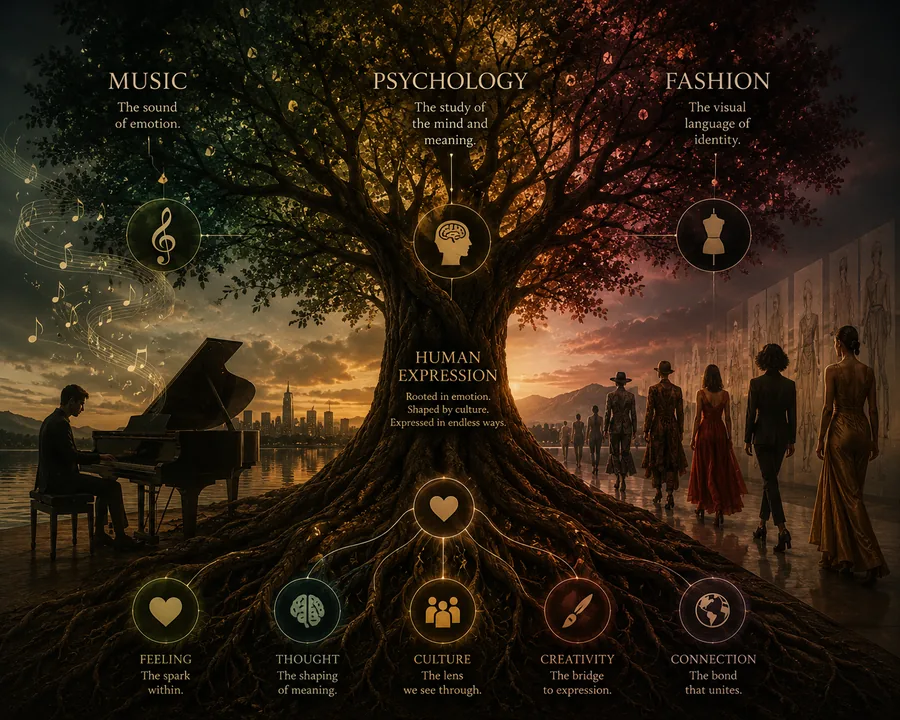
It is 7:40 in the morning. A song you have played a hundred times is filling the room, and without quite deciding to, you reach past three other shirts for the one that matches the mood the track just put you in. Two choices, the song and the shirt, made in the same breath. We file them in separate drawers. Music over here, fashion over there, psychology somewhere off in a textbook. They are not separate. Music and fashion are two channels carrying one signal, and the psychology underneath is the thing doing the carrying.
You do not pick a song and an outfit. You pick a version of yourself, twice.
The short version, if you’re skimming
- Psychology is the root. Music is how an identity sounds, fashion is how it looks. Same self, two surfaces.
- Your music taste works as a badge. Research shows people read your genre as a cluster of values, and you tend to choose genres that already match your self-image.
- What you wear does not only signal outward. “Enclothed cognition” suggests clothing can shift how you yourself think and carry yourself, though psychologists still argue about how strong the effect is.
- Subcultures (rock leather, hip-hop, today’s gender-fluid pop) are not fashion trends that happened to stand near music. They are single identities broadcasting on two frequencies at once.
- You can use this on purpose: dress the version of you the music is already calling up.
Quick gut check: which of these is true for you right now?
Tick the ones that fit. Hold on to your answers, we will come back to them.
- ☐ You have outfits that “go with” certain playlists, and swapping them would feel slightly wrong.
- ☐ You have sized someone up, fairly or not, the second you clocked their band tee or their playlist.
- ☐ Putting on specific clothes changes how you move, not just how you look.
- ☐ A genre you loved at sixteen still shows up somewhere in how you dress now.
Music, fashion, and psychology: three expressions of one self
Picture a tree. Most people look at the branches, the song on repeat, the jacket that finally feels like them, and treat each one as its own thing. The interesting part is underground. Music and fashion grow from the same root system, and that root is psychology: the ongoing, mostly automatic work of turning an inner life into something the world can perceive.
Here is the plain version. You have an inside self that is hard to say out loud. Identity, mood, the group you belong to, the person you are trying to become. You cannot hand any of that to a stranger directly. So you externalize it. You broadcast it through what you put in your ears and what you put on your body. Sound becomes one readable surface of you. Style becomes another. The branches look different. The root is identical.
This is the heart of how I think about it in my work on Neuro-Acoustic Behavioral Aesthetics: sound and aesthetic choices are not decoration sitting on top of behavior. They are behavioral information. A signal others read, and a signal that loops back and shapes you.
Try this: for one day, notice the order. Did the music set the mood and the clothes follow, or the other way round? The pairing is rarely random.
Your playlist is a badge (and so is your jacket)
In 1999, psychologists Adrian North and David Hargreaves tested a simple idea: that musical taste works as a “badge” of identity. Tell people your favorite genre and they will, instantly and confidently, infer a whole bundle of traits and values about you. Their studies found exactly that. Fans of one genre were rated as intellectual, of another as attractive or rebellious, and crucially, those judgments lined up with how the fans saw themselves. Music was acting as social shorthand. More recent work keeps tying the music we prefer to social identity and self-esteem (see, for example, this open-access study on music preference and social identity).
Two things follow, and both matter for fashion.
First, the signal goes outward. People genuinely read your taste. The same way a band tee or a particular silhouette tells a stranger which world you live in before you say a word.
Second, and this is the part people miss, the badge is not just chosen, it is matched. We tend to gravitate toward genres whose stereotype already fits the self-image we hold. You do not adopt the music and then become the person. You recognize yourself in the music and reach for it. Clothing does the identical job in a visual key. You do not put on the leather jacket to become a different person. You put it on because it says something you already feel is true.
So the jacket and the playlist are doing one job in two formats. Both are badges. Both are you, made legible.
Keep reading
Enclothed cognition: what you wear edits how you think
Most fashion writing stops at how others see you. The more interesting finding runs the other way.
In 2012, Hajo Adam and Adam Galinsky coined the term enclothed cognition for the idea that clothes systematically influence the wearer’s own psychological processes. In their experiments, people who put on a coat described as a doctor’s lab coat performed better on attention tasks than people who wore the same coat described as a painter’s, or who only looked at it. The effect, they argued, needs two ingredients together: the symbolic meaning of the garment and the physical act of wearing it. Wearing the doctor’s coat nudged people toward being a little more careful and attentive, because that is what the coat “means.”
I want to be honest about the science here, because overclaiming helps no one. The original lab-coat result has had a mixed replication record, and researchers still debate how large and reliable the effect is. What is not really in dispute is the broader phenomenon underneath it: what you wear feeds back into how you feel and carry yourself, not only into how others read you. Most of us have lived the small version of this. The interview blazer that makes you sit straighter. The soft clothes that let your shoulders drop.
Now notice that music does the exact same loop. You put on a song to feel a certain way, and the song moves you toward feeling it. The mechanism is twinned. Sound and clothing are both inputs you choose in order to become, a little, the person they imply. If this loop interests you, I went deeper into how others read these signals in You Are Not Just Seen or Heard, You Are Neurologically Perceived.
Where sound and style meet: one identity, two frequencies
This is why music and fashion keep fusing across every era, and why it never looks like coincidence.
Rock did not just sound rebellious, it dressed rebellious: ripped denim, leather, an open refusal worn on the body. Hip-hop carried its values, individuality and resistance, into oversized silhouettes and statement pieces as much as into the beat. David Bowie built Ziggy Stardust as a single artwork where the futuristic costume and the futuristic sound were the same statement made twice. Today, when Billie Eilish drowns her frame in oversized layers or Harry Styles wears whatever he likes regardless of the rules, the clothes and the music are arguing the same point about identity at the same time. The outfit is not promoting the song. They are co-expressions of one self.
You feel this in spaces too. Walk into a dim jazz room: the saxophone, the low light, the way people have dressed for it. The sound and the style are tuned to each other, and together they build an atmosphere that neither could make alone. Even our reach for certain colors and textures carries learned associations, the black worn in solidarity with a mood, the bright festival palette that signals release. Those meanings are shaped by culture more than hardwired into us, but they are real, and we read them fluently.
One identity. Two frequencies. Audible and visible.
What to actually do about it
- Notice the pairing, then name it. Next time a song and an outfit click, ask what the two of them are saying together. The answer is usually a version of you that wants out that day.
- Dress the version the music calls up. If a track makes you feel sharp and deliberate, let the clothes agree with it instead of fighting it. You are stacking two signals in the same direction.
- Read the badge kindly. When someone’s style or taste makes you form a snap judgment, remember it is a badge, not the whole person. Use it as a hello, not a verdict.
If you want to read your own playlist and wardrobe as one identity, with me rather than alone, that is the discovery consultation.
If this is the kind of thing you like to think about, the subscribe form at the bottom of the page sends new pieces like this straight to you.
Two branches, one root
Strip it all back and the same line keeps surfacing. People don’t just hear sound. They recognize themselves in it. And in the same motion, they reach for the clothes that say the same thing in a language you can see. Music and fashion are not two hobbies that happen to overlap. They are the two halves of one sentence about who you are, one you speak out loud every single day without meaning to.
So here is my question for you. What is the song-and-outfit pairing that feels most like you, and what do you think it is quietly telling the room? Tell me in the comments.
Keep reading: the sound, style, and identity series
- You Are Not Just Seen or Heard, You Are Neurologically Perceived
- Music for Self-Reflection: How Songs Help You Understand Yourself
- Why Certain Songs Make You Feel Understood
- Music Psychology in Daily Life: Sound, Stress, and Focus
Frequently Asked Questions
How are music and fashion psychologically connected?
Both are ways of turning an inner identity into something other people can perceive. Music expresses it in sound, fashion in sight, and the same psychological needs, belonging, mood, self-image, drive both. That is why a genre and a look so often travel together.
Is musical taste really a signal of identity?
Yes. Research going back to North and Hargreaves treats music preference as a “badge” that others read to infer your values and traits, and that you choose partly because it already matches how you see yourself. Clothing works the same way in a visual form.
What is enclothed cognition?
It is the idea, introduced by Adam and Galinsky in 2012, that clothes influence the wearer’s own thinking and behavior, not just how others see them, when the garment’s symbolic meaning and the act of wearing it combine. The exact size of the effect is still debated, but the broader loop between what we wear and how we feel is well recognized.
Why do people dress like the music they listen to?
Because dress and sound are signaling the same identity. Aligning your look with a genre marks which world you belong to, helps others in that world recognize you, and reinforces the self-image the music already speaks to. It is community and self-expression in one move.
Does what I wear actually change how I behave?
It can. Many people notice they carry themselves differently in an interview blazer versus soft clothes at home, which fits the broader idea behind enclothed cognition. Think of clothing as one input among many that nudges your mood and posture, not as a guaranteed switch.
How can I use this connection on purpose?
Notice when a song and an outfit feel like they belong together, then choose them deliberately. Let the music set a mood and let the clothes agree with it, so you are sending one clear signal to yourself and to the room instead of two mixed ones.

About the author
Dr. Shveata Mishra
Begin with the ritual
Get the free 5-Minute Sound Ritual.
A research-informed listening practice designed to help your nervous system settle, sent to your inbox as a PDF. You will also receive new writing on sound, emotion, and identity whenever an article is published.