

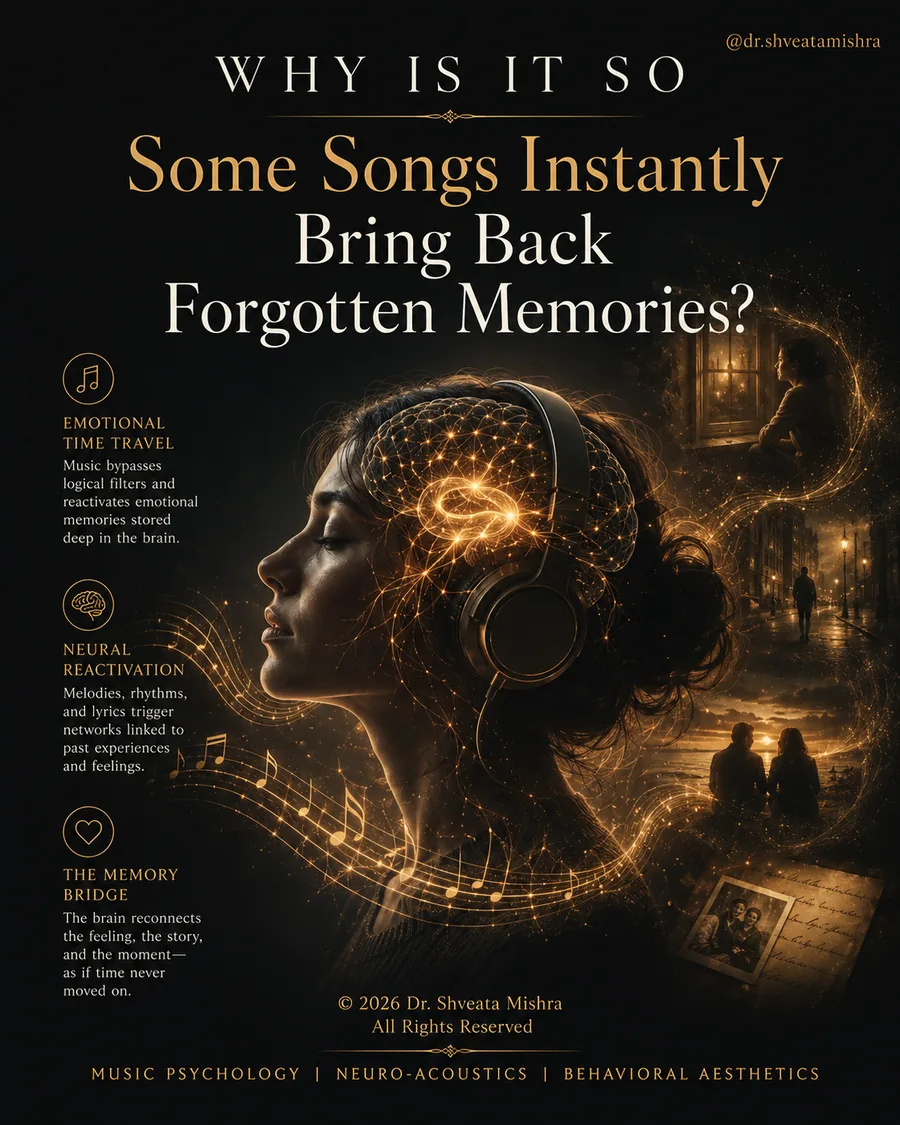
It takes one song. A few bars drifting out of a shop or a passing car, a track you have not heard in years, and songs bring back memories you did not go looking for.
Before you decide anything, you are gone.
A back seat on a long drive. A kitchen that no longer exists. A person you stopped speaking to. A summer you forgot you had. Sometimes it is not even a memory of an event. It is a version of you that you have not been in a long time, suddenly close enough to touch.
That is the quiet, almost unfair power of music. I study this for a living, and it still catches me off guard. Songs bring back memories the way nothing else does, not photographs, not smells, not even old letters. A few seconds of sound, and a whole season of your life walks back into the room.
This is not your imagination, and it is not nostalgia for nostalgia’s sake. There is real science underneath it, and it is more beautiful than I expected when I first started looking.
We do not just hear a song. We recognize, inside it, a self we thought we had left behind.
The short version, if you’re skimming
- Songs bring back memories because your brain stores life as more than facts: it saves the mood, the place, the body sensation, and the sound all bound together.
- There is even a name for it in the research: music-evoked autobiographical memory.
- One brain region (the medial prefrontal cortex) seems to hold music, emotion, and personal memory in roughly the same place, which is part of why a song can move you so fast.
- The music from your teens and early twenties tends to hit hardest. Researchers call that the reminiscence bump.
- The pull you feel is not weakness or living in the past. It is recognition.
Quick gut check: which of these is true for you right now?
Tick the ones that fit. Hold on to your answers, we will come back to them.
- ☐ A song came on and you teared up before you even knew why.
- ☐ You can forget a whole year of your life, then one track returns the feeling of it in seconds.
- ☐ There is a song you cannot play anymore because of who it belongs to.
- ☐ When life gets shaky, you reach for the same old songs, not new ones.
Why Songs Bring Back Memories So Suddenly
Memory is not a tidy filing cabinet. It is closer to a web.
Your brain does not only record what happened. It records the weather around what happened: how the room felt, what your body was doing, what you were feeling, and what was playing in the background. Those threads get stored together. Pull one, and the others come with it.
So when songs bring back memories, they are not unlocking a single fact. They are tugging a whole bundle: a feeling, a place, a person, a chapter. Psychologists have a precise term for this. They call it music-evoked autobiographical memory, and what makes it strange is how often it arrives uninvited. You are not trying to remember. The memory simply shows up.
Researcher Kelly Jakubowski and her colleagues found that these memories tend to surface most when your mind is free to wander, on a commute, doing dishes, walking nowhere in particular. The song slips past your busy attention and reaches something older.
A photo shows you the outside of a moment. A song drops you back inside it.
There is also a simple reason music outperforms almost every other cue. We replay songs. We listen to a track hundreds of times across a hard year in a way we never reread a book or rewatch a film. Each replay welds the sound a little tighter to the life around it.
Your Brain Stores Life With a Soundtrack
Here is the part I find genuinely moving.
In 2009, the neuroscientist Petr Janata scanned people’s brains while they listened to songs from their youth. The memories lit up a region just behind your forehead called the medial prefrontal cortex. The same region was tracking the movement of the music itself, the chords, the shape of the melody, at the same time it was holding the personal memory.
Translated out of the jargon: music and the story of your life appear to share an address in the brain. That overlap is part of why a song can reach your past faster than a thought can. You are not retrieving a memory step by step. You are landing in it.
This also explains something tender that families notice. In people living with Alzheimer’s, that medial prefrontal region is often one of the last to be damaged. A person who has lost names and faces can still come alive to a song from their wedding. The soundtrack outlasts almost everything else.
It is why you can forget the exact words someone said to you, yet still feel, precisely, how that whole year tasted the moment the right track plays. It is part of why songs bring back memories with a speed that ordinary thinking never matches.
Keep reading
Why the Music of Your Teens Marks You for Life
Notice which songs bring back memories for you most powerfully. For a lot of people, they cluster around one stretch of life: roughly ages fourteen to the early twenties.
That is not an accident. Memory researchers call it the reminiscence bump. The years when you were becoming yourself get encoded with unusual force, and the music you bonded to then gets pulled along with them. A 2025 study from the University of Jyväskylä that looked across cultures found the same pattern worldwide: the songs of our teenage years leave a mark the rest do not.
Think about what those years actually held. First love. First heartbreak. First time you chose your own taste instead of inheriting it. You were not just listening to music. You were using it to figure out who you were going to be. The song became part of the scaffolding.
The songs of your youth are not just catchy. They are load-bearing.
Why Old Songs Feel Safe When Everything Else Doesn’t
There is one more layer, and it is why familiar music feels almost physically steadying on a bad day.
Your nervous system likes prediction. When a song is deeply familiar, your brain already knows where it is going, the next chord, the lift before the chorus, the silence right before the last line. Psychologists call the warmth that comes from familiarity the mere-exposure effect: we tend to feel safer with what we already know. A known song asks almost nothing of you. There is nothing to brace for. The body can finally exhale.
That is why, when life feels uncertain, most of us do not reach for something new. We reach backward, for the songs that already feel like home. Familiar music will not erase what is hard. But it can hand you a thread of continuity, a sense that some part of you is still recognizably you.
If this part resonates, I went further into it here: Why Certain Songs Make You Feel Understood.
It Isn’t Only Memory. It’s Identity.
So we circle back to the deepest thing.
When an old song returns and the feeling floods in before the story does, your brain is not only recognizing a melody. It is recognizing an earlier version of you, and for a moment, reuniting you with it.
That is why some songs are so hard to let go of. The attachment was never really to the track. It was to the self that lived inside it, the one who heard it for the first time and did not yet know how the story turned out. We do not just remember the lyrics. We remember who we were while they played.
This sits at the center of how I think about sound. People do not simply hear music. They recognize themselves in it.
What to do when a song takes you somewhere
When songs bring back memories you were not braced for, you do not have to fix the feeling. But a few small things help you meet it instead of being ambushed by it.
- Let it finish. When a song pulls you under, resist skipping it. Stay for the three minutes. The feeling almost always softens once it has been felt.
- Name the chapter, not just the sadness. Ask “what part of my life is this song holding?” Naming it turns a flood into a memory you can actually look at.
- Build the playlist on purpose. If certain songs reliably steady you, that is not random. Keep them somewhere you can reach when a day gets loud.
- Let new songs in too. The tracks you bond to now are quietly becoming the memory cues of a future you. Give that future self something good to find.
If pieces like this are your kind of thing, the subscribe box at the bottom of the page is where I send the next ones.
The past is not pulling you back. It is reminding you it is still yours.
People worry that being moved by an old song means they are stuck, living backward. I do not read it that way.
A song that takes you across twenty years in three seconds is not proof you cannot move on. It is proof of how much you have carried, and how faithfully your mind kept it. Songs bring back memories not to trap you, but to show you that the life behind you is still part of the life you are in.
So I will ask you what I always end up asking myself. Which song, the second it starts, returns you instantly to someone you used to be? And when it plays next, will you skip it, or finally sit with it?
Tell me in the comments. I read them.
Keep reading: the music, memory, and identity series
- Why Certain Songs Make You Feel Understood
- Music for Self-Reflection: How Songs Help You Understand Yourself
- Why Your Body Reacts to Music Before Your Mind Understands It
- The Power of Music: Why the Best Songs Move Us
Frequently Asked Questions
Why do songs bring back memories so suddenly?
Because your brain stores experiences with their context attached, including the sound. When a familiar song returns, it reactivates the emotional memory bound to it, often involuntarily, so the feeling arrives before you have time to think.
What is it called when music triggers a memory?
Researchers call it music-evoked autobiographical memory. It is the experience of a song spontaneously bringing back people, places, and moments from your own past, usually without you trying to recall them.
Why does music bring back feelings faster than thinking does?
Music engages emotion, memory, reward, and the body at once, and brain imaging suggests music and personal memory overlap in the medial prefrontal cortex. That shared wiring lets a song drop you into a past feeling almost instantly.
Why are the songs from my teenage years the most powerful?
That is the reminiscence bump. The years when you were forming your identity get encoded especially strongly, and the music you attached to then is pulled along with those memories, which is why it can stay vivid for decades.
Why do nostalgic songs sometimes make me cry even when they are not sad?
Because the tears are usually not about the song. They are about what the song holds: time that has passed, people no longer here, and the version of you that first heard it. Nostalgic music reconnects you to all of that at once.

About the author
Dr. Shveata Mishra
Begin with the ritual
Get the free 5-Minute Sound Ritual.
A research-informed listening practice designed to help your nervous system settle, sent to your inbox as a PDF. You will also receive new writing on sound, emotion, and identity whenever an article is published.