

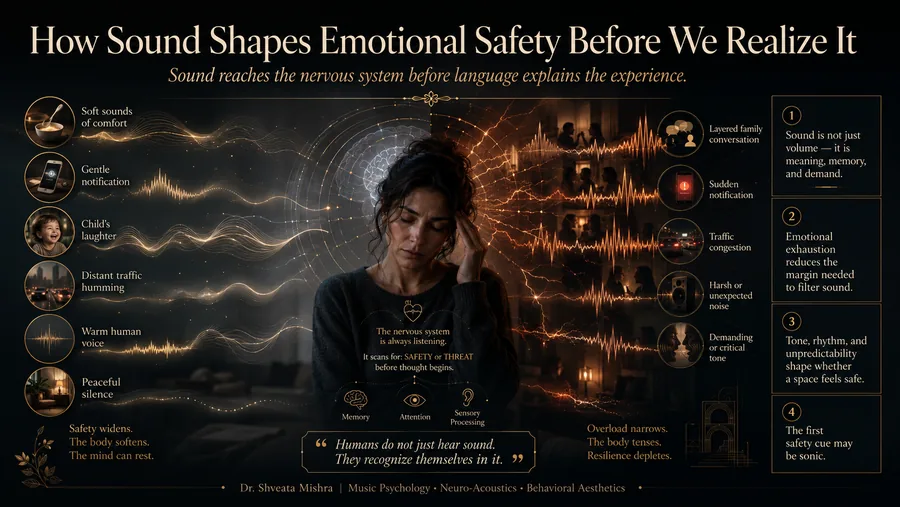
Before a room becomes a thought, it becomes a feeling.
You enter a home and your shoulders drop. You step into a hospital corridor and your body becomes alert. Someone says “I’m fine” in a tone that tells you they are not. A notification sounds and your stomach tightens before you have even looked at the screen.
Nothing dramatic has happened. No one has explained anything. Yet something in the body has already started making an assessment. Often, that quiet assessment is about emotional safety, and it is happening through sound.
Sound reaches us before language organizes the experience. It carries cues about distance, urgency, mood, threat, intimacy, belonging, fatigue, and care. Sometimes it tells us that we can soften. Sometimes it tells us to prepare.
Humans do not just hear sound. They recognize themselves in it.
That recognition may be comforting, painful, familiar, irritating, grounding, or overwhelming. But it is rarely neutral. Sound is one of the ways the human system asks, often before conscious thought, “Am I safe enough here?”
Emotional safety often begins before explanation. It begins with what the body hears.
The short version, if you are skimming
- Emotional safety often starts before words, in what the body hears in a place or a voice.
- The auditory system is fast and threat-sensitive, so sound can shift your state before you can explain why.
- Tone of voice carries relational information: the same sentence can land as care or as pressure.
- A sound becomes powerful when memory, identity, and repeated experience attach to it.
- There is no universal “safe” sound, so the useful question is what a sound is asking your body to do.
Quick gut check: which of these is true for you right now?
- ☐ A particular voice can settle me or unsettle me before I register the words.
- ☐ Constant background noise leaves me more tired or irritable than I expect.
- ☐ Silence sometimes feels less like peace and more like exposure.
- ☐ A specific song reaches a feeling I have not been able to say out loud.
Hold your answers. By the end, each one will make more sense.
Sound Is Part Of The Room’s Emotional Temperature
Most people can sense the emotional tone of a place without being able to list the evidence.
A school hallway after an argument feels different from the same hallway on a calm morning. A workplace with constant alert sounds feels different from one with fewer interruptions. A house where someone moves gently through the kitchen sounds different from a house where every cupboard closes like a warning.
We often call this “energy,” but much of it is sensory information. Sound is part of a room’s emotional temperature.
Volume matters, but volume is not the whole story. Timing, predictability, tone, source, and personal history all matter. Silence can feel peaceful, tense, lonely, sacred, or suspicious depending on what it has meant in a person’s life.
This is why emotional safety is never only about what is said. It is also about how a space sounds while people are trying to live, think, heal, work, love, or rest inside it.
Why The Brain Listens Before The Mind Explains
The auditory system is built for speed. Sound often arrives from beyond the visual field. We may hear what we cannot yet see. A footstep, a cry, a crash, an approaching vehicle, a change in voice tone: these signals help the brain decide where attention should go next.
When sound enters the ear, it is processed through pathways that connect hearing with attention, memory, emotion, movement, and bodily readiness. Sound does not create one fixed response in everyone. It shapes the conditions in which emotion unfolds.
Certain acoustic features are especially good at recruiting attention: sudden onset, sharpness, loudness, irregularity, rapid change, and the sense that something is approaching. Research on auditory looming shows that humans systematically overestimate sounds that seem to move closer, hearing them as nearer and arriving sooner than they are. That makes sense. An approaching sound may require action sooner than a receding one.
The same principle applies socially. Human voice is not merely words carried by air. Tone, pace, pause, breath, intensity, pitch, and rhythm all help us interpret whether someone is calm, irritated, tender, ashamed, bored, impatient, or emotionally available. This is the same fast reading I examine in why your body reacts to music before your mind understands it.
This speed is part of why emotional safety can rise or fall before you have reasoned your way to it. The mind may later say, “Something felt off.” The body often had the first draft.
Keep reading
The Tone Of A Voice Can Become A Safety Signal
Many people remember the sound of a voice more than the exact words spoken.
A teacher’s steady voice can make a student feel capable. A parent’s softened tone can help a child return from panic. A supervisor’s clipped delivery can make a team feel watched, even when the message is ordinary. A partner’s sigh can change the room before either person admits what is happening.
This is not about reading danger into every tone. It is about recognizing that voice carries relational information.
In music psychology and affective neuroscience, vocal prosody is a major part of emotional communication. Stephen Porges’ work on the polyvagal theory of safety describes how the nervous system constantly reads warmth or threat in a voice, and how a calm, melodic tone can quiet our physiology before a single point is made. Before we analyze a sentence, we are already listening for cues: warmth, threat, impatience, affection, contempt, steadiness. The nervous system is not only asking, “What did they say?” It is also asking, “How safe is it to receive this?”
This is why emotionally mature communication is not only honest. It is regulated. A steady, regulated tone is one of the most direct ways we offer another person emotional safety. If you want the deeper mechanism, I unpack it in why certain voices instantly calm your nervous system.
We can say the right words in a sound that makes closeness impossible. We can also say difficult words in a sound that preserves dignity.
Tone does not replace truth. It decides whether truth can be received without the body bracing.
Why Some Sounds Feel Personal
A sound becomes emotionally powerful when it is linked with memory, identity, or repeated experience.
For one person, rain on a window is rest. For another, it recalls flooding, loneliness, or a difficult season. A temple bell, church choir, azaan, mantra, school song, stadium chant, lullaby, or national anthem can carry layers of culture and belonging.
This is also why music can feel so intimate.
Music works through rhythm, expectation, melody, tension, release, timbre, memory, and bodily timing. Studies of musical pleasure and prediction show that music can engage prediction, emotion, and reward networks, which is part of why a familiar passage can move us so physically. But the important human point is simpler: a piece of music can give form to an inner state before language catches up.
Sometimes a song does not change what we feel. It reveals it.
And when a sound reveals us accurately, it can create emotional safety. Not because life is suddenly solved, but because the loneliness inside the feeling reduces.
The Cost Of Unsafe Sound
Not all sound is meaningful in a beautiful way. Some sound simply costs too much.
Chronic unwanted noise can make the body work harder. The WHO environmental noise guidelines link persistent noise exposure with annoyance, sleep disturbance, stress responses, learning interference, and broader health concerns. Anyone who has lived near constant traffic, construction, thin apartment walls, airport noise, loud neighbors, or continuous workplace alerts knows that the issue is not only preference.
Noise can reduce the feeling of being protected by one’s own environment.
It can make rest feel interrupted, attention feel fragile, and patience feel smaller. Over time, that erosion chips away at emotional safety in the very places meant to restore us.
This matters in homes, offices, hospitals, schools, restaurants, spiritual spaces, therapy rooms, public transport, and digital life. Sound design is not decoration. It is part of care.
When a hospital reduces unnecessary alarms, it supports recovery. When a school considers acoustic load, it supports learning. When a workplace reduces constant notification noise, it protects attention.
Emotional Safety Is Not The Same Sound For Everyone
One of the most important truths in neuro-acoustics is that there is no universal sound of safety.
Some people regulate through soft music. Some need silence. Some need the low hum of a fan because silence feels too exposed. Some focus better with cafe noise. Others cannot think when multiple conversations overlap. Some find chanting grounding. Others find repetitive sound unbearable.
The same sound may soothe at one life stage and irritate at another. This is why responsible sound work must stay humble. A playlist, sound bath, meditation track, or acoustic environment is not automatically calming, and not automatically emotional safety, because someone labels it that way.
Sound is relational. It asks, “Who is listening, and what are they carrying today?”
A More Intelligent Way To Listen
A practical shift begins with one question:
What is this sound asking my body to do?
A sharp alarm may ask you to prepare. A familiar voice may ask you to trust. A crowded restaurant may ask you to filter too much at once. A certain song may ask you to remember. A quiet room may ask you to meet feelings you were avoiding. A soft rhythm may ask your breath to slow.
This question does not make every reaction dramatic. It makes every reaction more understandable. It is also where your gut check pays off.
If a sound irritates you, you may not be “too sensitive.” You may be overloaded. If silence feels difficult, you may have learned to use sound as company. If a tone of voice unsettles you, your body may be noticing pressure before your mind has a social explanation. If music makes you cry, it may be because it has found the shape of something you have not yet said.
Listening intelligently means respecting both evidence and experience. It means knowing that sound is physical, psychological, relational, and cultural at the same time.
It also means making small choices where possible: fewer unnecessary alerts, calmer morning soundscapes, softer transitions for children, quieter recovery spaces, and music chosen for the state you need. These choices are not luxuries. They are forms of emotional design that protect emotional safety.
If this way of listening is useful, the subscribe form at the end of the page sends new pieces from my work on sound, emotion, and identity straight to you.
The First Safety Cue May Be Sonic
We live in sound before we describe the world.
Before a child understands a sentence, they understand tone. Before a room becomes an opinion, it becomes a felt sense.
Sound can warn us. It can organize us. It can exhaust us. It can hold us. It can make the world feel closer, harsher, softer, more human.
The deeper lesson is not that every sound must be controlled. Life will never be acoustically perfect.
The lesson is that listening is part of emotional intelligence. When we listen to how sound shapes safety, we understand behavior with more compassion. We stop judging every reaction as an overreaction and start asking what the person, place, or nervous system is responding to.
And sometimes, in the right sound at the right moment, a person does not merely hear something pleasant. They feel recognized.
So I will leave you with the question I keep returning to: what is one sound that tells your body it is safe? Tell me in the comments. I read them.
Keep reading: sound, safety, and the nervous system
- Why Do Certain Voices Instantly Calm Your Nervous System?
- Why Your Body Reacts to Music Before Your Mind Understands It
- The Body Knows Before the Mind: How Neuroception Detects Threat Before Logic
- Sound and the Nervous System: 5 Audio Anchors for a Steadier Mind
Frequently Asked Questions
Can sound really shape emotional safety?
Yes. Sound can influence emotional safety by shaping attention, arousal, memory, prediction, and social interpretation. It does not control a person, but it can make a room, voice, or environment feel more calming, demanding, familiar, threatening, or supportive.
Why do some sounds make me anxious before I know why?
The auditory system is fast and closely linked with attention and bodily readiness. Sudden, sharp, unpredictable, or personally meaningful sounds can activate alertness before conscious explanation. Past experiences can also make certain sounds feel charged.
Is silence always emotionally safe?
No. Silence can be restorative, but it can also feel tense, lonely, exposed, or unsafe depending on the person and context. Emotional safety is not one acoustic formula. It depends on the listener’s history, sensory needs, and current state.
Can music help with emotional regulation?
Music can support emotional regulation for many people by shaping pace, attention, memory, breathing, movement, and mood. The effect depends on the music, the listener, the setting, and whether the sound matches what the person actually needs.
What is neuro-acoustics?
Neuro-acoustics examines how sound interacts with the brain, body, perception, emotion, and behavior. Responsible neuro-acoustics avoids exaggerated claims and pays close attention to evidence, context, and individual differences.

About the author
Dr. Shveata Mishra
Begin with the ritual
Get the free 5-Minute Sound Ritual.
A research-informed listening practice designed to help your nervous system settle, sent to your inbox as a PDF. You will also receive new writing on sound, emotion, and identity whenever an article is published.