

Most people have at least one playlist they would struggle to explain honestly.
There is the one for working, the one for driving home when nobody needs anything from you, the one you made after a breakup and called “good music,” the one that helps you clean the kitchen because silence would make the day feel too exposed.
On the surface, a playlist looks like preference. Psychologically, it may be doing something more intimate. It may be showing your emotional regulation style.
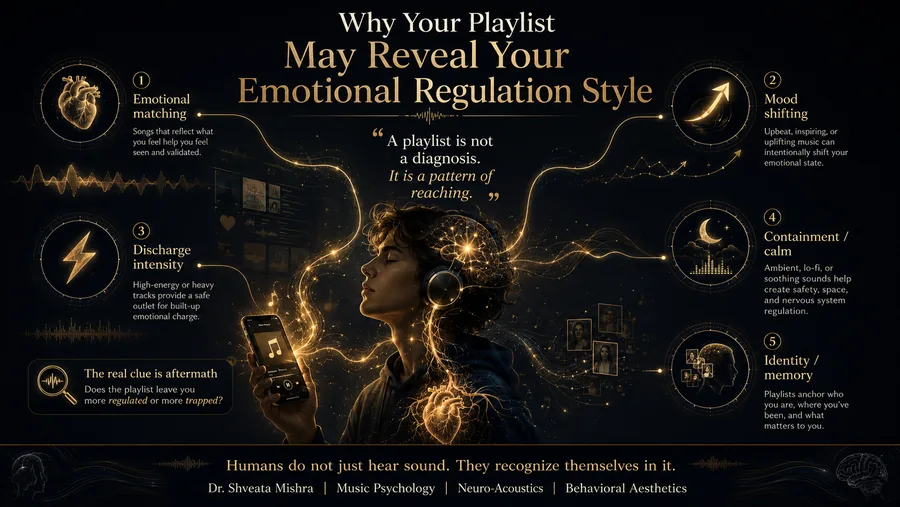
Not because music can diagnose you. It cannot. A playlist is not a clinical assessment, and a genre does not reveal your mental health. But the way you use music (when you reach for it, what you ask it to do, and how you feel afterward) can reveal something meaningful about your emotional style.
People do not just hear sound.
They recognize themselves in it.
A playlist is not a diagnosis. It is a pattern of reaching.
The quick read: A playlist reflects emotional use, not just taste. Most listeners move between five patterns, meeting a feeling, shifting it, discharging it, containing it, or remembering through it. The real signal is not the genre. It is the aftermath: does the music leave your emotional regulation steadier, or more stuck?
The Hidden Emotional Logic of a Playlist
Think about the names people give their playlists: “Focus,” “Late night,” “For when I need to cry,” “Soft mornings,” “Gym rage,” “Old me,” “Songs for the train,” “Calm nervous system.” Across New York, London, Toronto, Delhi, Mumbai, or anywhere else, people may use different languages and platforms, but the emotional logic is recognizable.
We do not only organize songs by artist or genre. We organize them by state.
One playlist helps us enter a feeling. Another helps us leave one. One holds memory. Another protects attention. One lets anger move through the body without becoming a conversation. Another keeps grief company without demanding that it improve.
This is why playlists can feel so private, even when the songs themselves are public. A song millions of people know can become, for one listener, the sound of a hospital corridor, a first job, a lost friendship, a country left behind, or a version of the self they are still trying to understand.
What Emotional Regulation Actually Means
Emotional regulation is the way we influence our emotional life: what we feel, when we feel it, how intensely we feel it, and how we respond.
Healthy emotional regulation does not mean forcing ourselves to be calm. It means flexibility: noticing a feeling, understanding enough of it, and choosing a response that does not harm us or others.
Music enters this process because it works on several levels at once. It can shift attention, change arousal through tempo and rhythm, activate memory, help name an emotion before language arrives, and make loneliness feel less absolute.
Music psychology research has described everyday listening as a set of emotional strategies: solace, diversion, discharge, revival, entertainment, strong sensation, and a kind of reflective mental work. In ordinary language, we use music to be held, distracted, energized, released, accompanied, or brought back to ourselves.
Neuroscience also suggests that music can engage networks involved in reward, emotion, prediction, memory, and bodily arousal. This is one reason a song can feel less like background sound and more like a change in the emotional room.
The responsible point is not “music heals everything.” It does not.
The more accurate point is this: music changes the conditions in which emotion is felt.
Keep reading
What Your Playlist May Reveal
The question is not simply, “What kind of music do you like?”
A better question is: “What emotional job is this playlist doing for you?”
1. The Playlist That Meets You Where You Are
This is the playlist you choose when you do not want to be talked out of your feeling.
Sad music when you are sad. Tender music when you feel raw. Slow songs after a long day. Lyrics that seem to understand what you have not said out loud.
As an emotional regulation strategy, this kind of listening offers emotional matching. Instead of forcing the nervous system into a different state, it says, “This is where we are. Let us begin here.” Many people do not need immediate positivity. They need recognition. It is part of why certain songs can make you feel deeply understood.
The risk appears when matching becomes trapping. If a playlist helps you feel your grief and then breathe again, it may be supportive. If it keeps you circling the same wound for hours and leaves you more hopeless, the emotional function has changed.
2. The Playlist That Moves You Somewhere Else
Some playlists are built for emotional shifting: the energizing songs before work, the upbeat track after a difficult call, the steady instrumental mix that helps you study, the Saturday morning playlist that turns chores into movement.
This style of listening redirects attention, alters energy, and creates momentum. Diversion is not always avoidance. Sometimes stepping out of a feeling is exactly what the mind needs.
The question is whether the shift supports you or silences you. Healthy shifting gives you enough distance to function. Avoidant shifting repeatedly uses sound to outrun something that still needs attention.
3. The Playlist That Lets You Discharge
Then there is the playlist for anger, frustration, defiance, and intensity.
For some listeners, intense music gives emotion a safe place to move. It can turn internal pressure into rhythm, breath, walking, lifting, dancing, or private release. But research also invites nuance. Using music mainly to discharge negative emotion can be linked, for some people, with anxiety, rumination, or prolonged distress.
The effect depends less on whether the music is intense and more on what happens after listening. As an act of emotional regulation, does it leave you clearer and steadier, or more activated and locked into the story?
4. The Playlist That Contains You
Some people do not use music to feel more. They use it to feel less flooded.
This is where predictable sound matters: lo-fi, ambient music, soft classical, devotional music, rain sounds, low-volume instrumental tracks, or familiar songs without surprise. For many listeners, this kind of playlist becomes a sensory boundary.
It tells the nervous system, “There is a stable pattern here.”
Music does not calm everyone in the same way. A song that soothes one person may irritate another, and a track you once loved can suddenly start to grate. A relaxing playlist before sleep may help one listener settle and make another more emotionally awake because of memory associations.
5. The Playlist That Remembers You
Some playlists are less about mood and more about identity.
They hold the songs from school, first love, migration, friendship, recovery, faith, grief, rebellion, family, or a younger self. Music-evoked autobiographical memory is powerful because songs are often tied to repetition, emotion, place, and life transitions.
This is why an old song can make you feel fifteen again before you can explain why, and why certain songs bring back memories you thought were long gone. Identity playlists remind us: I have been many people, and somehow I am still here.
The Important Question Is Aftermath
People often over-interpret music taste and under-interpret music use.
Someone who listens to sad songs is not necessarily depressed. Someone who listens to heavy music is not necessarily angry. Someone who listens to ambient music is not necessarily calm. A person who loves dance music may be grieving. A person who loves silence may be overstimulated, healthy, or simply tired of input.
Genre is not the deepest clue.
Function is.
Ask what the playlist does:
- Does it help you feel accompanied?
- Does it help you move from one state to another?
- Does it help you discharge intensity safely?
- Does it help you focus or reduce sensory load?
- Does it help you remember who you are?
- Does it leave you more regulated after twenty minutes, or more trapped?
Most people do more than one. That is healthy. Emotional regulation is not a single style. It is a repertoire.
How to Listen With More Self-Knowledge
You do not need to turn your music library into a therapy session. But you can become more aware of what your listening patterns are asking for.
The next time you choose a playlist, pause for five seconds and ask:
“What am I hoping this sound will help me do?”
Maybe the answer is simple: concentrate, sleep, exercise, cook, drive.
But sometimes the honest answer is deeper: I need to feel less alone. I need to stop thinking. I need to remember myself. I need to feel powerful. I need to cry without explaining. I need the room to feel safer.
That small moment of awareness can change the relationship. Instead of using music automatically, you begin practicing emotional regulation intentionally.
A Gentle Warning About Emotional Loops
Music can be a companion, but it can also become a hiding place.
If a playlist repeatedly leaves you more distressed, isolated, angry, hopeless, or less able to return to your life, it may be worth changing the pattern. That does not mean abandoning the music you love. It may mean shortening the listening window, adding a “landing” song at the end, or choosing a second playlist that helps the body come down.
This is not about making playlists morally correct.
It is about noticing whether the sound is helping you return to yourself.
Read next:
- Why Certain Songs Make You Feel Understood
- Why Songs Bring Back Memories You’d Long Forgotten
- Why Your Favorite Music Suddenly Feels Irritating
Frequently Asked Questions
Can my playlist reveal my emotional regulation style?
It can offer clues, but it cannot diagnose you. Your playlist may reveal your emotional regulation style: how you tend to use music to comfort yourself, shift mood, discharge intensity, focus attention, reduce sensory load, or reconnect with memory and identity.
Why do I listen to sad music when I am already sad?
Sad music can feel validating. It may help you feel understood, less alone, and more able to process emotion. The key is aftermath: if sad music helps you feel clearer or comforted, it may be supportive. If it keeps you stuck in rumination, you may need a different pattern.
Is angry or intense music bad for emotional regulation?
Not automatically. Intense music can help some people release energy safely. It becomes less helpful if it repeatedly increases aggression, resentment, anxiety, or emotional looping without helping you settle afterward.
What makes a playlist good for emotional regulation?
A playlist that supports emotional regulation supports flexibility. It helps you meet emotion, move through it, or return to daily life with more steadiness. It does not need to be cheerful. It needs to be useful without trapping you. ## What Your Playlist May Be Trying to Tell You Your playlist may not reveal who you are in a fixed way. It may reveal what you are practicing emotionally. How you soothe. How you protect attention. How you revisit memory. How you make sadness bearable. How you turn pressure into movement. How you keep yourself company when words are too demanding. This is why music feels so personal. It does not only enter the ear. It enters the biography. So the next time you find yourself choosing the same songs again, try not to judge the pattern too quickly. Listen for the need beneath the selection. Maybe you are not just choosing music. Maybe you are choosing a way back to yourself. People do not just hear sound. They recognize themselves in it.

About the author
Dr. Shveata Mishra
Begin with the ritual
Get the free 5-Minute Sound Ritual.
A research-informed listening practice designed to help your nervous system settle, sent to your inbox as a PDF. You will also receive new writing on sound, emotion, and identity whenever an article is published.