

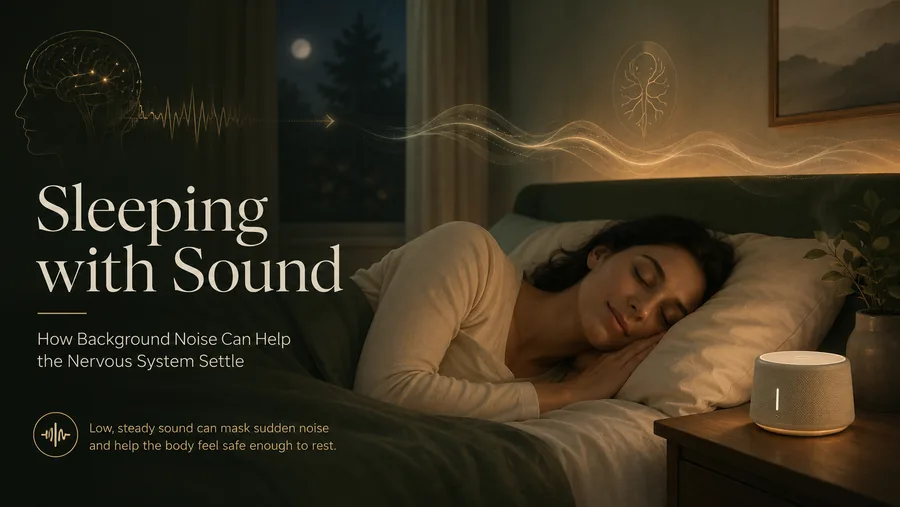
It is 1 a.m. The house has gone quiet, which is exactly the problem. A pipe ticks. A car door slams two streets over. The fridge shudders awake, and so do you. If silence has ever felt less like rest and more like a room holding its breath, you already understand why so many people end up sleeping with sound. A low, steady hum in the background can take the edge off a too-quiet room, and for a lot of us, that is the difference between drifting off and lying there cataloguing every creak.
I want to be careful here, because sound is not a sleeping pill and I am not going to pretend it is. But the question of why sleeping with sound sometimes helps the body let go is a genuinely interesting one, and the research has gotten more honest about it lately. Some of it is encouraging. Some of it is a useful warning. Let me walk you through both.
A quiet room is not always a calm room. Sometimes the silence is just a bigger screen for every small sound to play on.
The short version, if you’re skimming
- Sleeping with sound works mostly by masking, it fills the gap so a sudden noise no longer stands out against dead silence.
- A steady, low, predictable sound can read to the brain as “no threat here,” which supports the shift out of high alert.
- The evidence is mixed and personal: one review found positive results in far more pink-noise studies than white-noise ones, and a recent lab study found pink noise trimmed REM time.
- Volume and consistency matter more than the type of noise. Keep it low, keep it steady, keep the device away from your head.
- This is a comfort tool, not a treatment. If your sleep is genuinely broken, sound is a small lever, not the fix.
Quick gut check: which of these is true for you right now?
Tick the ones that fit. Hold on to your answers, we’ll come back to them.
- ☐ You sleep better in a hotel with the AC running than in your own silent bedroom.
- ☐ It is not the noise that wakes you, it is the sudden noise after a stretch of quiet.
- ☐ You have started needing a fan or an app to fall asleep, and silence now feels wrong.
- ☐ You turn something on for “background” and wake up four hours later with it still going.
Why sleeping with sound can quiet an alert brain
Here is the mechanism, in plain terms. Your auditory system never fully clocks out. Even in deep sleep, part of the brain keeps monitoring the room for anything that might matter, a holdover from a much older version of being human. The trouble with a silent room is not the silence itself. It is the contrast. When the baseline is near zero, any small sound, a creak, a cough, a notification, spikes hard against it. Sleep researchers sometimes call this the delta, the gap between the quiet floor and the sudden peak. The bigger that gap, the more likely the sound yanks you toward waking.
A constant background sound shrinks the gap. It raises the floor so the peaks no longer tower over it. This is auditory masking, and it is the least mystical and most reliable reason sleeping with sound helps. The creak still happens. It just stops being an event. For most people who swear by sleeping with sound, this is the whole story, and it is enough.
There is a second layer, and this is where I stay cautious with my language. A steady, low-pitched, unchanging sound carries very little information. Nothing in it is changing, nothing is approaching, nothing needs a decision. For a nervous system scanning for threat, “nothing is changing” is itself a kind of message. Researchers describe a consistent, non-threatening soundscape as something that can lower sympathetic arousal and support the parasympathetic shift that sleep onset requires. Notice the verbs. It can support. It does not flip a switch.
Try this: tonight, instead of reaching for total silence, set a low steady sound before you feel anxious about falling asleep, not after. You are raising the floor, not chasing sleep.
Keep reading
White, pink, and brown: does the color of noise matter?
You have probably seen sound machines offer “white,” “pink,” and “brown” noise as if they were flavors. They are not marketing inventions, they describe how energy is spread across frequencies. White noise plays every audible frequency at roughly equal intensity, which is why it can sound thin and hissy, like static. Pink noise weights the lower frequencies more heavily, so it lands softer and rounder, closer to steady rain or wind. Brown noise pushes even further down, into a deep rumble.
Does the color change anything? A little. A review in the Journal of Clinical Sleep Medicine found positive sleep outcomes in roughly 82% of pink-noise studies, compared with about 33% for white noise (the Sleep Foundation summarizes the pink-noise work well). That looks like a clear win for pink, and it might be. But read the fine print: many of the strongest pink-noise results came from controlled labs where the sound was synced to the sleeper’s own brain waves, which is nothing like pressing play on a track at home.
And the picture got more complicated recently. A University of Pennsylvania lab study of healthy adults found that broadband pink noise actually reduced time in REM sleep by close to 19 minutes a night. REM is the stage tied to mood and memory consolidation, so that is not a trivial cost, especially for children, who spend far more of the night in REM. I am not telling you to panic and unplug. I am telling you the honest answer to “which color is best” is “we are not sure, and more is not better.”
If this resonates, I went deeper into how steady sound steadies the body here: Sound and the Nervous System: 5 Audio Anchors for a Steadier Mind.
The catch: when sleeping with sound works against you
Sound can also be the thing keeping you up, and sleeping with sound has a few traps worth naming.
The first is volume. Louder is not safer. Experts generally point to a ceiling around 50 to 70 decibels, roughly the level of a normal conversation, and prolonged exposure above that can genuinely harm hearing. A machine pinned at high volume inches from your pillow is doing your ears no favors, and infant ears even less. Lower than you think is almost always the right setting.
The second is unpredictability. The same alert system that masking soothes gets provoked by sound that changes, lyrics, a podcast voice, a playlist that lurches from soft to loud. Even if you sleep through it, that kind of input can pull you into lighter stages and shave off deep and REM sleep without ever fully waking you. Steady and boring beats interesting every single time.
The third is dependence, and this is the one people ask me about most. Yes, you can train yourself to need it. Lean on a fan or an app every night and silence can start to feel unbearable. The reassuring part: this conditioning is generally reversible and not harmful in itself. But if the idea of a quiet night already makes you uneasy, that is worth noticing rather than feeding.
The goal is a sound you stop hearing, not one you start needing.
What to actually do about it
- Mask, don’t blast. Set the volume low enough that the sound blurs into the background within a minute. If you are still aware of it, it is too loud.
- Pick steady over interesting. A fan, rain, or pink noise beats anything with words, melody, or dynamic swings. Boring is the feature.
- Move the source away. Put the speaker or machine across the room, not on the nightstand by your head, and never right beside a crib.
- Test silence on your good nights. Now and then, sleep without it. If you drop off fine, you are using sound as a tool, not a crutch.
If you like the way I think through this, I send a short, research-informed note now and then, you can sign up for it at the bottom of this page.
The deeper point: sound as a signal, not a sedative
Come back to those boxes you ticked. Most of them are not really about noise. They are about safety, the felt sense that the room is steady and nothing is about to demand your attention. That is the lens I keep returning to in my work: sound is not just something we hear, it is information the body reads, including information about whether it is okay to let go. Seen that way, sleeping with sound is less a trick for the ears and more a message to a watchful body.
Sleeping with sound, at its best, is not about drowning out the world. It is about giving an over-vigilant nervous system one less reason to stay on duty. A fan does not cure anything. What it offers is a steadier signal, and sometimes a steadier signal is enough to let the body do what it already knows how to do.
So I will leave you with the question I find most revealing. On the nights you sleep best, is the room actually silent, or is something humming quietly in the background that you have stopped noticing?
Keep reading: the sound and the nervous system series
- Sound and the Nervous System: 5 Audio Anchors for a Steadier Mind
- Background Music and Focus: Your Emotional Wallpaper
- Why We Trust Calm People: Behavioral Dissonance and the Sound of Composure
- The Invisible Link Between Sound, Mood, and Human Behavior
Frequently Asked Questions
Does white noise actually help you sleep?
Sometimes, mostly by masking sudden sounds so they do not jolt you awake. The evidence is mixed: reviews show positive results in a minority of white-noise studies, so it helps some people and not others. It is reasonable to try, not something to count on.
Is sleeping with sound every night bad for you?
For most people a low, steady, consistent sound is fine night after night, as long as the volume stays modest and the device is not right against your head. The main risks are keeping it too loud over time and growing dependent on it.
What is the safe volume for a sound machine?
Keep it low, generally in the range of about 50 to 70 decibels, similar to a normal conversation. Prolonged exposure above roughly 70 decibels can damage hearing, so quieter is safer, and especially so for babies.
Is pink noise better than white noise for sleep?
Pink noise has performed better in more studies and sounds softer because it emphasizes lower frequencies, but a recent lab study found it reduced REM sleep. The honest answer is that the best type varies by person, and louder or “more” is not better.
Can you become dependent on background noise to fall asleep?
Yes, you can condition yourself to need it, and silence can start to feel uncomfortable. The good news is that this is usually reversible and not harmful in itself, so an occasional quiet night is a healthy thing to test.

About the author
Dr. Shveata Mishra
Begin with the ritual
Get the free 5-Minute Sound Ritual.
A research-informed listening practice designed to help your nervous system settle, sent to your inbox as a PDF. You will also receive new writing on sound, emotion, and identity whenever an article is published.