

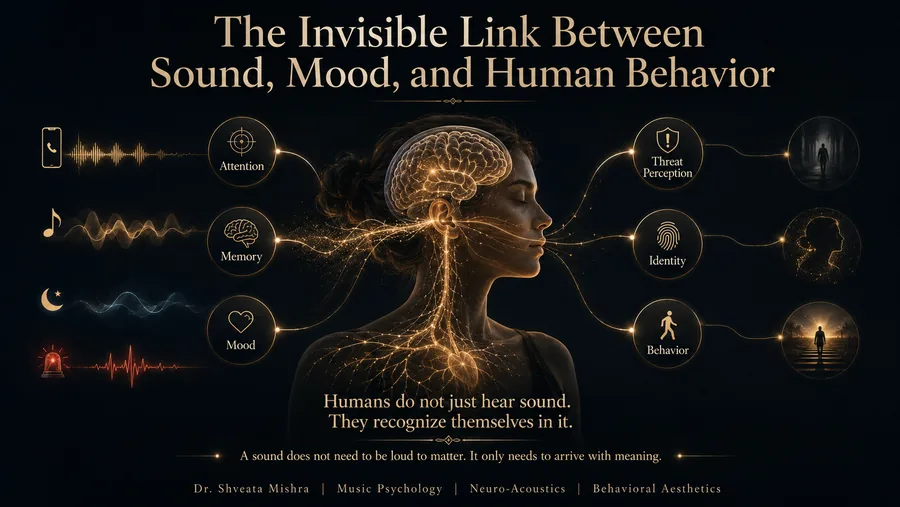
A ringtone can tighten the body before the mind has time to identify who is calling.
A familiar song can pull a person back into a version of themselves they thought they had outgrown.
The low hum of an office can make attention feel expensive. A lullaby can soften a room without asking anyone to explain why. A sudden siren can interrupt a sentence, a meal, a memory, even a sense of safety.
Sound is often treated as background: something around us, something we manage, tolerate, enjoy, or try to ignore.
But sound rarely stays in the background of the human system. It enters through the ear and meets attention, memory, mood, threat perception, culture, identity, and the body.
Humans do not just hear sound.
They recognize themselves in it.
That is the invisible link between sound, mood, and human behavior. A sound does not need to be loud to matter. It only needs to arrive with meaning.
This is the territory of neuro-acoustics: the study of how sound meets the brain, the body, and behavior, and how sound and mood become difficult to separate. Understanding how sound affects mood is less about volume and more about meaning.
Sound becomes powerful when it is not only heard, but interpreted.
Sound Is Never Just Sound
One of the most ordinary things about being human is that we react before we explain.
You hear a certain voice tone and know someone is upset. You hear your name spoken across a room and your attention turns before you decide to listen. You hear a song from school, a festival, a breakup, a place of worship, a car ride, or a childhood kitchen, and suddenly the past is not past in the same way.
This is not sentimentality. It is human perception.
Sound carries information about the world, but also about our relationship to the world. Is this place safe? Is someone angry? Should I move faster? Can I rest? Do I belong?
The same sound can feel different depending on who hears it, where it happens, and what state the person is in. A child laughing may feel joyful in one moment and piercing when someone is exhausted. Silence may feel peaceful to one person and unbearable to another. Music in a cafe may help one person focus and make another person leave.
Sound is not received by an abstract brain. It is received by a life.
Why The Brain Hears With The Body
The auditory system is built for speed and significance. Sound gives the nervous system fast information about what may be outside the visual field.
When sound enters the ear, it is translated into neural signals and processed through auditory pathways. But the experience of sound is not limited to the auditory cortex. The brain also links sound with attention, memory, emotion, movement, and bodily readiness.
This is why a song can create chills, a harsh alarm can raise tension, and rhythm can make the body want to walk, tap, sway, or breathe differently. Often the body reacts to music before the mind understands it.
None of this means sound has magical control over mood or behavior. A responsible neuro-acoustic view is more precise: sound can influence the conditions under which mood and behavior unfold.
It can cue memory, guide attention, affect arousal, support synchronization between people, and make an environment feel welcoming, hurried, clinical, intimate, unsafe, sacred, commercial, playful, or overwhelming.
Sound does not bypass the person. It meets the person.
That meeting is where the psychology lives.
Mood Changes What We Hear
Most people know that sound can affect mood. Fewer people notice that mood also affects sound.
When someone is well rested, a notification may simply be a notification. When they are anxious, it may feel like a demand. When someone is grieving, a song may feel almost too accurate. When they are depleted, ordinary background noise can become another layer of effort.
This is one reason sound sensitivity often increases during stress, burnout, poor sleep, or emotional overload, and one reason a favorite song can suddenly start to feel irritating. The sound has not always changed. The system receiving it has.
Unwanted noise is not just an irritation. Research on environmental noise has linked chronic noise exposure with sleep disruption, annoyance, stress-related responses, and effects on learning and cardiovascular health. The nervous system keeps responding to sound even when we tell ourselves to ignore it.
Anyone who has tried to concentrate near construction work, sleep beside traffic, recover in a noisy hospital ward, or think clearly under constant alerts understands this in the body.
Sound asks for attention.
Sometimes that request is welcome. Sometimes it is costly.
Keep reading
Why Music Feels So Personal
Music is one of the clearest places where sound becomes self-recognition.
A song can feel personal even when it was written by a stranger, in another city, in another language, for another life. Music does not communicate meaning through words alone. It works through rhythm, expectation, tension, release, repetition, timbre, memory, and emotional contour.
The brain is constantly making predictions. In music, it anticipates where a melody may go, when a beat may land, and when tension may resolve. Studies of intensely pleasurable music listening have shown involvement of reward systems, including dopamine-related activity during anticipation and peak emotional moments.
Music feels personal because it can organize feeling without forcing it into explanation. It gives shape to states often too complex for ordinary language: longing, relief, defiance, tenderness, homesickness, devotion, grief, desire, calm, courage.
Sometimes the right song feels less like entertainment and more like an accurate mirror. This is part of why certain songs make you feel understood, especially when they meet an emotional memory you have not yet put into words.
Music can become a place where emotion finally feels legible.
How Sound Quietly Shapes Behavior
Sound can change behavior in subtle ways because behavior is not only a matter of decision. It is also a matter of timing, attention, energy, and emotional state.
Rhythm is a powerful example. Humans naturally tend to coordinate movement with pulse and tempo. This is visible in walking to music, clapping together, chanting, dancing, exercising, or using rhythmic cues in rehabilitation settings. Rhythm can give the body an external structure when internal motivation feels scattered.
Environmental sound also shapes pace. A warm acoustic environment may invite people to linger. Fast, loud, or unpredictable sound may make people move quickly, speak louder, or become fatigued sooner.
This does not mean background music is a simple lever for controlling people. Human behavior is more complex than that. Culture, preference, association, volume, timing, context, personality, and current mood all matter.
A song that energizes one person may irritate another. Silence that restores one person may unsettle another. The aim of neuro-acoustics is not one universal prescription. It is to understand the relationship between sound and human behavior with enough humility to listen carefully.
Real Life Is Full Of Neuro-Acoustics
Neuro-acoustics is not only about laboratories or specialized equipment. It is already present in ordinary life: the mother who lowers her voice when her child is overwhelmed, the professional who chooses instrumental music to protect focus, the person who cannot sleep because the city keeps entering the body through the window.
It is in the way a hospital monitor can make a family member feel alert, or the way a temple bell, church choir, azaan, mantra, or drum circle can gather emotion beyond the individual self.
It is in the driver who turns the music down when searching for an address, the couple who knows the meaning of one shared song, and the workplace where acoustic fatigue is mistaken for poor focus.
Sound is not decoration. It is part of the emotional architecture of a place.
The Emotional Shift: Ask What The Sound Is Asking Of You
The deeper shift is this: instead of asking only "What am I hearing?" we can begin asking "What is this sound asking my nervous system to do?"
Some sounds ask us to prepare.
Some ask us to hurry.
Some ask us to remember.
Some ask us to belong.
Some ask us to endure.
Some ask us to soften.
This question can change how we understand our own reactions. If a sound irritates you, it does not automatically mean you are difficult. You may be overloaded. If silence feels uncomfortable, your mind may have been using sound to avoid what becomes louder inside. If one song makes you cry, it may be recognition arriving through the body.
Emotional intelligence begins when we stop judging every reaction as an overreaction and start listening for the context inside it.
Of course, not every sound response needs deep analysis. Sometimes the volume is too high, the alert tone is badly designed, the room is acoustically exhausting, or the song is not your taste.
But often, sound reveals the state of a person before words do.
A More Human Way To Listen
A neuro-acoustic way of listening begins with observation, not control, and it is where neuro-acoustics becomes practical rather than abstract. Notice what helps you arrive in yourself, and what makes you leave yourself.
Notice which sounds support focus, rest, movement, grief, intimacy, prayer, study, creativity, or recovery. Notice which sounds make your jaw tighten, your thoughts speed up, or your patience disappear.
Then make small, humane adjustments where possible: reduce unnecessary notification sounds, use predictable background sound when silence feels too exposed, protect quiet during sleep and deep work, choose music according to the state you need, and respect that other people’s sound needs may differ from yours.
These are not luxury adjustments. For many people, they are support for the nervous system.
In a world that is visually overloaded and constantly alerting us, sound hygiene is becoming part of emotional hygiene.
Frequently Asked Questions
Can sound really affect mood?
Yes. Sound can influence mood by shaping attention, arousal, memory, expectation, and bodily state. The effect depends on context, meaning, volume, timing, culture, and current emotional condition.
How does sound affect mood and behavior?
Sound can affect mood and behavior by shaping attention, arousal, memory, and bodily readiness, rather than by controlling anyone directly. A neuro-acoustic view looks at how sound and the nervous system interact in context, which is why the same sound can calm one person and unsettle another.
Why do certain sounds irritate me more when I am stressed?
Stress can reduce the capacity to filter incoming stimulation. A sound that feels neutral on a calm day may feel intrusive when the nervous system is already carrying fatigue, anxiety, sensory load, or sleep debt.
Is neuro-acoustics the same as sound healing?
Not exactly. Neuro-acoustics studies how sound interacts with the brain, body, perception, mood, and behavior. Responsible work avoids exaggerated claims and pays attention to evidence, context, and individual differences.
Why do some songs feel like they understand me?
Songs can feel personal because music connects emotion, memory, identity, prediction, and bodily response. A song may match the emotional shape of an experience before you have found words for it.
The Soundtrack Is Not Separate From The Life
We live inside sound more than we notice.
It surrounds work, relationships, rituals, grief, travel, celebrations, sleep, attention, and memory. It can soothe, sharpen, overwhelm, organize, disturb, connect, and remind.
The invisible link between sound, mood, and human behavior is not a trick of the brain. It is the everyday reality that neuro-acoustics takes seriously: how deeply human listening really is.
To listen is not only to receive vibration.
It is to meet the world through the nervous system.
And when the right sound reaches us at the right time, we do not simply hear it.
We feel recognized.

About the author
Dr. Shveata Mishra
Begin with the ritual
Get the free 5-Minute Sound Ritual.
A research-informed listening practice designed to help your nervous system settle, sent to your inbox as a PDF. You will also receive new writing on sound, emotion, and identity whenever an article is published.