

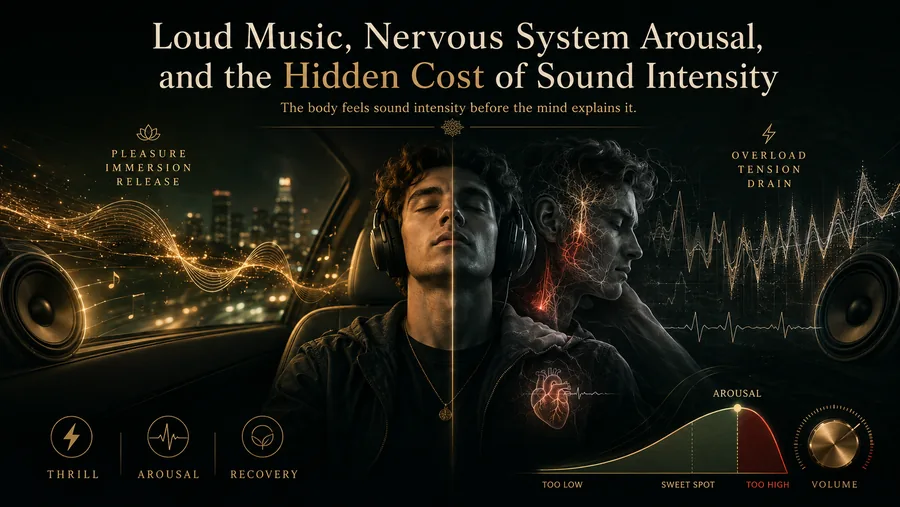
You turn it up. The bass fills the car, the chorus hits, and for a few seconds you feel bigger than your day. Then you get home and notice your jaw is tight, your shoulders are up near your ears, and you are oddly keyed up for someone who just listened to music they love. That gap between the pleasure and the aftermath is the whole story here. Loud music, nervous system arousal, and the slow tax that volume charges your body are more connected than most playlists let on.
I want to say something gently at the top. This is not an article telling you to turn it down and live quietly. I love volume. It is about understanding what high intensity sound asks of your body, so the choice stays yours.
Your ears hand the volume to your nervous system before your mind has decided whether you like it.
The short version, if you’re skimming
- Loud music, nervous system arousal, and stress chemistry are linked: your body shifts before you consciously react.
- There is a sweet spot. The same song can feel thrilling at one volume and threatening at another.
- The hidden cost is rarely one loud night. It is repeated intensity your body never fully recovers from.
- Hearing damage starts around 85 decibels with long exposure, and the nervous system load starts well before that.
- You can keep the music you love and still spend the volume more wisely.
Quick gut check: which of these is true for you right now?
Tick the ones that fit. Hold on to your answers, we’ll come back to them.
- ☐ I reach for loud music to feel something, then feel drained afterward.
- ☐ Crowded, loud places leave me wired and irritable, not relaxed.
- ☐ My ears ring a little after a workout, a club, or a long drive.
- ☐ I turn music up to drown out a busy mind, and it sort of works, until it doesn’t.
Loud Music, Nervous System Arousal, and What Actually Happens
Here is the part most volume conversations skip. Sound does not wait for your opinion. The moment a loud track enters your ear, the signal travels from the cochlea up through brainstem pathways that sit right next to the circuits controlling alertness and the autonomic nervous system. Some of that input reaches the amygdala, the brain’s threat and salience detector, on a fast route that bypasses conscious thought.
That is why loud music, nervous system arousal, and that sudden alert feeling arrive together. Your sympathetic nervous system, the accelerator, nudges heart rate up, sharpens attention, and releases stress chemistry. Your parasympathetic nervous system, the brake, quietly steps back. None of this is a malfunction. It is a body doing exactly what evolution built it to do: treat a sudden surge of intensity as information worth acting on.
Try this: next time a loud song ends, put two fingers on your wrist before you move. Notice the pace. That is your nervous system narrating what your ears just did.
Researchers call this baseline shift autonomic arousal, and it is measurable in heart rate, blood pressure, and skin response. Gentle music can lower it. High intensity sound tends to raise it. The interesting twist is that we often want that raised state. Arousal is not the enemy. The question is how much, how often, and whether your body gets to come back down.
The sweet spot: why the same song can thrill or threaten
In the 1870s, Wilhelm Wundt sketched a simple curve that still holds up. Decades later the researcher Daniel Berlyne turned it into a rule for pleasure: our enjoyment of a stimulus follows an inverted U. Too little arousal and we are bored. Too much and we tip into discomfort and anxiety. The peak of pleasure sits in the middle.
Volume rides that curve. A song at a moderate level can land right at the top of the U, all reward and goosebumps. Push the same song louder and you can slide down the far side, where the body reads thrill as threat. This is why a track you adore can feel glorious in the car and unbearable in a packed bar. The music did not change. Your position on the arousal curve did.
This also explains a strange, common experience: turning music up to escape a racing mind. For a moment the volume crowds out the noise in your head. But if you are already high on the arousal curve, more intensity does not soothe you. It stacks. I wrote about a close cousin of this in Why Your Favorite Music Suddenly Feels Irritating, where a beloved song starts to grate. Loud music, nervous system arousal, and an already full tank are a recipe for exactly that flip.
Keep reading
The hidden cost of sound intensity
The obvious cost is your hearing. The numbers are worth knowing plainly. Sound at or below 70 decibels is generally considered safe. Damage risk climbs around 85 decibels with sustained exposure, and the safe listening time drops fast as volume rises: roughly eight hours at 85 decibels, but only about two hours near 91. Many headphones at full volume push well past that. The hair cells that translate sound into signal do not grow back, which is how loud habits become tinnitus and permanent loss.
But there is a quieter cost, and it is the one I find more interesting. Each surge of arousal is fine on its own. The body is built to spike and recover. The trouble is repetition without recovery. When loud, activating sound is a constant, your system spends more of its day in accelerator mode and less in the brake. Researchers describe this accumulated wear as allostatic load, the cost of a body adapting to chronic demand. You may feel it as being wired but tired, slow to wind down at night, or strangely fragile after days that were not even hard.
The hidden cost is rarely the loud night you remember. It is the recovery you never quite get.
That is the through line of loud music, nervous system arousal, and intensity over time. Not one evening of glorious volume, but a baseline that quietly creeps up and rarely resets.
When loud is exactly the point
Let me be honest about the other side, because the brand of fear that says all volume is harmful is just bad science. Sometimes high intensity is the medicine. A concert where ten thousand people sing the same line, a workout that needs the bass to push you, a long drive where loud music is the only thing keeping a hard feeling moving through you instead of sitting on your chest. That shared, embodied arousal is part of how music does its oldest job. Loud music, nervous system arousal, and a crowd singing as one is not a problem to solve.
The difference is intention and recovery, not decibels alone. A peak you choose, feel fully, and then come down from is a gift to your nervous system. A peak you live in by default, with no descent, is the part that costs you. If you want the body-first version of why this hits before you think, I went deeper in Why Your Body Reacts to Music Before Your Mind Understands It.
What to actually do about it
- Find your 60 percent. As a rough guide, keeping headphones under about 60 percent of max volume keeps most listening in safer territory. Your ears stop being the limiting factor.
- Schedule the descent. After a loud event, give your system a deliberate quiet runway: a few minutes of low sound or silence before you ask it to do anything else.
- Notice the reach for volume. When you turn music up, ask once whether you want energy or escape. Escape usually wants quiet, not more intensity.
- Protect the loud you love. Earplugs at concerts are not a buzzkill. They let you keep going to loud shows for decades instead of years.
- Watch the ring. Ringing or muffled ears after listening is your body’s receipt. Treat it as data, not background.
If pieces like this help you listen to your own body a little better, the subscribe form at the bottom of the page sends the next one straight to you.
What your volume is really telling you
Here is the reframe I want to leave you with. The volume you reach for is rarely just about the music. It is a dial you turn on your own arousal, a way of asking your body to feel more or feel less. Loud music, nervous system arousal, and the cost of intensity are not a warning to be quiet. They are an invitation to listen on purpose: to notice what state you are in before you turn it up, and to give your body the descent it needs after.
So I’ll ask you the question I keep asking myself. When you reach for the volume, what are you actually reaching for?
Keep reading: the sound and the nervous system series
- Sound and the Nervous System: 5 Audio Anchors for a Steadier Day
- Why Your Body Reacts to Music Before Your Mind Understands It
- Why Your Favorite Music Suddenly Feels Irritating
- Music Psychology in Daily Life: Sound, Stress, and Focus
Frequently Asked Questions
Does loud music really affect the nervous system, or is that just a feeling?
It is measurable, not just a feeling. The loud music, nervous system arousal, link shows up as changes in heart rate, blood pressure, and stress chemistry, often before you consciously react.
How loud is too loud for everyday listening?
Sound at or below 70 decibels is generally considered safe. Risk to hearing rises around 85 decibels with extended exposure, and safe listening time shrinks quickly as volume climbs higher.
Why do I turn up music to calm down if it raises arousal?
Loud music can crowd out a busy mind for a moment, which feels like relief. But if you are already highly aroused, more intensity tends to stack rather than soothe, which is why the calm often does not last.
Is it bad to go to loud concerts?
Not at all. Chosen, time-limited intensity is part of how music works on us. The cost comes from constant loudness with no recovery, so enjoy the peak, wear earplugs, and give your system a quiet descent afterward.
What is the difference between sound that energizes and sound that overwhelms?
It often comes down to where you sit on the arousal curve. Moderate intensity tends to feel pleasurable, while too much pushes you past the peak into something the body reads as threat, even when you like the song.
Can loud music cause anxiety?
The loud music, nervous system arousal, response can trigger the body’s alert state and contribute to feeling anxious or wired, especially when you are already stretched. This is educational information, not medical advice, so see a professional for persistent anxiety.

About the author
Dr. Shveata Mishra
Begin with the ritual
Get the free 5-Minute Sound Ritual.
A research-informed listening practice designed to help your nervous system settle, sent to your inbox as a PDF. You will also receive new writing on sound, emotion, and identity whenever an article is published.