

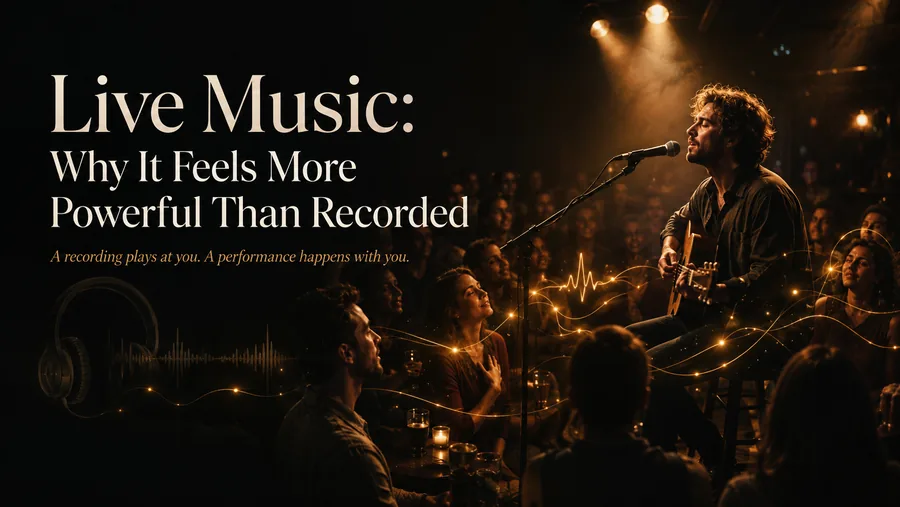
You have the song. You have owned it for years. You know every breath the singer takes before the second verse. Then you hear it as live music, in a room that is badly lit and slightly too loud, with a stranger’s shoulder against yours, and something happens that the recording has never once managed to do to you.
That gap bothers people. The recording is cleaner. It is better mixed, better balanced, and free of the man behind you talking through the quiet part. On every measurable quality of sound, it wins. And it still loses.
Live music is not simply a higher-fidelity version of a recording. It is a different psychological event.
A recording plays at you. A performance happens with you, and your brain can tell the difference.
The short version, if you’re skimming
- Live music produces stronger and more consistent activity in the brain’s emotional circuitry than the same music recorded.
- Part of the reason is adaptation. A performer responds to a room in real time. A file cannot.
- Your brainwaves track a live performance more closely, and the size of that tracking predicts how much pleasure you report.
- Audiences physically synchronise with each other. Heart rates converge, and the effect grows with emotional intensity and physical closeness.
- The unpredictability that makes live music risky is not a flaw in the experience. It is a large part of the reward.
Quick gut check: which of these is true for you?
Tick the ones that fit. Hold on to them, we will come back.
- ☐ You have cried at a concert over a song that has never made you cry at home.
- ☐ You remember a live version more vividly than the studio one you have heard a hundred times.
- ☐ You have been moved by a performance you would call technically imperfect.
- ☐ You went alone and still felt part of something.
- ☐ You have tried to describe a gig afterwards and found the words came out flat.
—
What live music does that a recording cannot
Start with the obvious thing that is easy to overlook. A recording is finished. Whatever it is going to do, it decided years ago, and it will do exactly that in a hospital waiting room and at a funeral and in your kitchen at 2am. It cannot read the situation.
A performer can. That is not sentiment, it is the design of the event.
In 2024, Wiebke Trost, Sascha Frühholz and colleagues published a study in PNAS that isolated this rather cleverly. A pianist performed while receiving real-time neurofeedback from the listener’s amygdala, adjusting the playing to what the listener’s brain was actually doing. Compared with recorded versions of the same music, the live performance produced higher and more consistent amygdala activity, along with more information exchange across the wider affective network.
Read that carefully, because it is more specific than the headlines suggested. The finding is not merely that live sounds nicer. It is that a loop existed. The music was responding to the listener while the listener was responding to the music.
Try this: at the next gig you attend, watch the performer’s eyes rather than their hands for one song. You will see them adjusting to the room in real time.
—
Your brain locks onto a live performance more tightly
There is a second layer, and it sits below emotion.
Your neural activity naturally tracks the rhythmic structure of what you are hearing, a phenomenon usually called entrainment or phase-locking. It is the reason a beat can feel physically compelling rather than merely audible.
Recent work by Asthagiri and Loui took this into a concert hall, comparing live solo violin against recordings of the same excerpts. The live condition produced stronger tracking of the music at rhythm-relevant frequencies, and the size of each listener’s difference predicted how much pleasure and engagement they reported. The people whose brains locked on hardest were the people who enjoyed it most.
I want to be fair about the limits here. That study used twenty-one trained musicians listening with their eyes closed, in a one-to-one setting, and it has not yet completed peer review. It is a strong signal, not a settled fact. Still, it points somewhere sensible: liveness may change how deeply the auditory system engages, not only how the evening feels afterwards.
If you have ever felt a live song in your ribs before you had an opinion about it, that is this. I went further into that gap here: Why Your Body Reacts to Music Before Your Mind Understands It.
—
Keep reading
The room is part of the instrument
Now add the other people, because this is where live music becomes something a pair of very good headphones can never reproduce.
Audiences do not just sit near each other. They synchronise. Research measuring audiences during real performances has found that cardiac synchrony emerges spontaneously between people sharing a performance, and that this convergence tracks how similarly they end up evaluating what they heard. Related work using EEG across audience members has found that synchrony between brains rises with the intensity of the emotion and with physical closeness.
Sociologists have a much older word for this. Durkheim called it collective effervescence: the charge that builds when a group is caught up in the same thing at the same time. Recent research on live music events links exactly this experience to higher reported happiness and meaning, persisting for days afterwards.
This is what people are reaching for when they say a gig “did something” to them and then fail to explain what. They are not describing sound quality. They are describing having been part of a temporary body of people who all wanted the same three minutes to keep going.
You did not go to hear the song. You went to be someone who was there when it was played.
—
Why the unpredictability is the point
Here is the part that gets treated as a drawback.
Live music can go wrong. The singer’s voice can crack. The band can take the bridge somewhere strange. The sound can be muddy in the second song and only settle by the fourth. Every one of these is a defect if you are grading a recording, and none of them is a defect at a performance.
Musical pleasure is closely tied to prediction. Your auditory system is constantly guessing what comes next, and much of the reward in music comes from the interplay between what you expected and what actually arrived. A recording you know well has almost no uncertainty left in it. You have already resolved every guess.
Live music restores the uncertainty. You genuinely do not know whether this will be the night the ending is held four bars longer. That open question keeps attention leaning forward, and attention leaning forward is most of what we mean by being moved.
The risk is not the price you pay for live music. The risk is a good part of the product.
—
What recordings still do better
I would be misrepresenting this if I let it become an argument that live is simply superior.
Recordings offer repetition, and repetition is how songs become part of a person. You cannot play a concert four hundred times on the walk to work through the worst winter of your life. Recordings offer control, privacy, and the ability to return to an exact emotional coordinate on demand. They are also, for many people, more accessible: cheaper, quieter, and possible on a bad day.
Those are not lesser experiences. They are different ones. Recorded music is where a song becomes yours. Live music is where you find out it also belonged to a room full of other people, and somehow still stayed yours.
—
What to actually do about it
- Go to smaller rooms than you think you should. Synchrony effects are associated with proximity and emotional intensity, both of which fall away at the back of an arena.
- Do not spend the show through a screen. Recording it converts a shared event into a private artefact you will rarely rewatch.
- See music you do not already know by heart. Unfamiliar material leaves the prediction system with actual work to do.
- Notice the imperfections instead of forgiving them. The cracked note is evidence a person is in the room taking a risk on your behalf.
- Go with people, or go alone and let the room be the company. Both work. Isolation inside a crowd is the one that does not.
If this is the kind of thinking you enjoy, my newsletter goes out from the subscribe form at the bottom of this page.
—
The real reframe
We talk about live music as though the value were in hearing the songs performed. It is not, or not mainly. You could hear them more clearly at home.
What live music offers is witness. Something happens once, it cannot be repeated, and you and several hundred strangers are the only people who will ever have been in that particular room while it did. Recorded music lets you recognise yourself privately. Live music lets you do it out loud, next to people doing the same thing, which is a far rarer permission than we usually admit.
People do not just hear sound. They recognise themselves in it, and occasionally they get to do that together.
What is the one performance you would go back to if you could, and what was actually happening in the room that night? Tell me in the comments, I read them.
Keep reading: the sound and emotion series
- Why Your Body Reacts to Music Before Your Mind Understands It
- Why Certain Songs Make You Feel Understood
- The Unseen Relationship Between Music and Self-Identity
- How Sound Shapes Emotional Safety Before We Realize It
—
Frequently Asked Questions
Why does live music feel more powerful than recorded music?
Several things stack. A performer adapts to the room in real time, your neural activity tracks a live performance more closely, the outcome is genuinely uncertain, and you are synchronising physically with an audience. None of that is available from a file.
Is there real evidence that live music affects the brain differently?
Yes. A 2024 PNAS study found stronger and more consistent amygdala activity for live piano performance than for recordings, with broader communication across emotional brain networks.
Why do I cry at concerts but not at home?
Emotional intensity is amplified by being among others feeling the same thing, and audience research shows physiological synchrony rising with emotional intensity and closeness. Add uncertainty and a one-time event, and the threshold for tears drops considerably.
Does live music have lasting benefits?
Research on collective effervescence at live music events has linked the experience to higher reported happiness and sense of meaning for days afterwards. It is an association from self-report studies, not a treatment, and it is not a substitute for care.
Is recorded music worse than live music?
No, it is different. Recordings give repetition, privacy, control, and accessibility, which is how songs become woven into a personal history. Live music gives presence and shared witness.
Why does a live version I have heard on video not feel the same?
A video removes the two ingredients that matter most: the performer cannot respond to you, and you are not synchronising with anyone. What remains is a recording of an event rather than the event.

About the author
Dr. Shveata Mishra
Begin with the ritual
Get the free 5-Minute Sound Ritual.
A research-informed listening practice designed to help your nervous system settle, sent to your inbox as a PDF. You will also receive new writing on sound, emotion, and identity whenever an article is published.