

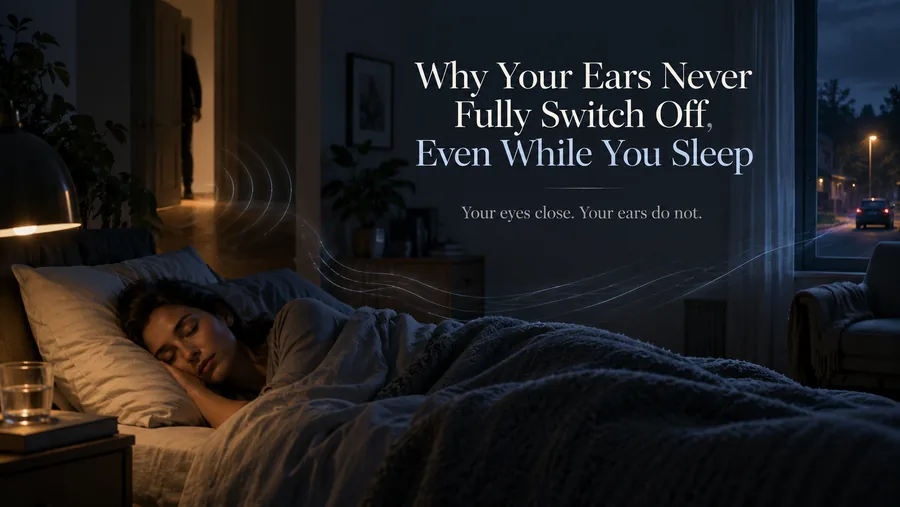
Three in the morning. A car door shuts somewhere down the street and you sleep straight through it. Twenty minutes later a floorboard moves inside the house and you are upright before you have decided anything. Same volume, roughly. Completely different outcome.
That is not luck, and it is not light sleeping. It is a filter doing its job. Hearing while you sleep is not switched off and then switched back on in the morning. It runs all night, quietly sorting what matters from what does not, and the reason you woke for one sound and not the other is that something in you already ran the sound through a triage system before you had any say in it.
Your eyes close. Your ears do not have that option.
The short version, if you’re skimming
- Vision has lids. Hearing has none, so the auditory system stays online all night and the brain filters instead of shutting the door.
- Recordings from the human brain show the auditory cortex still responds strongly to sound during sleep. What drops away is the feedback loop that turns hearing into awareness.
- The sleeping brain sorts sound by meaning, not only by volume. Your own name and unfamiliar voices get a bigger response than neutral sounds.
- K-complexes and sleep spindles are the gate. One suppresses arousal for sounds judged safe, the other dampens incoming sensory traffic.
- Understanding hearing while you sleep changes what you do about a noisy bedroom, because the goal is predictability rather than silence.
Quick gut check: which of these is true for you right now?
Tick whatever fits. We will come back to these.
- ☐ I sleep through traffic but wake at a whisper of my name.
- ☐ A partner’s alarm does nothing to me. My own alarm does.
- ☐ New places wake me more than my own bedroom, even when they are quieter.
- ☐ I have woken with a jolt and no idea what caused it.
- ☐ Background sound helps me sleep, and sudden silence sometimes does not.
Hearing while you sleep is a design decision, not an oversight
Every other major sense has a way out. You close your eyes. You stop moving, so touch quietens. Smell dulls. Hearing has no lid, no shutter, no off position, and evolution never built one.
That is worth sitting with. For most of human history, sleep was the most defenceless stretch of the day, and the only sense that could reach across a dark room was hearing. So instead of shutting the ears, the brain kept them running and moved the intelligence downstream. It built a night shift: keep listening, but raise the bar for what counts as worth waking for.
Hearing while you sleep, in other words, is not a bug in an otherwise offline brain. It is the sentinel.
Try this tonight: notice the last sound you register before sleep. Most people find it is a sound they have decided is safe.
The ear still reports. The brain stops replying.
This is the part that surprised me most when I first read it properly.
Using recordings taken directly from inside the human brain, researchers compared responses to sound in wakefulness and in sleep. The auditory cortex kept responding robustly during sleep: neurons fired, high-frequency activity rose, and the basic acoustic detail arrived much as it did while awake. What changed was later and higher up. The signature of feedback signalling, where higher regions send information back down and hold the sound in mind, was substantially reduced.
Translate that and it is almost poetic. The message still gets delivered. Nobody is at the desk to reply to it.
That single distinction explains a lot of ordinary night experience. Sound reaches you all night, which is why hearing while you sleep can still influence dreams, heart rate and restlessness. But because the reply loop is dampened, almost none of it becomes a memory or a decision. You are receiving without conversing.
Keep reading
The night shift sorts by meaning, not just volume
If the filter were only about loudness, a passing truck would beat a whisper every time. It does not, and the research explains why.
The sleeping brain treats some sounds as more significant than others. Your own name produces a stronger response than other names. And in a study that I find genuinely striking, the sleeping brain showed larger responses to unfamiliar voices than to familiar ones, with more of the arousal-linked activity that marks a sound as worth attention. A stranger talking near you at night is a different category of event from your household moving around, and the brain appears to know it before you do.
There is more. Work with sleeping participants has shown they can continue to carry out a simple word-sorting task, preparing appropriate responses to spoken words after falling asleep, which means some meaning is still being extracted rather than only raw sound. Not deep comprehension. Not learning a language overnight. But categorization, running in the dark. Hearing while you sleep, at its best, is a triage nurse rather than a student.
I have written elsewhere about how the body detects threat before conscious thought arrives. The night version of that is the same machinery on a lower setting: the body knows before the mind does, and at 3am it does it without you.
K-complexes and spindles: the actual gate
So what physically stands between a sound and your waking up? Two things, and they are visible on an EEG.
The K-complex is a large, sharp waveform that appears in non-REM sleep, often triggered by exactly the kind of weak external sound we are discussing. It has been described as sleep-protective, suppressing cortical arousal in response to stimuli the sleeping brain judges not to signal danger. It fires, it damps the response, sleep continues. K-complexes appear roughly every one to two minutes through parts of the night, and are frequently followed by a burst of spindles.
Sleep spindles are short bursts of rapid oscillation, and they reduce responsiveness to outside stimuli. Loosely, they close the sensory gate for a moment. People whose brains produce more spindles tend to be harder to wake with noise, which is one plausible reason two people in the same bedroom experience the same street very differently.
So the honest picture of hearing while you sleep is not a wall. It is a bouncer. Every sound arrives at the door. Most are waved off with a K-complex. The gate closes a little tighter during spindles. And occasionally something gets through, because something in the pattern did not fit. That is the whole architecture of hearing while you sleep in one sentence.
The question your sleeping brain asks is not “how loud was that?” It is “does that belong here?”
Why predictability beats silence
Here is the practical consequence, and it is the opposite of what most people assume.
A steady, boring, unchanging sound is easy for the night shift. It sets a background the filter can learn, and after a while it stops generating responses. A sudden change against a silent room is hard, because there is nothing for it to blend into. This is why a fan, rain, or low steady noise often helps, and why the same person can sleep beside a motorway for years and then wake instantly in a silent country cottage when an owl calls.
It is also why new places are worse. Your filter has no model of that building yet, so more sounds are unclassified, and unclassified means escalate. Give it two or three nights and most of them get demoted to background. Hearing while you sleep improves in a new place because the filter is learning the building, not because you are trying harder.
If you already use sound at night, this is the mechanism behind it, and I went into the practical side here: Sleeping with Sound: How Background Noise Can Help the Nervous System Settle.
What to actually do about it
Look back at your gut-check ticks. Most of them are the filter working exactly as designed, not a sleep problem.
- Aim for consistency, not silence. A steady low sound gives the night shift something to learn. Absolute quiet makes every small event a stranger.
- Kill the unpredictable, not the constant. A dripping tap, an intermittent fridge, a phone that buzzes once an hour: these cost far more sleep than a continuous hum at the same volume.
- Give a new room three nights. The filter builds its model quickly. Expect the first night anywhere new to be worse and stop treating it as failure.
- Watch the meaningful sounds. Your name, your child’s voice, your own ringtone. These have priority status and no volume setting will change that.
- Be careful with audio you actually care about. Content you find interesting is more likely to pull you toward the surface than something you find dull, which is why an engaging podcast is a poor sleep aid.
- Stop calling it light sleeping. Hearing while you sleep is doing threat triage on your behalf, and the occasional false alarm is the price of a system that has no off switch.
If this kind of body-and-sound writing is useful to you, the subscribe form at the bottom of the page will send new pieces your way.
The reframe: someone stayed up for you
We describe sleep as going offline, as if the whole system powers down and reboots. It never does. Something in you sits up all night with the door open, listening to the building, checking each sound against a model of what normal sounds like here, and letting almost everything go. Hearing while you sleep is the least appreciated act of care your nervous system performs.
Understanding hearing while you sleep changed how I think about being woken at 3am. It is not your body failing to rest. It is your body deciding, on very little evidence and with no time to consult you, that this particular sound needed you awake. Most nights it is wrong. It only has to be right occasionally to have earned its place.
So I am curious about yours. What is the one sound that always wakes you, no matter how quietly it happens?
Keep reading: the sound and the nervous system series
- Sleeping with Sound: How Background Noise Can Help the Nervous System Settle
- The Body Knows Before the Mind: How Neuroception Detects Threat Before Logic
- Why Does Overthinking Feel Worse at Night?
- Sound and the Nervous System: 5 Audio Anchors for a Steadier Mind
Frequently Asked Questions
Can you actually hear things while you are asleep?
Yes. Hearing while you sleep continues throughout the night. Direct recordings from the human brain show the auditory cortex still responding strongly to sound during sleep, while the feedback signalling that turns hearing into conscious awareness is reduced.
Why do I wake up at my own name but sleep through traffic?
Because the filter sorts by significance, not only volume. Your own name produces a stronger brain response during sleep than other names, and unfamiliar voices attract more arousal-linked activity than familiar ones, so meaning outranks loudness.
What are K-complexes and sleep spindles?
They are the gate. A K-complex is a large waveform often triggered by a sound, and it suppresses arousal for stimuli the sleeping brain judges safe. Sleep spindles are short bursts of activity that reduce responsiveness to outside stimuli, which is why they make people harder to wake.
Does background noise help or hurt sleep?
Steady, predictable sound generally helps, because the filter learns it and stops flagging it. Intermittent or unpredictable sound is far more disruptive, even at a lower volume, because each event has to be assessed again.
Can you learn things while you sleep?
Not in any meaningful way, and hearing while you sleep should not be confused with learning during it. Research shows sleepers can still perform simple categorization of spoken words, so some processing of meaning survives, but that is a long way from learning new material. Treat overnight learning claims with skepticism.
Why am I a worse sleeper in hotels and new houses?
Your filter has no model of that building yet, so more sounds arrive unclassified and get escalated. This usually settles within two or three nights as the night shift learns which noises belong.

About the author
Dr. Shveata Mishra
Begin with the ritual
Get the free 5-Minute Sound Ritual.
A research-informed listening practice designed to help your nervous system settle, sent to your inbox as a PDF. You will also receive new writing on sound, emotion, and identity whenever an article is published.