

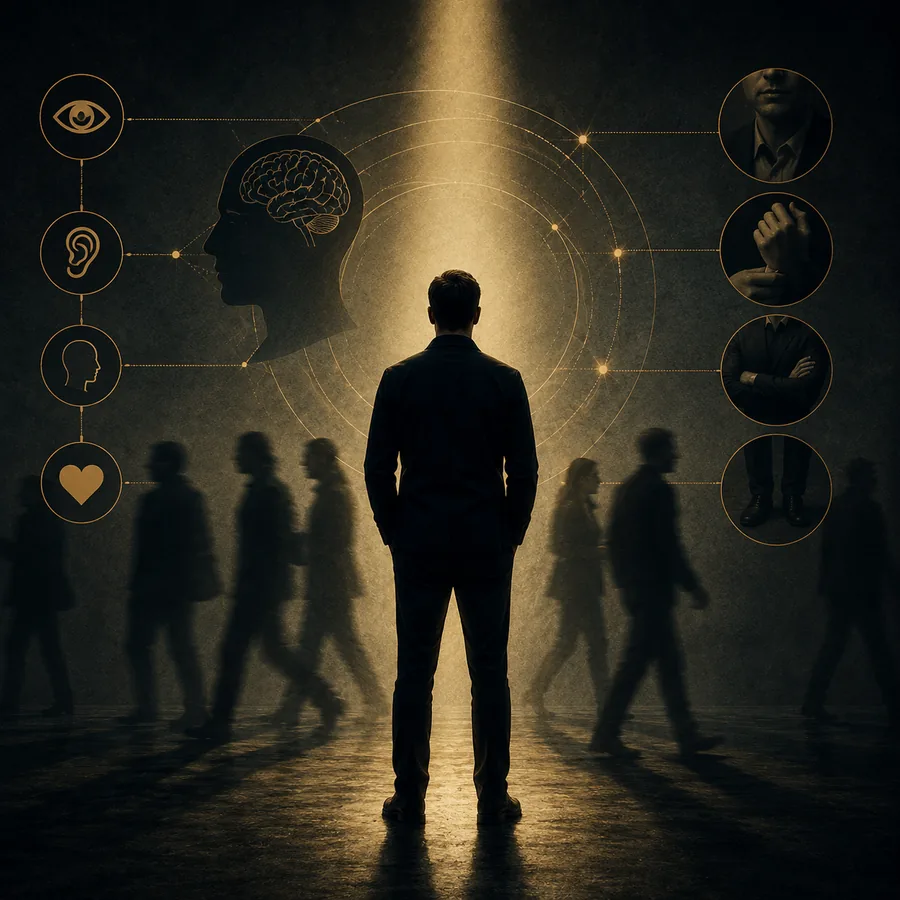
You are at dinner with someone everyone admires. The voice is calm. The stories land. Every sentence arrives polished. And somewhere underneath all of it, your stomach has quietly tightened.
No incident. No evidence. Just a signal.
What you do next matters more than the signal itself. Dismiss it automatically and you are practicing blind trust. Obey it automatically and you are practicing paranoia. This is the intuition vs paranoia question, and it deserves a better answer than “always trust your gut.”
You don’t accuse a note of being wrong. You simply hear when it’s out of tune.
The short version, if you’re skimming
- Intuition and paranoia can feel identical in the body. They behave differently over time: intuition observes patterns, paranoia jumps to conclusions.
- Your nervous system registers behavioral signals (tone, rhythm, mismatch between words and expression) before your conscious mind analyzes anything.
- Research on thin-slicing shows that brief samples of behavior carry real information. Your quick reads are not noise.
- A gut feeling is information, not a verdict. The checking step is what separates intuition from paranoia.
- Awareness protects without hardening you. Cynicism is not the price of safety.
Quick gut check: which of these is true for you right now?
- ☐ I have ignored a “something feels off” feeling because the person seemed too polished to question
- ☐ I sometimes spiral from one odd detail into a full story about someone’s intentions
- ☐ I trust calm, articulate people faster than I probably should
- ☐ After being wrong about someone, I either trusted everyone less or doubted my own judgment more
Hold your answers. We will come back to them.
The Problem With Blind Trust (and With Constant Suspicion)
We live in a strange psychological split.
On one side, we are taught to trust appearances: calm voices, polished speech, professional composure, reassuring smiles. On the other, we are warned to stay alert and read between the lines.
So most people swing between two extremes. Blind trust, followed by betrayal. Then hypervigilance, followed by exhaustion and cynicism. Then back again.
Neither is healthy. Neither is intelligent. And neither one is actually awareness.
True awareness lives somewhere quieter and far more precise. It does not assume danger everywhere. It does not label people. It does not require you to become cold or guarded. It is the ability to notice without panic: perceiving patterns, not judging personalities.
Most of us were simply never taught how to tell intuition from paranoia. So we treat every uneasy feeling as either a prophecy or a malfunction.
Intuition vs Paranoia: The Difference Is Evidence and Time
Here is the intuition vs paranoia distinction that changes everything.
Intuition observes patterns over time. Paranoia jumps to conclusions instantly.
Awareness asks questions:
- Does this behavior repeat?
- Is the rhythm consistently misaligned, or was that one strange moment?
- Do words, tone, and context harmonize, or do they keep conflicting?
Paranoia declares answers:
- This means something bad.
- This person must be dangerous.
One works like science: observe, wait, compare. The other is emotional overload wearing the costume of insight.
The research supports keeping these separate. In a study of 500 adults published in Psychiatry Research, psychologist Daniel Freeman and colleagues found that heavy reliance on gut feelings was associated with more paranoid thinking, while deliberative, analytic checking was protective. The most paranoid pattern was high gut-reliance combined with low deliberation.
Read that carefully, because it is not an argument against intuition. The gut feeling is not the problem. Skipping the verification step is. That checking step is the entire intuition vs paranoia divide: intuition that never gets checked curdles into suspicion.
Your Nervous System Notices First
Before the mind analyzes, the nervous system registers.
It picks up rhythm inconsistencies. Emotionally flat speech in emotional contexts. A tone that stays perfectly controlled where some flexibility would be natural. A mismatch between what the words claim and what the voice and body are doing.
This happens automatically. You do not have to train it. You only have to stop overriding it.
There is real science here, and it is worth knowing by name. In a famous gambling experiment, neuroscientists Antoine Bechara, Antonio Damasio and colleagues found that people’s skin conductance (a quiet stress response) began rising before risky choices, before participants could explain why certain card decks were bad. Damasio called these body-based signals somatic markers: physical traces of past experience that weigh in on decisions ahead of conscious reasoning. Later researchers showed participants knew more consciously than first claimed, so the strongest version of the theory is still debated. The broader point has held up well, though: the body participates in judgment. It does not wait for permission.
Psychologists Nalini Ambady and Robert Rosenthal demonstrated something related from the outside. In their thin-slicing research, observers who watched only a few seconds of someone’s behavior made judgments that lined up surprisingly well with assessments made over months. Brief behavioral samples carry real information.
Most people feel these signals first as subtle discomfort. A vague sense that something feels off. Unease without explanation. And then they override it with logic, politeness, or social conditioning. This is the moment where intuition or paranoia gets decided: not by the feeling itself, but by what you do with it next. I have examined how the body detects threat before logic does, a process called neuroception. This piece is about what to do with that signal once it arrives.
Try this: the next time you feel an unexplained “off” signal around someone, do nothing outwardly. Note the date and what you noticed. If the same pattern shows up twice more, you have data. If it never repeats, you have learned something useful about your own state that day.
Keep reading
Why You Were Taught to Override the Signal
From a young age, many of us were trained to ignore discomfort to appear respectful. To doubt intuition to appear rational. To silence bodily signals to appear agreeable.
Especially in elite, professional, or intellectual spaces, we are rewarded for appearing calm, not for being perceptive.
But calm is not the same as safe. Confidence is not the same as coherence. Articulation is not the same as integrity.
Polished composure misleads sharp minds most of all. I examined this pattern in why highly intelligent people miss red flags: the better you are at logical explanation, the faster you can explain away your own perception. Intelligence does not settle the intuition vs paranoia question. It only argues both sides more fluently.
Sound Is Behavior: What Music Psychology Adds
Music psychology trains us to see something most disciplines miss.
Sound is behavior. Not metaphorically. Biologically.
Tone, tempo, rhythm, pauses, breath: these are regulated by the nervous system, not by intention alone. You can rehearse words. You can polish narratives. But rhythm leaks truth.
Prosody, the musical layer of speech (pitch, pacing, stress), is far harder to script than vocabulary. It is why the voice often reveals more than the words it carries, and why we instinctively read tempo as a marker of authority and trust.
That is why listening deeply is not about suspicion. It is about literacy. Reading sound does not make you cynical any more than reading body language makes you judgmental. It makes you informed.
What to Actually Do With a Signal
Remember your gut-check answers from the top? Each one is the same fork in the road: intuition or paranoia, observation or projection. Here is the sequence I recommend, and it works for every one of them.
- Notice without acting. The signal is information, not a verdict. You are allowed to feel it fully and still do nothing yet.
- Look for repetition. One odd moment is a data point. Three is a pattern. Observing over time is exactly what separates intuition from paranoia.
- Check the harmony. Do words, tone, and context agree? Coherence across channels is the most honest signal we have.
- Ask what state you are in. Tired, stressed, or recently burned, we all hear threat in neutral signals. Intuition includes knowing the condition of your own instrument.
- Respond instead of reacting. Pause rather than rationalizing discomfort. Slow the relationship down rather than confronting or fleeing.
If you want help running that sequence on a real situation in your life, the discovery consultation is built for exactly that.
If this series is useful to you, the subscribe form at the bottom of the page will send the next piece to your inbox.
Awareness Protects Without Hardening
The goal of awareness was never to withdraw from people.
It is to choose more consciously. To engage more wisely. To stay warm, with boundaries. To keep empathy, without self-betrayal. To remain open, without naivety. This is emotional intelligence in its most mature form.
This series was never about exposing individuals. It examines patterns: patterns that repeat across leadership, power, relationships, media, and institutions. Manipulators adapt. Awareness is the only defense that evolves with them.
And with awareness comes responsibility. Not to accuse. Not to diagnose. Not to sensationalize. But to listen more carefully, to take the nervous system seriously without being ruled by fear, and to stay perceptive without losing compassion.
The most dangerous people are not always loud. And the safest people are not always calm.
Learning to tell intuition from paranoia is not suspicion. It is maturity.
So let me leave you with the question this whole series has been building toward: when did you last feel that quiet “off” signal around someone, and what did you do with it? And looking back, was it intuition or paranoia? Tell me in the comments. I read them.
Keep reading: the behavioral signals series
- Teaching Behavioral Awareness Without Creating Fear
- Why Highly Intelligent People Miss Red Flags
- Why We Trust the Wrong People: The Psychology of Misplaced Trust
- Why We Trust Calm People: Behavioral Dissonance and the Sound of Composure
Frequently Asked Questions
How can you tell the difference between intuition and paranoia?
Watch what the feeling does over time. Intuition points at something specific, stays calm enough to examine, and looks for evidence: repeated behavior, mismatched tone, words that conflict with context. Paranoia jumps to a conclusion instantly, resists checking, and grows on “what if” thinking rather than observation. That is the core intuition vs paranoia test: evidence over time versus instant certainty.
Is a gut feeling about someone usually accurate?
It is real information, but not a verdict. Thin-slicing research shows quick impressions from brief samples of behavior are often surprisingly accurate, yet stress, fatigue, and past hurt can distort the same signal. Treat a gut feeling about someone as a reason to observe more carefully, not as proof. If it keeps pointing at real, repeating evidence, you are dealing with intuition, not paranoia.
What does it mean when something feels off about a person?
It usually means your nervous system detected a mismatch: emotionally flat speech in an emotional moment, an over-controlled tone, or a gap between words and expression. That detection happens before conscious analysis, which is why you can feel it before you can explain it.
What are behavioral signals?
Behavioral signals are observable patterns in how someone speaks and acts: tone, tempo, rhythm, pauses, timing, and the consistency between words, voice, and context. They are revealing because they are regulated largely by the nervous system, which makes them much harder to script than vocabulary.
Can past experiences make paranoia feel like intuition?
Yes. After deception or betrayal, threat detection can become oversensitive and fire on neutral behavior. That is why the checking step in the intuition vs paranoia distinction matters: ask whether the pattern repeats and the evidence is current, or whether the feeling belongs to an older story.
Does learning to read behavioral signals make you cynical?
No, and it should not. Reading behavioral signals is literacy, like reading body language. Cynicism comes from unprocessed betrayal, not from awareness. Practiced well, awareness lets you stay warm and open while choosing more consciously who earns your trust.

About the author
Dr. Shveata Mishra
Begin with the ritual
Get the free 5-Minute Sound Ritual.
A research-informed listening practice designed to help your nervous system settle, sent to your inbox as a PDF. You will also receive new writing on sound, emotion, and identity whenever an article is published.