

You hit play on a song you’ve loved for years. The one that got you through a miserable commute, a breakup, a whole gym phase, those 2 a.m. work nights when nothing else would do.
And it lands wrong.
Not boring. Irritating. The voice is suddenly too sharp, the chorus shows up too fast, and that beat you used to ride? It grates now. Somewhere in the back of your mind a small voice asks: what is wrong with me?
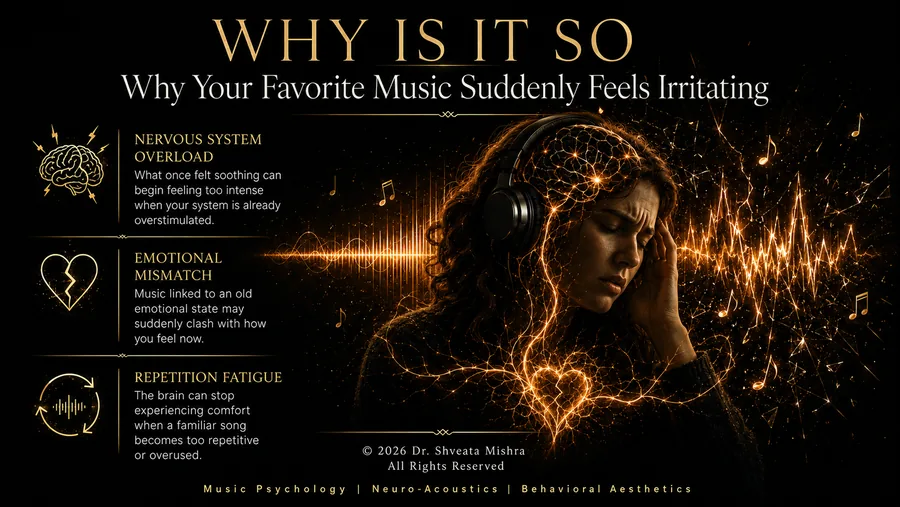
Nothing. I want to say that first, because people carry a strange guilt about this one. Nothing is wrong with you. When your favorite music suddenly feels irritating, what you’re feeling has a name, a few of them actually, and it’s about as ordinary as a brain and a body get.
Your favorite song didn’t betray you. You just stopped meeting it the same way.
The short version, if you’re skimming
- Liking a song follows a curve: it climbs with repetition, then drops once you’ve heard it too much.
- Sometimes it’s your ears, not the song. There’s a real name for that, listener fatigue.
- Sometimes it’s your nervous system. When you’re maxed out, even beautiful sound feels like one more demand.
- And sometimes it’s your heart. The song still fits who you were, not who you are now.
- Irritation isn’t rejection. It’s information. Below, you’ll work out which one is happening, and what to do about it.
Quick gut check: which of these is true for you right now?
Tick the ones that fit. Your answers point you to the section that will help most.
- ☐ I’ve had this song on repeat for days or weeks.
- ☐ It only bothers me when I’m tired, stressed, or it’s the end of a long day.
- ☐ I’m craving silence even though I normally love music.
- ☐ The song is tied to a person, a place, or a chapter I’ve moved past.
- ☐ Honestly, all music feels like too much lately, not just this one.
Hold on to what you ticked. We’ll come back to it.
Why your favorite music suddenly feels irritating: liking runs on a curve
There’s a reason a song usually grows on you after a few plays.
Those first few listens, your brain is still learning the shape of it. Where the rhythm sits. When the chorus lands. How the melody resolves itself. Psychologists have a name for the warm feeling that comes with all that learning. They call it the mere-exposure effect, and the gist is simple: the easier something is for your brain to process, the more it tends to like it. Prediction feels good, so familiarity feels good.
What gets left out of that tidy story, though, is the ceiling.
Researchers map it as an inverted-U, sometimes called the Wundt curve. Liking climbs as a song gets familiar, hits a peak, then starts sliding back down once you’ve heard it too many times. Past the peak the chorus stops surprising you. The hook stops hooking. Your brain has basically solved the song, and a solved puzzle just doesn’t light you up the way an unsolved one did. For some people it overshoots boredom completely and lands on annoyance.
So if you’ve had a track on heavy repeat, you may simply have ridden it over the top of its own curve. That isn’t bad taste. That’s a brain that learned the song all the way through.
It might not be the song at all. It might be listener fatigue.
Sound is physical. It reaches your body before it ever becomes a thought, and your ears get tired the same way the rest of you does.
Audio engineers actually have a term for this. They call it listener fatigue, or ear fatigue. After hours of continuous sound your hearing dulls a little, your focus slips, and music you’d normally love starts to feel like work. It’s the reason mixing engineers step away from a session and swap in different reference tracks. A bit of variety lets the ears reset.
You don’t need a studio to hit that wall. If one song has been the backing track to every workout, every drive, every focus session for a month, your auditory system might simply be full.
Try this, it costs you nothing. Don’t play the song for 48 hours, then play it once, quietly, in a calm room. If the irritation softened, it was fatigue, not a lost love.
Keep reading
Or it might not be your ears. It might be your nervous system.
Now pay attention to when the irritation shows up.
If your favorite music only bothers you at the end of a wrung-out day, after the calls and the traffic and the group chats and the deadlines, that’s a completely different signal. It isn’t the song. It’s a nervous system that has already taken in every bit of input it can hold.
The word for it is sensory overload. When your senses are pulling in more than your brain can comfortably sort, anything extra starts to register as too much, even something genuinely lovely. In that state your favorite song isn’t comfort. It’s just one more thing tugging at your sleeve.
Sometimes irritation is just your body saying, in the only language it has, that it can’t process more right now.
People say the same thing whether they’re in New York, London, Mumbai, or Toronto: I love music, but today I just need quiet. That pull toward silence (did you tick that box earlier?) isn’t bad taste. It’s your body asking for less. Give it some, and the music tends to find its way back on its own.
If the way your body reacts before your mind catches up is interesting to you, I went deep on it here: Why Your Body Reacts to Music Before Your Mind Understands It.
And sometimes it’s the tenderest reason: a different you is listening
Music isn’t a fixed object sitting still out in the world. It shifts depending on who’s listening, and you are not the same person every day.
Take a high-energy track. When you’re fired up it sounds like power. Catch the very same song when you’re flattened by the day and it sounds like noise. Sad songs do it too. They can feel like company while you’re grieving, then turn into quicksand a few weeks later once you’re trying to climb back out.
The notes never moved. Your relationship to them did.
That’s the thing about a favorite. It’s rarely just a song. It gets tangled up with a person, a season, something you were chasing, a version of yourself you’ve half outgrown. So when one starts to grate, there’s a kinder question than "what’s wrong with me" worth asking: is this still written for who I was?
What once felt empowering can start to feel loud. That isn’t loss. That’s you, having moved.
Is it your ears, or your heart? A ten-second way to tell
Ask yourself one question. When the song irritates you, what exactly feels wrong?
- The sound itself feels harsh, sharp, or like too much. That’s sensory, your ears or your nervous system. What helps: lower the volume, take a real break from the track, reach for quiet or soft instrumental textures, and come back later. It will probably return.
- The feeling it stirs up is the uncomfortable part, a memory, a person, a former self. That’s emotional. What helps: let the song rest without guilt, and get curious instead of frustrated. Ask what chapter it belongs to. Some songs we outgrow on purpose, and that’s growth, not betrayal.
Most "why does my favorite song suddenly annoy me" moments are one of these two. Naming which one changes everything about what you do next.
What to actually do about it
Whatever the cause, the moves are gentle and simple.
- Let it rest, and don’t force the love back. Music returns differently after space. A song that grates today can feel meaningful again once you’re no longer saturated by it.
- Change the context. A track that feels harsh through headphones while you’re stressed can feel like a different song played softly in an open room. Volume, timing, and setting matter as much as the music.
- Name whether it’s sensory or emotional. You just did this above. The fix follows the cause.
- Rotate your sound. New genres and new textures let your ears reset, the same trick engineers use to beat listener fatigue.
- Let silence count. Silence isn’t the opposite of music. Often it’s the thing that lets you love music again.
And if the irritation has outlasted the gentle moves, a discovery consultation is where I look at what is actually driving it with you.
This is the kind of thing I dig into every week, how sound quietly shapes mood, memory, and the nervous system. If that’s your world too, subscribe at the bottom of this page and I’ll send the next piece straight to you.
The reframe: irritation as information
When music you love starts to bother you, it can honestly feel like a tiny grief. Most of the time, though, it’s closer to a message.
Maybe you’re overstimulated. Maybe a song has slipped from familiar into overplayed. Maybe the sound no longer matches where you are, or a version of you has quietly packed up and left. None of that wipes out what the song gave you when you needed it. It just means the two of you have changed.
Because in the end, we don’t only hear sound.
We find ourselves in it. And when the self moves, the music moves too.
The irritation isn’t always rejection. Sometimes it’s your body asking for a new relationship with sound.
So here’s my question for you: which song stopped feeling like home, and looking back, was it your ears, your stress, or a version of you that you’ve outgrown? Tell me in the comments, I read them.
Keep reading, the sound and nervous system series
- Why Your Body Reacts to Music Before Your Mind Understands It
- Why Certain Songs Make You Feel Understood
- Why Some Songs Instantly Bring Back Forgotten Memories
- Why Certain Voices Instantly Calm Your Nervous System
Frequently Asked Questions
Why does my favorite song suddenly annoy me?
Usually one of four things: overexposure, where you’ve heard it past the peak of its liking curve; listener fatigue, where your ears are saturated; sensory overload, where your nervous system is maxed out; or an emotional shift, where the song is tied to a feeling or a self you’ve moved past.
Is listener fatigue a real thing?
Yes. Listener fatigue, also called ear fatigue, is a recognized phenomenon. After long exposure to sound, hearing loses sensitivity and listening starts to feel tiring or uncomfortable. Taking breaks and varying what you listen to helps it reset.
Songs I used to love now annoy me. Does that mean my taste changed?
Sometimes, but not always. It can also reflect overexposure, stress, sensory overload, or the emotional associations attached to the song. Taste shifts are real, but they are only one of several explanations.
Can listening to a song too much make you dislike it?
Yes. Liking tends to rise with repetition at first, an effect psychologists call the mere-exposure effect. But past a certain point, described as an inverted-U or Wundt curve, too much repetition reduces pleasure and can tip into irritation.
Why do I crave silence even though I love music?
When you’re stressed, overstimulated, or mentally tired, even pleasant music adds to your sensory load. Silence gives your auditory system and nervous system room to recover.
What should I listen to when music feels irritating?
Try silence first. Then reach for lower volume, gentle instrumental textures, nature sounds, or unfamiliar music that doesn’t carry strong memories, and give your overplayed favorites a rest.

About the author
Dr. Shveata Mishra
Begin with the ritual
Get the free 5-Minute Sound Ritual.
A research-informed listening practice designed to help your nervous system settle, sent to your inbox as a PDF. You will also receive new writing on sound, emotion, and identity whenever an article is published.