

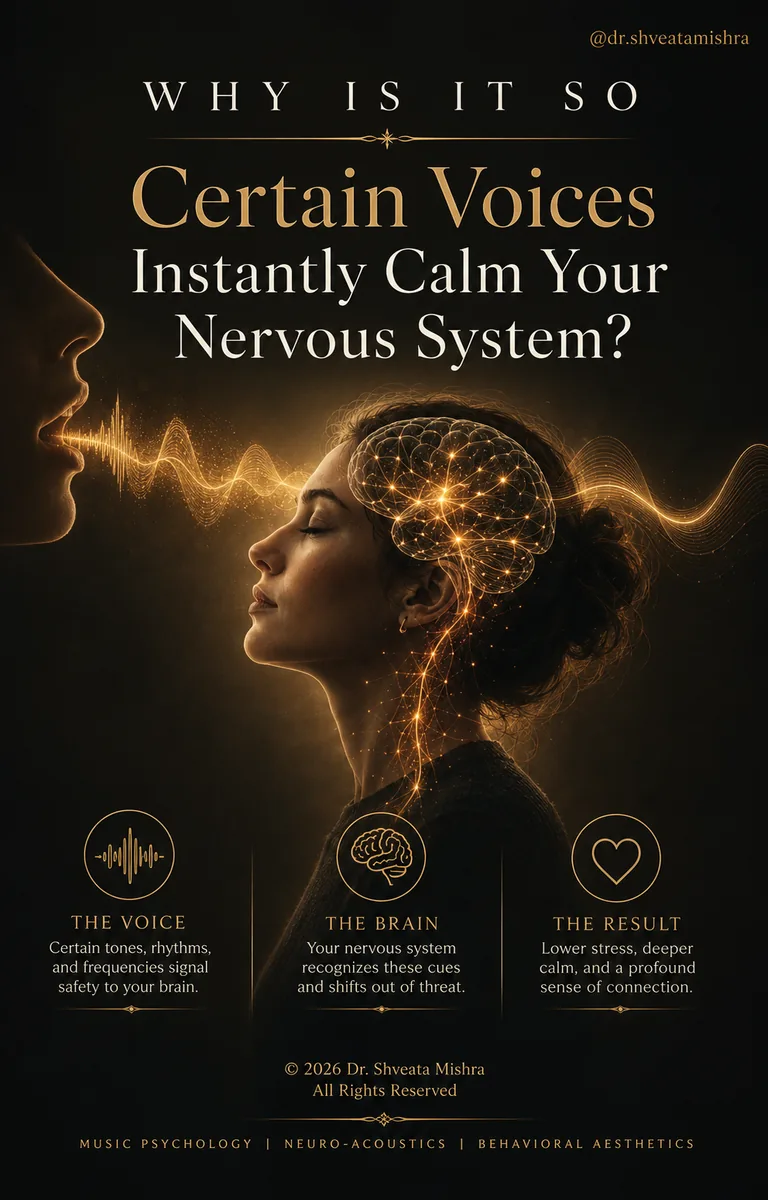
Someone says a few ordinary words, and your whole body answers before your mind has caught up. Your breathing slows. Your shoulders drop a centimetre. The tightness in your chest loosens, just slightly. For a moment, the part of you that is always half-bracing for something stops bracing.
Most people explain this away. They decide they simply “like” that person’s voice. But what just happened is older and deeper than preference. A calming voice reaches a layer of you that does not deal in opinions. It deals in safety.
People do not just hear sound. They recognize themselves in it. And sometimes a voice feels calming because the nervous system reads it as safe long before conscious thought has a chance to ask why.
A calming voice doesn’t convince you that you’re safe. It lets your body decide you are, before you’ve thought a single word.
The short version, if you’re skimming
- Your nervous system scans every voice for safety before your mind understands the words.
- A calming voice carries warm, steady, predictable prosody, the tone and rhythm beneath language.
- This reading is fast and below conscious awareness, a process researchers call neuroception.
- Familiar vocal patterns can lower stress hormones; one study found a phone call from mom raised oxytocin and dropped cortisol much like a hug.
- “Comfort” is often your body recognizing the rare absence of threat, not a verdict your mind reached.
Quick gut check: which of these is true for you right now?
Tick the ones that fit. Hold on to your answers, we’ll come back to them.
- ☐ One person in your life makes you exhale the moment they start talking.
- ☐ Another person says all the “right” things, yet you stay quietly tense around them.
- ☐ A particular podcast host or singer feels weirdly personal, almost like company.
- ☐ After a loud day, a single gentle voice can make you unexpectedly emotional.
Your Nervous System Listens Before Your Mind Understands
We are taught that communication is about words. Psychologically, that is only half the story.
Long before a baby understands a single word, the brain is already learning emotional meaning through sound. An infant cannot parse vocabulary. But the nervous system responds to tone, rhythm, volume, and whether a voice is predictable or jagged. This is one of the earliest forms of emotional recognition we ever develop, and it never really switches off.
A soft voice can settle a distressed child before any explanation exists. A sharp one can trigger fear before the words are even processed. That pattern does not vanish when we grow up. It just gets quieter and more sophisticated.
So as adults we keep responding to the voices around us in ways we rarely notice. Some people leave you calmer within minutes. Others leave you drained, even when nothing they said was wrong. Your nervous system is reading emotional congruence, the match between what a voice says and how it is held, faster than logic can weigh in.
That same fast, below-conscious read also shapes who we trust, not only who we find soothing. I examined how voice, pace, and rhythm tilt that judgment before logic gets a turn in How Voice Shapes Trust.
Why a Calming Voice Feels Emotionally Safe
Here is the mechanism, named plainly. Your brain is continuously scanning for cues of safety and threat, a process the researcher Stephen Porges calls neuroception: detection that happens beneath awareness, without you deciding to do it. Vocal tone is one of its richest sources of information.
When a voice carries warmth, steadiness, controlled pacing, and a predictable rhythm, the body tends to register it as low-threat. Not because some inner committee has concluded the person is trustworthy. Because the nervous system recognizes a pattern it associates with steadiness rather than danger.
This matters because regulation is not a solo act. Humans calm each other constantly, through faces, through touch, through the rooms we share, and very powerfully through sound. A chronically sharp, sarcastic, or volatile tone can hold another person’s system in low-grade vigilance for hours. A grounded, evenly paced voice can lower that internal alarm without saying anything profound at all.
The body doesn’t wait for the explanation. It has usually decided how safe you are before you finish your first sentence.
The technical word for the part of a voice that does this work is prosody: the melody, pitch, pacing, and stress of speech, everything except the literal words. Calming voices tend to share a prosodic signature. Lower pitch. Slower pace. Smooth, unhurried contours. A relaxed, low tone is hard to fake, because it tends to appear only when the speaker’s own body is relaxed, which is exactly why it reads as a signal of safety.
Why Some Voices Feel Familiar Within Seconds
One of the strangest, most human facts in this whole area is that people sometimes feel connected to a voice before they feel connected to the person attached to it.
That is not irrational. Your brain stores emotional memory through sensory association, and sound gets laced into emotional experience across an entire life. So a particular vocal quality can quietly echo something earlier:
- being protected
- being soothed as a child
- predictability when everything else felt uncertain
- belonging
- gentleness arriving in the middle of distress
And the reverse runs just as deep. Other vocal patterns can trip stress associations tied to criticism, unpredictability, or fear, without anyone meaning to send that signal. It is why two people can hear the identical voice and split completely. One relaxes. One bristles. One feels strangely, instantly attached.
The voice is never working alone. Your nervous system is comparing the sound in front of you against years of stored emotional pattern, in real time, and answering before you can.
Keep reading
What the Research Actually Shows
This is not only a poetic idea. It shows up in the body’s chemistry.
In a well-known study from the University of Wisconsin-Madison, researchers put girls through a stressful task, then let some of them hear their mother’s voice, in person or only by phone. The voice alone, even over a phone line, raised oxytocin, a hormone tied to bonding and trust, and lowered cortisol, the main stress hormone, about as much as a physical hug. The body responded to the sound of a safe person almost as if that person were holding them. (Seltzer and colleagues, published in Proceedings of the Royal Society B.)
More recent work points the same direction for strangers, not just loved ones. In a 2025 study in Comprehensive Psychoneuroendocrinology, people who heard a deliberately soothing vocal tone during recovery from a stressor showed cortisol returning to baseline faster than those who recovered in silence. A calming voice did not erase the stress. It seemed to help the body climb down from it sooner.
None of this means a voice is medicine. It is not a treatment, and it is not a substitute for therapy or care. What the research does suggest is humbler and, I think, more interesting: the human voice is genuine emotional information, and a steady one can nudge a stressed body toward settling.
A calming voice doesn’t fix you. It reminds your nervous system that it’s allowed to put the alarm down.
The Quiet Link Between Voices and Exhaustion
So many people describe themselves as drained, overstimulated, wrung out. Far fewer notice how much of that fatigue is acoustic.
Modern life pours near-constant vocal tension over us. Loud media. Argument as entertainment. Speed-talking. Urgency baked into every notification’s tone. The nervous system was never built to sit under continuous emotional noise, and a lot of what we call tiredness is closer to sensory overload than to a heavy workload.
Which is why some people get unexpectedly emotional hearing one genuinely calm voice. Their body simply has not met vocal steadiness in a long time. Sometimes what we name “comfort” is just the nervous system noticing, with something like relief, that the threat is briefly gone.
If this resonates, I went deeper into that depletion here: Why Your Favorite Music Suddenly Feels Irritating.
Why Singers, Podcasters, and Certain Creators Feel So Personal
This also explains the oddly intimate bond people form with singers, podcast hosts, narrators, even fictional characters. We assume we are attached to the content. Often we are attached to a nervous-system experience.
Some voices set a pace that feels regulating. Others bring intensity, or familiarity, or escape. We are deeply sensory-emotional creatures, even in the moments we are most convinced we are being purely rational. It is part of why people replay a particular song on loop through a hard week. The sound starts working almost like emotional stabilization, not because music magically dissolves pain, but because the nervous system recognizes itself inside certain rhythms, tones, and frequencies.
People do not only consume sound. They organize themselves with it.
What to Actually Do With This
- Notice your own evidence. Go back to the gut check. The person who makes you exhale, and the one who keeps you subtly tense, are real data about which voices your system reads as safe.
- Audit your acoustic diet. If your days are wall-to-wall fast, sharp, urgent audio, build in pockets of slower, steadier sound. Your nervous system counts that as rest.
- Mind your own prosody. In parenting, leadership, caretaking, teaching, the steadiness in your voice regulates other people more than the cleverness of your words. People rarely remember what you said. They remember how their body felt near you.
If you’d like more pieces that examine how sound shapes emotion, memory, and identity, the subscribe form at the bottom of the page is the quiet way to get the next one.
What a Calming Voice Is Really Telling You
Strip away the neuroscience and this is, in the end, a very human thing.
Most people are moving through the day far more overstimulated than they look. Many are functioning while carrying chronic tension, loneliness, or a low hum of hypervigilance they have stopped noticing. In a world like that, a genuinely calming voice becomes meaningful, not because people are fragile, but because regulation was always meant to be relational. The nervous system was never designed to soothe itself alone.
Maybe that is why certain voices stay with us for years. Not because they were the loudest or the most impressive. Because they let the body feel safe enough to soften, even for a minute.
So I’ll ask you the question I keep coming back to: whose voice makes your whole body exhale, and have you ever told them what it does for you?
Keep reading: the sound, safety, and the nervous system series
- How Voice Shapes Trust
- Why We Trust Calm People: Behavioral Dissonance and the Sound of Composure
- The Body Knows Before the Mind: How Neuroception Detects Threat Before Logic
- Why Your Favorite Music Suddenly Feels Irritating
Frequently Asked Questions
Why do certain voices instantly feel calming?
A calming voice usually carries warm, steady, predictable prosody, the tone, pacing, and rhythm beneath the words. Your nervous system reads those qualities as low-threat signals through a fast, below-conscious process, so the body often relaxes before the mind has decided anything.
Is there real science behind a soothing voice?
Yes. A University of Wisconsin study found that hearing a mother’s voice, even by phone, raised oxytocin and lowered the stress hormone cortisol much like a hug, and a 2025 study found a soothing vocal tone helped cortisol return to baseline faster after stress. A voice is genuine emotional information, though it is not medicine or a replacement for care.
Why does the same voice calm one person and irritate another?
Because your nervous system compares each voice against years of stored emotional memory. A vocal pattern that echoes past comfort can feel safe, while one that echoes past criticism or unpredictability can feel stressful, which is why two people can hear the identical voice and respond in opposite ways.
Why do I feel emotionally attached to a singer’s or podcaster’s voice?
People often bond less with the content and more with how a voice makes the nervous system feel. Familiar pacing, steady prosody, and a sense of sensory regulation can make a stranger’s voice feel personal and companionable.
Can a calming voice actually reduce stress?
It can support the body’s own settling. Research links soothing vocal tone to faster cortisol recovery and to oxytocin release, which is why a steady voice can take the edge off tension. It is a gentle, research-informed effect, not a cure for anxiety or a substitute for professional help.
Is this connected to music psychology?
Closely. Music psychology and neuro-acoustics both examine how sound, rhythm, tone, and sensory environments shape emotional regulation, memory, behavior, and identity, and the human voice is one of the most powerful instruments in that story.

About the author
Dr. Shveata Mishra
Begin with the ritual
Get the free 5-Minute Sound Ritual.
A research-informed listening practice designed to help your nervous system settle, sent to your inbox as a PDF. You will also receive new writing on sound, emotion, and identity whenever an article is published.