

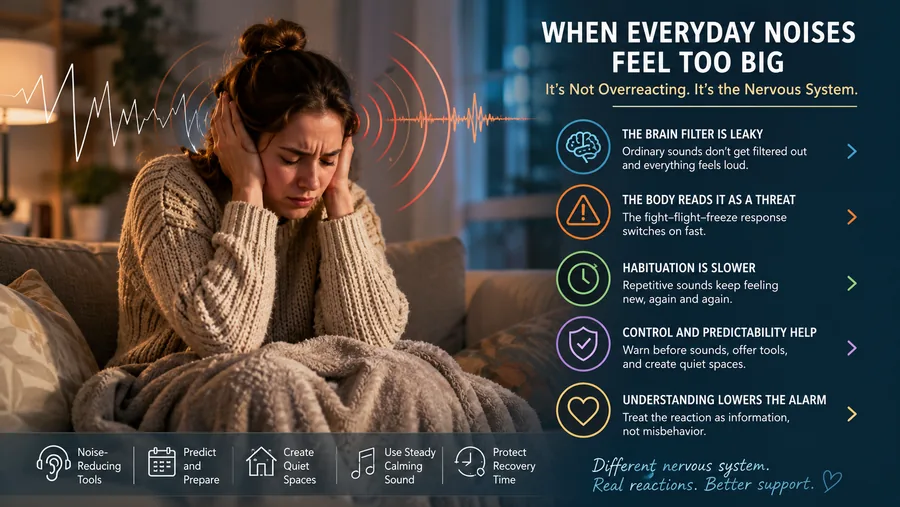
The hand dryer roars in a public bathroom and your child folds in half, hands clamped over both ears, eyes shut, refusing to move. The vacuum comes out and they leave the room before you have finished plugging it in. A birthday party, the one they begged to go to, ends in tears by the cake. If any of that feels familiar, you are not raising a dramatic child. You are very likely living alongside sound sensitivity in children, and once you understand what is happening underneath the reaction, almost everything about it gets easier to carry.
I want to say something clearly at the start. A child who covers their ears at the blender is not being difficult. Their nervous system is doing exactly what a nervous system is built to do, just with the volume turned up.
The meltdown is not the problem. It is the alarm telling you the problem already happened.
The short version, if you’re skimming
- Sound sensitivity in children is usually about how the brain filters and processes sound, not about the ears being damaged or the child being defiant.
- A more reactive nervous system reads ordinary noise as a threat, which can trigger a fight, flight, or freeze response.
- Two mechanisms matter most: a weaker sensory filter and slower habituation, meaning the brain keeps reacting to a sound instead of tuning it out.
- Small, predictable changes to the sound environment help more than asking a child to “just ignore it”.
- Persistent or sudden sensitivity is worth a check with a pediatrician or audiologist to rule out anything medical first.
Quick gut check: which of these is true for your child right now?
Tick the ones that fit. Hold on to your answers, we will come back to them.
- ☐ They react to sounds other kids barely notice (the fridge hum, distant traffic, a flushing toilet).
- ☐ Loud or sudden noise sends them straight into tears, anger, or freezing, not gradual upset.
- ☐ Noisy places (parties, cafeterias, malls) wear them out faster than anything else.
- ☐ They cover their ears, ask people to be quiet, or beg to leave before the noise even starts.
What sound sensitivity in children actually is
Sound sensitivity in children is not one single thing, and that is the first piece worth holding loosely. Sometimes it shows up as discomfort with specific noises. Sometimes it is a whole-body distress in busy, echoing rooms. The clinical term you will run into is hyperacusis, an unusual intolerance of everyday sounds, and research suggests it is more common than parents expect. In one set of findings, roughly one in ten children met criteria for hyperacusis based on what both parents and children reported.
Here is the part that reframes everything. For most children, this is not a problem with the ear itself. It is a difference in how the brain receives and sorts sound. The volume coming in is normal. The processing is what differs.
Try this: for one week, jot down the exact sound that set off each hard moment. Patterns hide in the specifics.
Why the nervous system treats a vacuum like a threat
Picture two filters. In most brains, there is a background process quietly deciding what deserves attention. The refrigerator hum gets filed under “ignore”. A voice across the table gets filed under “listen”. This is sometimes described as auditory gating, the brain’s ability to dampen repetitive, predictable input so the important signals can rise above it.
In a child with auditory over-responsivity, that filter is leakier. Background noise is not filtered out, so the fridge can register as loudly as a person speaking, sometimes louder. Now imagine living a whole day with no filter between you and every sound in the building. It is exhausting, and it is frightening, and the body responds accordingly. A leaky filter like this is the engine behind a great deal of sound sensitivity in children.
That response is the second piece. Studies of children with sensory over-responsivity find greater sympathetic arousal to stimuli, the fight-or-flight branch of the nervous system switching on, paired with a harder time settling back down to baseline. So when your child seems to “overreact”, what you are often watching is a genuine threat response. The body does not wait for the explanation. It just sounds the alarm.
This is one of the things I examine in my own work on sound, emotion, and behavior. Sound is not only information about the world. For a sensitive nervous system, sound is a constant stream of signals about safety, and the body listens to it long before the thinking brain gets a vote.
Keep reading
The habituation piece most advice skips
There is a quieter mechanism that explains a lot of the daily frustration, and most parenting tips never mention it. It is called habituation, the nervous system’s ability to stop reacting to a sound once it learns the sound is harmless.
For most of us, habituation is automatic. You move into a home near a railway line and within weeks you genuinely stop hearing the trains. Research on children, though, shows they habituate to repeated sounds less readily than adults do, and children with sensory over-responsivity show this even more. In practical terms, their brain reacts to a repetitive noise as if each repetition were brand new. The clock that you have tuned out is, for them, ticking loudly for the hundredth time with no relief.
When you know this, “you have heard that sound a thousand times, why does it still bother you” stops being a fair question. For their nervous system, it really is closer to the first time, again and again. This is also why sound sensitivity in children can feel so relentless to live with, for them and for you.
If this resonates, I went deeper into the adult version of this experience here: Why Emotional Exhaustion Changes the Way You Hear the World.
Is it sensory, or is it something else?
This is the question that keeps parents up at night, so let me be direct about it.
Sound sensitivity in children can stand entirely on its own. It can also travel alongside autism, ADHD, anxiety, or sensory processing differences, and it shows up across all of them. Sensitivity to sound is not, by itself, a diagnosis of anything. It is a signal worth understanding, not a verdict.
Is it the ears, the brain, or worth a doctor’s visit?
- It is likely processing. When there is no medical explanation, researchers point to how the brain sorts sound rather than damage in the ear. What helps: adjusting the environment and building predictable coping tools.
- It could be physical. Occasionally a middle-ear muscle that does not contract well, ear infections, or a medication side effect can make sounds seem louder. What helps: rule this out first.
- The honest rule. Always start with a pediatrician or audiologist to rule out a medical cause before assuming it is purely sensory.
I am a music psychology researcher, not a physician, and this article is educational, not a diagnosis. Trust the people who can examine your child directly.
What to actually do about it
Most of the day-to-day help for sound sensitivity in children comes down to one idea. The goal is not to toughen a child up to noise. It is to lower the threat load enough that their nervous system can do its own learning over time.
- Name the triggers, then warn before them. Once you know the vacuum or the hand dryer is the culprit, count down out loud before the sound starts. Predictability shrinks the threat.
- Give them an exit and a tool. Noise-reducing ear defenders, a quiet corner, permission to step out. Control over the sound matters as much as the volume.
- Build a quiet zone at home. A small space with soft, sound-absorbing things (a rug, cushions, a closed door) where the nervous system can actually return to baseline.
- Use sound on purpose, not just against noise. Steady, predictable sound (a fan, gentle background music they choose) can mask the unpredictable noises that startle them most.
- Protect recovery time after loud places. A noisy party is a real energy cost. Plan a calm landing afterward instead of stacking another busy thing on top.
If this is the kind of thinking that helps your family, the subscribe form at the bottom of this page will send you my new writing on sound, behavior, and the people we are becoming.
What changes when you stop calling it “overreacting”
Here is the reframe I most want you to leave with. A child who is overwhelmed by everyday sound is not failing to cope. Their nervous system is coping extremely hard, all day, with a world that is louder to them than it is to you. The covered ears are not defiance. They are competence. The body protecting itself with the only tool it has in the moment.
When you start treating the reaction as information instead of misbehavior, two things tend to happen. The child feels understood, which itself lowers the threat. And you stop fighting the alarm and start lowering the fire.
So I will leave you with the question I would actually ask in your shoes. What is the one everyday sound your child reacts to most, and what would it change if you treated that reaction as a message rather than a problem?
Keep reading: the sound and the nervous system series
- Sleeping with Sound: How Background Noise Can Help the Nervous System Settle
- Loud Music, Nervous System Arousal, and the Hidden Cost of Sound Intensity
- Why Emotional Exhaustion Changes the Way You Hear the World
- Sound and the Nervous System: 5 Audio Anchors for a Steadier Day
Frequently Asked Questions
Is sound sensitivity in children a real condition?
Yes. When everyday sounds feel painfully loud or distressing, it is often called hyperacusis, and research suggests around one in ten children may experience it. It is a genuine difference in how the brain processes sound, not a behavior problem.
Does noise sensitivity in children always mean autism?
No. Sensitivity to sound can occur on its own, and it can also appear alongside autism, ADHD, anxiety, or sensory processing differences. On its own it is a signal worth understanding, not a diagnosis of any one condition.
Why does my child react to sounds that do not bother anyone else?
Their brain likely filters background sound less effectively, so the fridge hum or distant traffic that others tune out registers loudly for them. Many children also habituate to repeated sounds more slowly, so a noise keeps feeling new instead of fading.
Will my child grow out of being sensitive to loud noises?
Many children become more tolerant as their nervous system matures and as they build coping tools, though some sensitivity can persist. With sound sensitivity in children, reducing the threat load now, rather than forcing exposure, tends to support that gradual change.
How can I help a child who is sensitive to loud noises?
Identify the specific triggers, warn before unavoidable sounds, offer noise-reducing headphones and a quiet space, and protect recovery time after noisy places. Control and predictability help more than asking a child to simply ignore the sound.
When should I see a doctor about my child’s sound sensitivity?
See a pediatrician or audiologist first to rule out ear infections, a middle-ear issue, or a medication side effect, especially if the sensitivity is sudden, painful, or affecting daily life. Medical causes should be checked before assuming the cause is purely sensory.

About the author
Dr. Shveata Mishra
Begin with the ritual
Get the free 5-Minute Sound Ritual.
A research-informed listening practice designed to help your nervous system settle, sent to your inbox as a PDF. You will also receive new writing on sound, emotion, and identity whenever an article is published.