

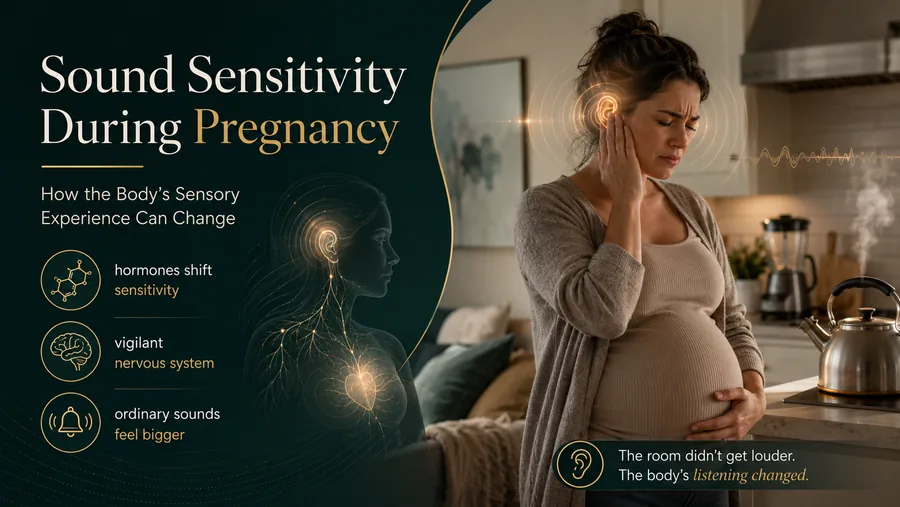
The kettle has always whistled. The neighbour’s dog has always barked. Your partner has always chewed the way your partner chews. None of that is new. What is new is that, somewhere in the second trimester, all of it started to feel like it was happening inside your skull. If sound sensitivity during pregnancy has crept up on you, turning ordinary noise into something you have to brace against, you are not imagining it and you are not being dramatic. Your body is recalibrating, and hearing is part of what it touches.
The volume in the room didn’t change. The body listening to it did.
The short version, if you’re skimming
- Sound sensitivity during pregnancy is real and reported often: many people notice ordinary noise feels louder, sharper, or harder to tune out.
- The likely drivers are hormonal (estrogen and progesterone), circulatory (more blood volume reaching the inner ear), and attentional (a nervous system on higher alert).
- It usually peaks in the second and third trimesters and tends to ease in the months after birth, though some shifts linger postpartum.
- Sound is not just noise here. It carries emotional weight, which is why a sharp sound can land as irritation, dread, or tears, not only as “loud”.
- Most of this is benign. Sudden hearing loss, persistent tinnitus, or one-sided changes are worth a call to your doctor.
Quick gut check: which of these is true for you right now?
Tick the ones that fit. Hold on to your answers, we’ll come back to them.
- ☐ Sounds you used to ignore now feel physically intrusive.
- ☐ You’ve started leaving rooms, muting the TV, or asking people to lower their voices.
- ☐ A noise that’s only mildly annoying makes you unexpectedly tearful or angry.
- ☐ You feel “full” or pressured in your ears, like you’re on a descending plane.
What sound sensitivity during pregnancy actually is
Let me name it plainly first. In clinical language, a lowered tolerance for everyday sound is called hyperacusis: sounds at a level most people find comfortable register as too loud, too sharp, or even uncomfortable. Sound sensitivity during pregnancy is usually a softer, temporary version of this. You’re not losing hearing. If anything, the system is turned up, not down.
Researchers have measured pieces of this. Studies on audiological changes in pregnancy have found shifts in hearing thresholds, particularly at lower frequencies, that tend to improve again after delivery. One often-cited finding is that hearing sensitivity changed during pregnancy and recovered postpartum, which points to the pregnancy itself as the driver rather than a permanent change to the ear.
Try this: next time a sound spikes your irritation, name it out loud, “that’s the blender, it’s safe.” Labelling a sound tells the alarm part of your brain it doesn’t need to fire.
So why does the body do this? Three systems are moving at once.
The hormones: estrogen, progesterone, and the inner ear
Estrogen and progesterone climb dramatically in pregnancy, and they don’t only act on the uterus. Estrogen supports blood flow and healthy function in the cochlea, the spiral organ in the inner ear that turns vibration into the signal your brain reads as sound. Progesterone appears to influence how the inner ear and the auditory pathways handle that signal.
When those hormone levels swing, the finely tuned gain on your hearing can swing too. Some people also notice a feeling of fullness or pressure in the ears, a popping or blocked sensation, because the same hormonal shifts affect fluid and the tissues lining the nose and Eustachian tube. It’s the same family of changes behind the famous pregnancy congestion, just expressed in the ear.
This is worth holding onto: sound sensitivity during pregnancy is not a flaw in your coping. It has a measurable physiological floor underneath it.
The body: more blood, more alert, less filtered
By the third trimester your blood volume has risen by roughly 40 to 50 percent. That extra circulation reaches the inner ear too, and a more vascular, more pressurised auditory system can simply be more reactive. Tinnitus, a ringing or whooshing with no external source, shows up more often in pregnancy for related circulatory reasons.
Then there’s attention. Pregnancy nudges the nervous system toward vigilance. That’s not a malfunction, it’s arguably the point: a body preparing to keep a newborn alive gets better at detecting things that might matter. The cost is that the same heightened filter that will one day snap you awake at a tiny cry right now snaps you to attention at a slammed cupboard. Your brain is doing threat-detection overtime, and sound is its fastest input. That vigilance is a big part of why sound sensitivity during pregnancy tends to feel worse on tired, overstimulated days.
If this resonates, I went deeper into the body-first nature of sound reactions here: Why Your Body Reacts to Music Before Your Mind Understands It.
Keep reading
Why a sound can feel like an emotion, not just a noise
Here’s the part most pregnancy guides skip, and it’s the part my work examines most closely. Sound is never only acoustic. It is behavioural information. A particular pitch, texture, or rhythm carries emotional meaning your brain assigns before you consciously decide anything.
So when sound sensitivity during pregnancy hits, it rarely arrives as a neutral “this is loud”. It arrives wrapped in feeling. The garbage truck doesn’t just register as decibels, it registers as too much. A child’s high shriek doesn’t just pierce, it spikes something close to dread. That’s because the auditory system and the emotional centres of the brain are tightly wired together, and pregnancy turns up both the input and the emotional reactivity at the same time. You’re not overreacting. You’re hearing the world with the volume and the meaning dialled up together.
People don’t just hear sound. They recognize themselves in it. In pregnancy, that recognition gets louder.
This is also why the gentle, predictable sounds can feel disproportionately good right now, a fan, rain, a low hum, a familiar voice. Sameness reads as safety to a vigilant system.
What to actually do about it
None of this cures sound sensitivity during pregnancy, but each of these lowers the daily cost of it.
- Lower the floor, not just the peaks. A quieter baseline (soft background hum, a fan, low familiar music) gives your nervous system fewer sharp contrasts to flinch at. Silence isn’t always calming when you’re this alert.
- Use ear protection without guilt. Foam earplugs or noise-reducing earmuffs in genuinely loud places (concerts, power tools, a roaring kitchen) are sensible, not precious.
- Name and predict the sound. Much of the distress is the startle. Knowing the dishwasher is about to thunk, or telling your household what’s spiking you, takes the threat charge out of it.
- Protect sleep and steady blood sugar. Fatigue and dips in blood sugar both lower your tolerance for sensory input. The ears get harder to please when the rest of you is depleted.
- Flag the red lights. Sudden hearing loss, ringing that won’t quit, real ear pain, or changes in just one ear are not “just pregnancy”. Call your provider.
If sound sensitivity is shaping your pregnancy more than you would like, a discovery consultation looks at your sound environment specifically, alongside whatever care you already have.
If pieces like this help you make sense of your own sensory life, the subscribe form at the bottom of the page sends the next one straight to you.
A reframe before you go
It is easy to experience sound sensitivity during pregnancy as your body betraying you, one more thing that’s “too much” in a season that’s already a lot. I’d offer a different read. This heightened listening is the early edge of a profoundly tuned-in state. The same system learning to find every sharp sound intolerable is the system that will, very soon, pick your baby’s specific cry out of a crowded room before you’re even awake. It’s not malfunction. It’s preparation, arriving a little ahead of schedule and without an instruction manual.
So you get to be both things at once: someone who needs the kitchen quieter today, and someone whose hearing is quietly becoming extraordinary. Which everyday sound has become hardest for you to be around right now, and what does it make you feel when it happens?
Keep reading: the sound and the body series
- Sound and the Nervous System: 5 Audio Anchors for a Steadier Mind
- Why Do Certain Voices Instantly Calm Your Nervous System?
- The Body Knows Before the Mind: How Neuroception Detects Threat Before Logic
- The Invisible Link Between Sound, Mood, and Human Behavior
Frequently Asked Questions
Is sound sensitivity during pregnancy normal?
Yes. Many people report that ordinary noise feels louder, sharper, or harder to ignore, especially in the second and third trimesters. It’s linked to hormonal, circulatory, and attentional changes, and it usually eases after birth. Persistent hearing loss or one-sided symptoms are the exception and deserve a doctor’s review.
Why do sounds feel so much louder now?
A few things stack up at once: estrogen and progesterone affect the inner ear, blood volume rises and reaches the auditory system, and the pregnant nervous system runs on higher alert. Together they can turn up both the perceived volume and your emotional reaction to it.
Will my sound sensitivity go away after the baby comes?
For most people it eases in the weeks to months after delivery as hormones and blood volume settle. Some sensitivity can linger postpartum, partly because new-parent sleep loss and stress keep the nervous system reactive. If it doesn’t improve or it worsens, talk to your provider.
Can loud noise during pregnancy hurt my baby?
Brief everyday noise is not a concern. Prolonged exposure to very loud environments (sustained industrial or concert-level sound) is best limited, since a fetus can perceive sound in later pregnancy. When in doubt about your specific situation, ask your obstetric provider.
Why does a single sound make me cry or snap, not just wince?
Because hearing and emotion are deeply linked in the brain, and pregnancy heightens both. Sound carries emotional meaning, so a sharp noise can land as dread or irritation rather than as plain loudness. That emotional charge is part of the experience, not a sign you’re failing to cope.
Should I see a doctor about pregnancy sound sensitivity?
See your provider if you have sudden hearing loss, persistent tinnitus, ear pain, dizziness, or symptoms in only one ear. General heightened sensitivity that comes and goes is usually benign, but anything sudden, one-sided, or painful is worth checking.

About the author
Dr. Shveata Mishra
Begin with the ritual
Get the free 5-Minute Sound Ritual.
A research-informed listening practice designed to help your nervous system settle, sent to your inbox as a PDF. You will also receive new writing on sound, emotion, and identity whenever an article is published.