

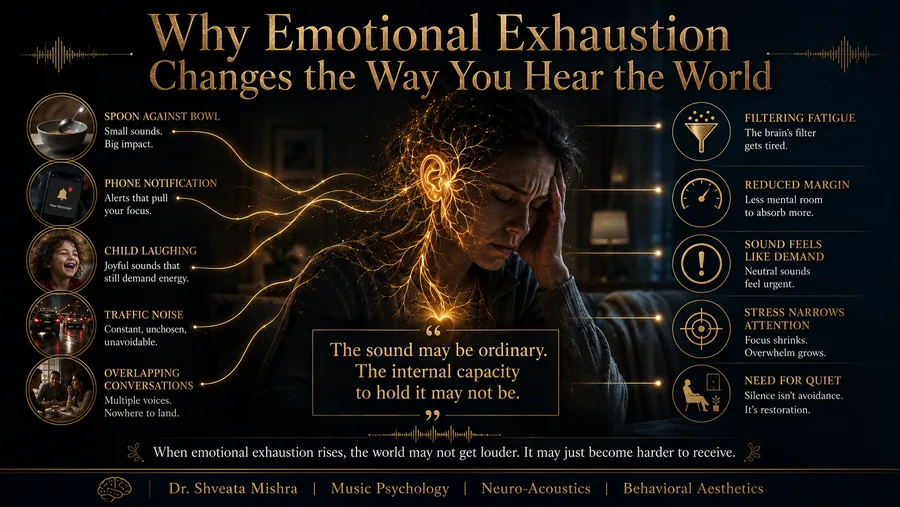
Sometimes the first sign of emotional exhaustion is not crying, collapsing, or saying, “I cannot do this anymore.”
Sometimes it is the sound of a spoon against a bowl.
A notification that feels like interruption. A child’s laughter that lands too sharply. The hum of traffic outside. A family conversation full of love, yet somehow too much to take in.
The world has not necessarily become louder.
But it may be harder to receive.
This is one quiet truth of emotional exhaustion: it does not only change how much energy we have. It can change the way the world reaches us. Sound can become less like background and more like demand.
In my work as a music psychologist, I keep meeting this quietly. Many people experience it privately and then judge themselves for it. They think, “Why am I so irritable?” “Why does everything sound too close today?”
A more compassionate question may be: what is my nervous system being asked to process when it has very little margin left?
The sound may be ordinary. The internal capacity to hold it may not be.
The short version, if you’re skimming
- Emotional exhaustion can raise sound sensitivity, so ordinary noise starts to feel like too much.
- The issue is usually not your ears. It is the depleted margin your brain needs to filter sound.
- Repetitive, sudden, and emotionally loaded sounds tend to hurt most when you are running empty.
- This is a capacity signal, not a character flaw, and self-blame only makes the noise feel worse.
- Small, controllable sound changes help, and persistent or painful sensitivity deserves real care.
Quick gut check: which of these sound like you lately?
- ☐ A notification or ping lands like a small jolt.
- ☐ A familiar voice feels sharper than the words deserve.
- ☐ A cafe or train that used to feel fine now feels like too much.
- ☐ A song you love suddenly feels like one more demand.
Hold whichever ones you recognized. We will come back to them.
Sound Is Not Just Volume
When people talk about sound sensitivity, they often describe it as if the issue is only loudness. Sometimes it is. Very loud sound can overwhelm the auditory system.
But in daily life, the sounds that disturb us are not always loud.
They may be repetitive. Unpredictable. High-pitched. Emotionally associated. Socially demanding. Impossible to control. A phone alert at the wrong moment may feel more invasive than louder music. A familiar voice may hurt more than an unfamiliar sound because it carries meaning.
This matters because humans do not hear sound as raw vibration alone.
We hear through attention, memory, expectation, emotion, culture, and bodily state. The brain is not a passive recording device. It is constantly asking: What is this? Does it matter? Do I need to respond?
That is why the same sound can feel different on different days.
After good sleep, a busy cafe may feel lively. After emotional strain, it may feel like every cup, chair, and voice has entered your body without permission.
Sound is never only outside us. It meets the condition of the person listening.
What Emotional Exhaustion Does To Listening
Emotional exhaustion is often discussed as a mood problem, but it is also a capacity problem.
It can appear after chronic workplace stress, caregiving, grief, uncertainty, relationship strain, overstimulation, or years of holding yourself together. In burnout research, exhaustion is one of the central dimensions: not ordinary tiredness, but a deeper depletion that changes effort, patience, attention, and recovery.
Listening requires all of these. Even when hearing is physically normal, listening is active work. The brain must separate relevant sound from background sound, follow speech, inhibit distractions, and decide whether a sound needs action. This is easy to underestimate because we do it so automatically when we are well.
But when you are emotionally exhausted, automatic processes can begin to feel expensive. A conversation in a noisy restaurant becomes work. A Zoom call with slightly delayed audio becomes irritating. A crowded train becomes not only transportation, but a full sensory negotiation.
The sound is not just sound anymore. It is another request for processing. This is the quiet groundwork of sound sensitivity.
When you are running on empty, even silence has to compete with everything you are already holding.
The Science: Stress Narrows The Margin
A scientifically responsible explanation does not need to claim that exhaustion “rewires” the brain in some dramatic, permanent way. The more accurate point is that stress changes how resources are allocated.
Under stress, the body prepares to respond. Attention can become more threat-oriented. The brain may give greater priority to signals that are sudden, uncertain, or emotionally charged. At the same time, the prefrontal systems that help with filtering, perspective, and flexible attention can become less available, especially when stress is intense or prolonged.
In simple language: the part of you that usually says “ignore that, it is not important” may have less energy to do its job.
This is one reason emotionally exhausted people may feel more reactive to sound. The nervous system is already carrying load. A noise that would normally be filtered out now competes for scarce attention. A repeated sound becomes intolerable because repetition demands inhibition, and inhibition is tiring.
Research does not suggest that every exhausted person develops clinical sound sensitivity. People differ widely. But the connection between stress, exhaustion, and sound discomfort is real enough to take seriously.
One especially relevant study found that after an acute stress task, women with high emotional exhaustion showed increased signs of hyperacusis, meaning reduced tolerance for everyday sound. The study should not be overgeneralized, but it points to something many people recognize: stress can change the threshold at which sound feels like too much.
Environmental noise research adds another layer. According to the World Health Organization, chronic noise exposure is not merely annoying. It has been associated with sleep disturbance, stress responses, annoyance, cognitive effects, and longer-term health risks. The body may keep reacting to sound even when the mind tries to be reasonable.
So when a person says, “I cannot take noise today,” they may not be being dramatic.
They may be describing a nervous system with reduced capacity to screen the world. Seen this way, sound sensitivity is less a flaw than a readout of capacity.
Keep reading
Real-Life Examples Of Sound Sensitivity When Exhausted
Sound sensitivity during exhaustion often shows up in ordinary places.
At work, someone may tolerate complex tasks but feel undone by constant pings or side conversations. The issue is not laziness. Their attention is being split before it can settle.
At home, a parent may love their child deeply and still feel pierced by normal noise at the end of a long day. Love does not cancel sensory load.
In cities, traffic, construction, generators, horns, sirens, and apartment noise can make the nervous system feel as if it never fully gets to stand down. This may be felt in New York, London, Toronto, Delhi, Mumbai, or anywhere modern life enters the body through sound.
In relationships, a partner’s voice may feel harsher during exhaustion, even when their words are neutral. The auditory system is not only processing pitch and volume. It is reading emotional meaning.
And with music, something very personal can happen. A song that usually comforts you may suddenly feel intrusive. I have written separately about why a favorite song can suddenly start to grate, and exhaustion is often the hidden reason. This does not mean you have stopped loving music. It may mean your system needs less input before it can receive beauty again.
Humans do not just hear sound.
They recognize themselves in it.
When we are exhausted, what we recognize in sound may be our own depleted state.
The Emotional Shift: From Self-Blame To Self-Understanding
The most important shift is not to label every irritation as pathology. It is to stop shaming every sound reaction as a character flaw.
If you are more sensitive to noise when depleted, it may not mean you are fragile, difficult, antisocial, or ungrateful. It may mean your filtering system is tired.
That distinction matters.
Self-blame makes the sound feel even more threatening, because now the noise is joined by shame. Self-understanding creates enough space to ask useful questions. Think back to the gut check earlier.
What kind of sound is hardest right now: sudden, repetitive, layered, emotional, or uncontrollable?
Does this happen more after poor sleep, conflict, travel, caregiving, or emotionally demanding work?
Am I reacting to the sound itself, or to what the sound represents: interruption, obligation, criticism, loss of control, or no time to recover?
This is where emotional intelligence enters listening. The question is not only “What am I hearing?” It is also “What is this sound asking of me?”
Some sounds ask us to respond. Some ask us to remember. Some ask us to protect attention. Some ask us to stay available when we have already given too much.
When the request exceeds capacity, even small sounds can feel large.
Small Sound Adjustments That Respect The Nervous System
A more humane sound life does not require silence everywhere. It requires fewer unnecessary demands.
Start with the sounds you can control. Turn off nonessential alerts. Change harsh notification tones. Create a short quiet buffer before and after intense conversations. Use predictable background sound if complete silence makes every small noise more noticeable.
Try this tonight: pick one nonessential alert and silence it completely for forty-eight hours. Notice whether the day feels even slightly less crowded.
If you work in a noisy environment, headphones, quieter rooms, written follow-ups, or fewer overlapping audio channels may support attention. If you live with others, explain sound sensitivity as a capacity issue rather than an accusation.
Instead of saying, “You are too loud,” try, “My system is overloaded today. I need a little less sound for a while.”
There is dignity in naming the need without blaming the person.
If this way of understanding sound speaks to you, the subscribe form at the end of the page is where reflections like this one arrive first.
It is also important to know when support is needed. If sound causes pain, fear, major avoidance, new tinnitus, hearing changes, dizziness, or severe distress, speak with an audiologist, ENT specialist, psychologist, or qualified health professional. Sound sensitivity can overlap with hyperacusis, misophonia, migraine, trauma, anxiety, hearing changes, and other conditions. It deserves care, not dismissal.
Hearing The World With More Compassion
Emotional exhaustion changes listening because listening is not separate from living.
A depleted person does not meet sound with the same inner resources as a rested person. The auditory system may be doing its job, but the whole person is carrying too much.
This is why the way we hear the world can become a private barometer of capacity. The sharpness of a notification, the pressure of a voice, the sudden need for quiet: these may all be signals that the system needs recovery, not criticism. Rising sound sensitivity is one of those signals.
The goal is not to become perfectly calm around every sound. That would not be human.
The goal is to listen more intelligently to our listening.
When the world begins to sound too loud, too close, or too demanding, it may be asking us to notice something we have been overriding. Not only the sound outside, but the exhaustion inside.
So here is my question for you. When the world starts to sound like too much, what is the first sound you wish you could turn down? I read the comments, and I would genuinely love to know.
Keep reading: the sound, stress, and the nervous system series
- Why Emotional Exhaustion Makes Small Tasks Feel Heavy
- Why Do Certain Voices Instantly Calm Your Nervous System?
- Sound and the Nervous System: 5 Audio Anchors for a Steadier Mind
- Why Your Body Reacts to Music Before Your Mind Understands It
Frequently Asked Questions
Can emotional exhaustion really make sounds feel louder?
It can make sounds feel louder, sharper, more intrusive, or harder to tolerate. This does not always mean the ear itself has changed. Often, exhaustion reduces the mental and emotional margin needed to filter sound, manage attention, and stay calm around stimulation.
Is sound sensitivity the same as hyperacusis or misophonia?
Not necessarily. Hyperacusis usually refers to reduced tolerance for everyday sound levels. Misophonia involves strong emotional reactions to particular trigger sounds. General sound sensitivity during exhaustion may overlap with these experiences, but it can also be temporary and context-dependent.
Why do sounds bother me more after work or poor sleep?
Work stress, poor sleep, emotional strain, and decision fatigue all reduce capacity. When the brain is already managing too much, ordinary sounds may feel like additional demands rather than neutral background.
Does sound sensitivity from exhaustion go away?
Often it eases as you recover, sleep, and lower your overall load, because it tracks your capacity rather than a fixed change in your hearing. If the sensitivity persists, worsens, or appears without an obvious stressor, it is worth having it assessed.
Can music still help when I feel overwhelmed by sound?
Sometimes, but the kind of sound matters. When you are overloaded, quieter, slower, and more predictable sound is usually easier to receive than rich or unfamiliar music. On the hardest days, less input, not more, may be what lets you enjoy music again later.
When should I seek professional help?
Seek support if sound sensitivity is painful, worsening, linked with tinnitus or hearing changes, causing major avoidance, affecting work or relationships, or making daily life feel unsafe. A professional can help distinguish stress-related sensitivity from auditory, neurological, or psychological conditions.

About the author
Dr. Shveata Mishra
Begin with the ritual
Get the free 5-Minute Sound Ritual.
A research-informed listening practice designed to help your nervous system settle, sent to your inbox as a PDF. You will also receive new writing on sound, emotion, and identity whenever an article is published.