

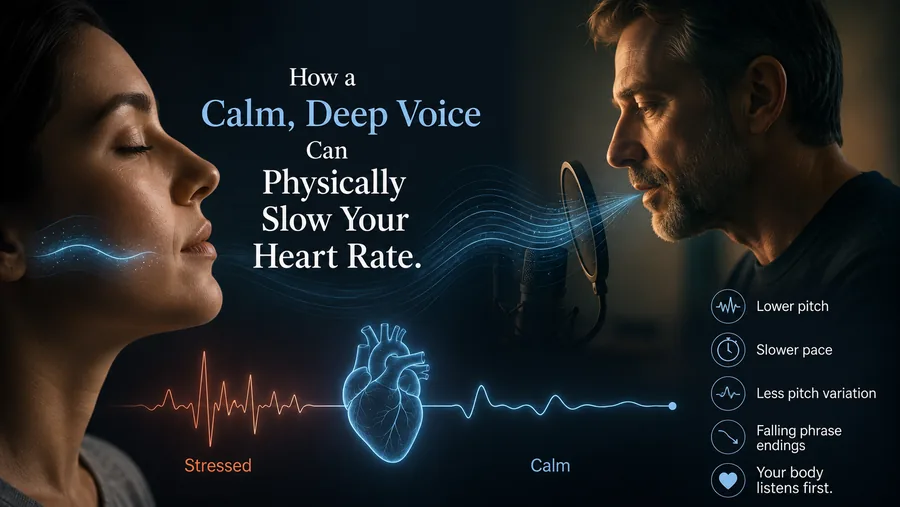
Think of the last time someone talked you down. Not with a good argument. With a voice. Maybe it was a doctor explaining a scan, or a pilot on the intercom during turbulence, or a friend who picked up at 2am and said your name slowly. Your shoulders came down before you had processed a single word. That is a calm deep voice doing its work, and the effect is not only emotional. It shows up in the body, in measurements as ordinary as beats per minute.
The words arrive second. The voice arrives first, and the body has already begun answering it.
The short version, if you’re skimming
- A calm deep voice is a specific acoustic package: low fundamental frequency, slow speech rate, small pitch variation, smooth phrases that fall at the end rather than rising.
- Your heart rate tracks attention and emotional state continuously, so a voice you are listening to closely is already influencing it.
- Listeners’ heart rates synchronise when they attend to the same spoken narrative, and that synchrony collapses when they stop paying attention.
- In laboratory work on soft, whispered speech, heart rate dropped by roughly three beats per minute alongside a rise in pleasant feeling.
- The changes are real and modest. This is a measurable shift, not a treatment, and a calm deep voice can be used to reassure or to manipulate.
Quick gut check: which of these is true for you?
- ☐ There is one person whose voice settles you even when the news is bad.
- ☐ You have chosen a podcast or an audiobook narrator mainly for how they sound, not what they say.
- ☐ A raised, fast voice on a call leaves you activated for a while after you hang up.
- ☐ You deliberately lower and slow your own voice when someone near you is upset.
What a calm deep voice actually is
Let me be precise, because “soothing voice” is doing a lot of vague work in most articles. When people describe a calm deep voice, they are usually responding to four measurable features at once.
- Low fundamental frequency. The pitch of a voice is set by how fast the vocal folds vibrate. Adult male voices typically sit around 85 to 155 Hz, adult female voices around 165 to 255 Hz. “Deep” simply means the lower end of a person’s own range.
- Slow speech rate. Fewer syllables per second, with longer pauses between phrases.
- Narrow pitch variability. The voice moves, but within a small band. Nothing spikes.
- Falling phrase endings. Statements settle downward. Anxiety and urgency push endings upward.
Collectively these features are called prosody: the melody, rhythm, and stress of speech, the layer that survives even when you cannot make out the words through a wall. Prosody is what your brain reads first, and it is remarkably hard to disguise.
Try this: on your next difficult call, exhale fully before you speak. Not a technique for them. Your own pitch drops on a relaxed out-breath, and the rest tends to follow.
Why your heart rate is listening at all
Heart rate is not a fixed number waiting for a shock to change it. It fluctuates constantly, beat to beat, under the influence of the vagus nerve and your breathing. Researchers measure that fluctuation as heart rate variability, and it moves with attention, effort, and emotional state, second by second. Anything you attend to closely is already in the loop.
The most striking demonstration I know comes from work on narrative listening. A team led by Pauline Pérez and colleagues found that listeners’ heart rates synchronise with one another when they attend to the same spoken story, that this synchrony drops when listeners are distracted, and that stronger synchrony predicts better recall of what was said. Their conclusion is the interesting part: heart rate fluctuations are partly driven by conscious processing of what you are hearing.
Read that again in the context of a voice. If merely following a spoken narrative reshapes cardiac rhythm across a room of strangers, then the specific voice delivering it is not a neutral carrier. It is part of the signal your body is responding to.
The measurable evidence for a calm deep voice
Two findings anchor this for me.
The first is the ASMR work by Giulia Poerio and colleagues at Sheffield. In their laboratory study, participants who experience the tingling response watched videos built around whispering, soft speech, and close personal attention. Those participants showed reduced heart rate, around three beats per minute on average, alongside increased positive emotion and higher skin conductance. Note the combination. Calmer heart, more engaged skin. This is not sedation. It is a particular state of alert settledness.
The second is older and, I think, more moving. Leslie Seltzer, Toni Ziegler and Seth Pollak stressed a group of children and then comforted them in different ways. Children who received full contact from their mother showed the expected hormonal recovery. So did children who heard only their mother’s voice over the phone: oxytocin rose and cortisol fell in a strikingly similar pattern, with no touch involved at all. The authors concluded that vocalisation may matter as much as touch in the neuroendocrine side of human bonding.
A voice reached across a phone line and did much of what an embrace does. That is the scale of what we are discussing.
Keep reading
Why low pitch specifically
Now the part that explains the word “deep”. Two things are happening.
The first is signalling. Across species, low-frequency vocalisations tend to come from larger bodies, so lower pitch has long carried associations with size, stability, and control rather than alarm. Human listeners rate lower-pitched voices as more authoritative and more trustworthy in first impressions, an effect studied most consistently in male voices. Whatever its evolutionary origin, the association is well established in perception.
The second is honesty of the signal, and this is the part I find most useful. To produce a genuinely low, steady pitch you need a relaxed larynx, an unhurried out-breath, and no excess muscular tension in the neck and jaw. Stress does the opposite: it tightens the vocal tract, shortens the breath, and lifts pitch. So a calm deep voice is partly a readout of the speaker’s own physiological state. You are not just hearing what they want you to think. You are hearing, to some degree, what their body is actually doing.
That is why a fully faked version tends to leak. The pitch can be pushed down while the speech rate stays fast, or the phrases stop falling properly at the end, and listeners register the mismatch as something being slightly off without being able to say why. I have written about that gap between performed and actual composure in Why We Trust Calm People: Behavioral Dissonance and the Sound of Composure.
Where this fits in my own work
My research examines sound as behavioural information: input that shapes what people feel, do, and identify with, usually before conscious evaluation. The human voice is the densest example of this we encounter daily. Every sentence you hear carries semantic content and, riding on top of it, a continuous physiological broadcast about the state of the person speaking.
A calm deep voice is therefore not decoration on a message. It is a second message, delivered to a system that responds in heartbeats rather than in words.
People don’t just hear sound. They recognize themselves in it. And in another person’s voice, they read the state of their own body back.
The honest limits
I would rather you leave with an accurate picture than an inspiring one.
- The effects are modest. A few beats per minute in a laboratory, not a transformation. Anyone promising that a particular voice or frequency heals conditions is overselling.
- It is not universal. The ASMR heart rate effect appeared in people who experience ASMR and not in those who do not. Voice preference is personal, shaped by memory, culture, and association.
- Familiarity may matter more than pitch. In the Seltzer work, the active ingredient was a specific mother’s voice. Not any calm voice. Hers.
- The same signal can be used against you. A calm deep voice reduces vigilance, which makes it a favourite instrument of people selling things you do not need. Steadiness in a voice is evidence about a body, not a certificate of good intent. See Vocal Cues of Deception and Honesty.
How to use your own voice better
You do not need a naturally deep voice for any of this. You need the other three features, which are entirely learnable.
- Exhale before the first word. Speaking on the tail of a relaxed breath naturally lowers pitch and slows the rate. It is the single highest-yield change.
- Slow down by adding pauses, not by dragging words. Stretched syllables sound patronising. Silence between phrases sounds considered.
- Let sentences fall at the end. Upward endings signal question, uncertainty, or urgency. Downward endings signal completion, which is what a distressed listener needs.
- Drop volume before you drop pitch. Forcing your larynx down to sound authoritative causes vocal strain and reads as false. Quieter and slower gets you most of the way there safely.
- Say the person’s name, once, early. It reliably captures attention, which the research suggests is the channel through which the rest of it works.
If this way of reading everyday sound is useful to you, the subscribe form at the bottom of this page sends the next piece straight to you.
A reframe before you go
We tend to think of a voice as a delivery vehicle. Content is what matters, tone is the packaging. The evidence points somewhere less tidy. Tone reaches the body first, moves attention, and leaves a trace in something as basic as the interval between two heartbeats.
Which means the way you speak to a frightened child, a stressed colleague, or a parent in a hospital corridor is not a soft skill sitting beside the real work. Some of the time, it is the work. And it costs nothing but an out-breath and a slower pace.
So here is my question for you. Whose voice slows you down, and what exactly does it do differently from everyone else’s?
Keep reading: the voice and the nervous system series
- Why Do Certain Voices Instantly Calm Your Nervous System?
- How Voice Shapes Trust: The Hidden Tempo Behind Authority
- Why We Trust Calm People: Behavioral Dissonance and the Sound of Composure
- The Body Knows Before the Mind: How Neuroception Detects Threat Before Logic
Frequently Asked Questions
Does a calm deep voice really slow your heart rate?
Small, measurable reductions have been recorded. In laboratory work on soft, whispered speech, heart rate fell by roughly three beats per minute in people responsive to that kind of audio. Listening attentively to a spoken narrative also reshapes heart rate in a consistent, measurable way across listeners.
Why does a low-pitched voice sound more trustworthy?
Partly association, partly physiology. Lower pitch has long signalled larger body size and lower threat, and listeners consistently rate lower-pitched voices as more authoritative in first impressions. Producing a genuinely low, steady pitch also requires a relaxed larynx and an unhurried breath, so it partly reflects the speaker’s real state.
Can I train myself to have a calm deep voice?
You can train the parts that matter most. Slow your rate, add pauses, let phrases fall at the end, and speak on a relaxed out-breath. Do not force your larynx downward to sound deeper, since that causes strain and listeners tend to detect the effort anyway.
Is this the same as sound healing?
No. This is music psychology and voice research describing measurable perceptual and physiological effects. It does not treat, cure, or replace medical or psychological care, and any claim that a particular voice or frequency heals illness goes well beyond the evidence.
Why does one particular person’s voice calm me more than others?
Familiarity and emotional memory. In research on comforting children, a mother’s voice alone produced hormonal recovery close to that of full physical contact, and the effect was tied to that specific voice. Association built over years usually outweighs acoustic features on their own.
Can a calm deep voice be used manipulatively?
Yes, and it is worth knowing. Vocal steadiness lowers a listener’s vigilance, which makes it useful in sales, persuasion, and coercive relationships. Treat a calm voice as information about someone’s physiological state, not as proof of their intentions.

About the author
Dr. Shveata Mishra
Begin with the ritual
Get the free 5-Minute Sound Ritual.
A research-informed listening practice designed to help your nervous system settle, sent to your inbox as a PDF. You will also receive new writing on sound, emotion, and identity whenever an article is published.