

There is a kind of tiredness that does not announce itself dramatically.
You may still be going to work, answering people, paying bills, studying, parenting, caregiving, and appearing reasonably functional. From the outside, your life may look normal.
But inside, something has become heavy.
Replying to one message feels like climbing a hill. Opening a document feels strangely threatening. Washing a cup, booking an appointment, folding laundry, making one phone call: none of these tasks is objectively large. Yet each one arrives with an invisible weight.
This is a misunderstood experience of emotional exhaustion.
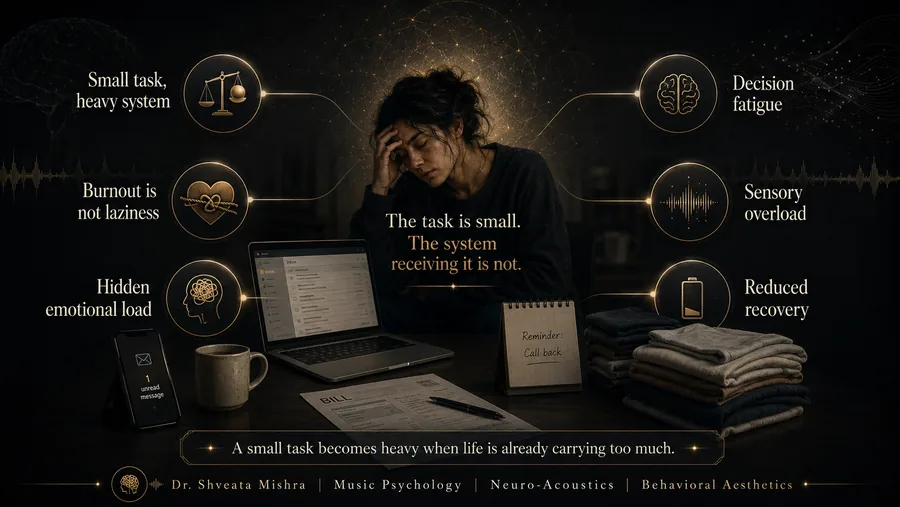
The task is small. The system receiving it is not.
When people ask, "Why does emotional exhaustion make small tasks feel heavy?" they are asking a deeper question: Why do I feel capable in theory and unable in the moment?
The answer is not laziness, weakness, or a character flaw hiding under the language of self-care.
It is often the human nervous system reaching the limit of what it can keep carrying without repair.
A small task can become heavy when it lands on a life already carrying too much.
The short version, if you are skimming
- Emotional exhaustion does not only drain energy. It raises the felt cost of effort, which is why small tasks feel heavy.
- A task is judged by your current capacity, not its size. After a depleting week, five minutes can feel impossible.
- Most simple tasks carry hidden labor: decisions, emotions, and meaning stacked behind one small action.
- When you are depleted, ordinary sound can start to feel like a demand. The nervous system has less room for input.
- The way out is not force. It is making the task smaller than your shame, and letting recovery count as much as effort.
The Ordinary Heaviness People Rarely Admit
Most emotionally exhausted people do not first notice burnout during a crisis. They notice it in small, private moments.
The email that should take three minutes sits unanswered for days. The groceries are in the fridge, but making a simple meal feels like managing a project. The calendar reminder appears, and the body reacts before the mind has even read it.
These moments create shame because the task looks too small to justify the struggle. People start speaking to themselves harshly. "Why can’t I just do it?" "Other people manage so much more."
But emotional exhaustion does not only reduce energy. It changes the felt cost of effort.
A task is not experienced by size alone. It is experienced through current capacity, emotional residue, stress level, sensory load, decision burden, and recovery.
This is why a five-minute task can feel impossible after an overextended week.
Burnout Is Not Just Being Busy
The World Health Organization describes burn-out as an occupational phenomenon linked to chronic workplace stress that has not been successfully managed. Its dimensions include energy depletion or exhaustion, increased mental distance or cynicism related to work, and reduced professional efficacy.
Being busy is not the same as being burnt out. A busy person may be tired but still feel connected to meaning and able to return to effort after rest.
Burnout is different. It happens when demand repeatedly exceeds restoration. It is not only "too much work." It can also be too little control, too little recognition, too much emotional labor, too many interruptions, or too long living in a system where your body never receives the signal that pressure has ended.
The brain begins to conserve. The body begins to resist. Motivation becomes harder to access because effort has been paired too many times with depletion or no real relief afterward.
The body is no longer evaluating only the task. It is evaluating the history of what tasks have cost.
Why Emotional Exhaustion Changes How The Brain Prices Effort
Mental effort is not free.
Research on mental fatigue suggests that the brain weighs the potential reward of a task against its energetic and emotional demands. In everyday language, the mind is asking: Is this worth the cost right now?
Under ordinary conditions, small tasks usually pass that test. Send the message. Make the call. Move the laundry.
But when emotional exhaustion is high, the cost side of the equation changes. Planning, starting, switching tasks, regulating irritation, ignoring notifications, smiling when depleted, and listening carefully when overloaded all require effort.
By the time the small task appears, it is not arriving on an empty desk. It is landing on a full internal workload.
This is why emotional exhaustion can make ordinary executive functions feel less available: prioritizing, sequencing, deciding, beginning, sustaining attention, and stopping at the right time.
The brain has not "shut down." That would be an exaggeration. But the systems that support flexible, goal-directed action can become harder to recruit when chronic stress and fatigue are high.
So the question is not, "Why can’t I do this tiny thing?"
The better question is, "What else is my system already doing that I have stopped counting?"
Keep reading
The Hidden Labor Behind Simple Tasks
Small tasks are rarely just tasks. Replying to a message may also mean managing expectations, choosing the right tone, remembering the relationship, and bracing for the next response.
Paying a bill may also mean confronting money anxiety, uncertainty, guilt, or the fear of not being ahead enough.
Booking a medical appointment may also mean facing vulnerability, paperwork, cost, time, and the possibility of bad news.
Cooking dinner may also mean making decisions when your decision-making system is already worn out. Cleaning a room may also mean facing visual evidence of how tired you have been.
This is why advice such as "just do it" often fails emotionally exhausted people. It misreads the problem. The barrier is not always the physical action. It is the emotional meaning attached to beginning.
A task can be technically simple and psychologically loaded.
The modern world is full of people who are not doing too little. They are doing too much without enough places to put down the weight.
When you are rested, a task can remain one task. When you are depleted, the same task becomes the doorway to everything behind it. Emotional exhaustion turns the future into a crowd.
The Sound Of Overload
Sound can make this visible.
Humans do not just hear sound.
They recognize themselves in it.
When you are well-resourced, the ordinary soundtrack of life may feel manageable: a phone buzz, a kettle, traffic outside, a colleague speaking, a child calling, a message tone, a washing machine, a song in the background.
When you are emotionally exhausted, the same sounds can feel intrusive. The phone does not simply ring. It asks. The notification does not simply appear. It demands.
This does not mean sound caused the burnout. It means the nervous system may have less capacity for incoming stimulation.
From a neuro-acoustic perspective, sound is never only sound. It is context, memory, attention, expectation, and bodily state meeting vibration.
For some people, quiet helps. For others, complete silence makes internal noise louder, and a soft, predictable sound (rain, a fan, gentle instrumental music) can create steadiness. This is part of why background sound quietly shapes the nervous system long before you consciously notice it.
The goal is not to force a universal sound cure. The goal is to notice what your system is telling you.
Sometimes the sound that bothers you is not the problem. It is the messenger.
What Helps When Everything Feels Too Heavy
The first step is not to romanticize exhaustion. The first step is to reduce the cost of beginning.
Make the task smaller than your shame.
Do not "clean the kitchen." Put three things away.
Do not "catch up on messages." Reply to one person with one honest sentence.
Do not "fix your life." Write down the next decision that actually needs your attention.
Do not "get your routine back." Choose one anchor: water, food, daylight, movement, sleep timing, or ten quiet minutes.
Try this today: pick the one task that feels heaviest, then do a version so small it almost feels silly. One sentence. One cup. One minute. Let starting be the whole goal.
When emotionally exhausted, the nervous system needs proof that effort will not always become endless. Stopping matters. Recovery after effort matters.
It can help to sort tasks into three categories: what must be done today, what can be made smaller, and what belongs to someone else, another day, or a system that needs changing.
For burnout especially, individual coping has limits. Breathing, sound, rest, journaling, and routines can help. But if the environment keeps demanding more than a person can sustainably give, deeper repair may require boundaries, workload changes, social support, medical care, therapy, or a serious reassessment of what has become normal.
Burnout is not only a personal issue. Often, it is a relationship between a person and a system.
If this way of looking at effort and the nervous system speaks to you, the subscribe form at the end of this page is where I share new pieces on sound, emotion, and behavior.
The Emotional Shift: From "Why Am I Like This?" To "What Has This Cost Me?"
There is dignity in asking a better question.
Instead of "Why am I so lazy?" ask, "Where has my energy been going?"
Instead of "Why can’t I handle normal life?" ask, "What has become normal that may not be humane?"
Instead of "Why is this small task so hard?" ask, "What meaning, fear, fatigue, or sensory load is attached to this task?"
These questions do not excuse every responsibility. They make responsibility possible by removing unnecessary self-attack.
Emotional exhaustion often needs honesty before strategy.
It needs the truth that you cannot keep extracting effort from a system that has not been allowed to replenish. Productivity without recovery is not strength. It is a debt arrangement with the body.
And the body always keeps the account.
Keep reading: sound, emotion, and the nervous system
- The Body Knows Before the Mind: How the Nervous System Detects Threat Before Logic Catches Up
- Why Certain Voices Instantly Calm Your Nervous System
- The Emotional Wallpaper: Why Your Background Music Is Architecting Your Nervous System
- From Chaos to Harmony: Music Psychology in Daily Life for Mental Health and Focus
Frequently Asked Questions
Is emotional exhaustion the same as laziness?
No. Laziness is often used as a moral label, while emotional exhaustion is a state of reduced capacity after sustained stress, overload, or emotional demand. A person may want to act and still struggle to begin because the cost of effort feels unusually high.
Why does burnout make simple tasks feel impossible?
Burnout can make simple tasks feel impossible because planning, deciding, starting, and regulating emotion all require mental effort. When chronic stress is high, even low-effort tasks can feel demanding.
Can emotional exhaustion affect memory and focus?
Yes. Many people report poorer focus, forgetfulness, slower thinking, and difficulty organizing tasks during burnout or mental fatigue. Research links burnout with cognitive difficulties, though not every person experiences it in the same way.
Why do everyday sounds feel more irritating when I am emotionally exhausted?
When capacity is low, the nervous system has less room for incoming stimulation, so ordinary sounds can start to feel like demands rather than background. From a neuro-acoustic view, the sound is often the messenger rather than the cause. It signals that your system is already carrying a lot.
When should someone seek professional help?
If exhaustion is persistent, worsening, interfering with daily life, or accompanied by depression, panic, sleep disruption, physical symptoms, or thoughts of self-harm, seek support from a qualified health professional or local crisis service.
The Small Task Is Telling The Truth
A small task can be a messenger.
It may be telling you that your body is not recovering.
It may be telling you that your work has become too costly, or that your environment asks for constant responsiveness but gives little restoration.
It may be telling you that the problem is not your discipline, but your depletion.
This does not mean you should abandon responsibility. It means responsibility must include your nervous system, your limits, and your need for recovery.
There will be days when the brave thing is answering one message, eating something simple, lowering the noise, asking for help, or letting one non-urgent thing wait.
Small tasks become lighter when the person carrying them is no longer invisible.
And that may be the deeper work of burnout recovery: not simply doing more, but learning to count what effort has been costing you.
What is one small task that has been feeling heavier than it should lately? Sometimes naming it is where the counting begins. I read the comments.

About the author
Dr. Shveata Mishra
Begin with the ritual
Get the free 5-Minute Sound Ritual.
A research-informed listening practice designed to help your nervous system settle, sent to your inbox as a PDF. You will also receive new writing on sound, emotion, and identity whenever an article is published.