

There is a particular kind of exhaustion that is hard to explain because, from the outside, nothing looks obviously wrong.
You may have a bed, a phone, transport, running water, online banking, digital calendars, and more choices than previous generations could have imagined.
And yet, by the end of an ordinary day, your mind feels strangely spent.
Not devastated. Not always depressed. Not necessarily ungrateful.
Just tired in a way that sleep does not fully fix.
Psychology has a name for this quiet depletion: mental fatigue, the slow draining of attention, decision-making, and emotional control that can build even when nothing dramatic has happened.
This is one of the quiet confusions of modern life: many people are living with more physical comfort than their ancestors had, but with less psychological quiet than their nervous systems can process well.
Comfort can make life easier. It does not automatically make life restorative.
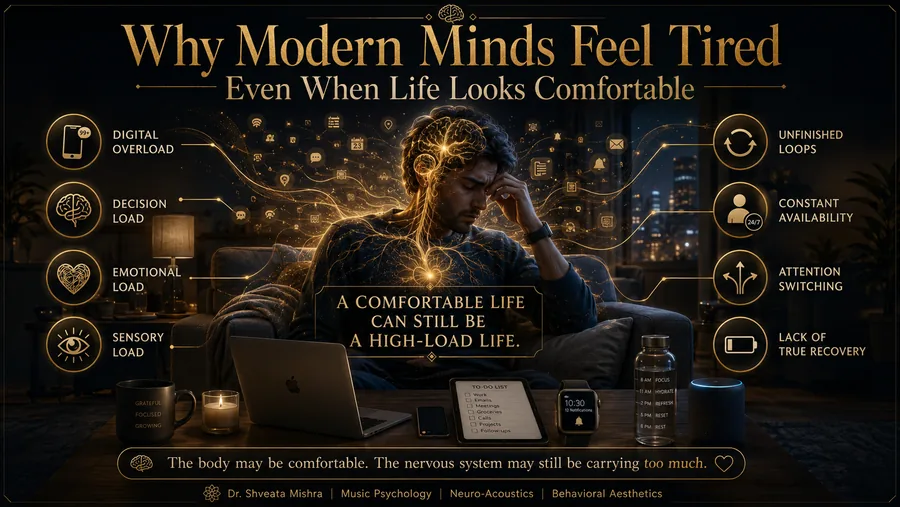
A comfortable life can still be a high-load life.
The Tiredness That Does Not Look Like Hardship
Mental fatigue often hides because it is not always attached to visible suffering, a dramatic crisis, or an obvious emergency.
It may look like a person sitting on a soft sofa, unable to answer one message.
It may look like a student with every resource but no mental room to begin. It may look like a professional in New York, London, Toronto, Delhi, Mumbai, or Dubai whose body tightens before the laptop opens. It may look like someone scrolling in bed because they are too tired to be awake and too activated to sleep.
The outside life may be comfortable. The inside life may still be crowded.
Human beings do not only need resources. We need recovery, endings, and periods where the body no longer has to monitor, compare, decide, perform, respond, or prepare.
Modern life gives many people more convenience. It also gives them fewer clean pauses.
Why Comfort Does Not Equal Recovery
It is tempting to assume that if life is easier, the mind should be less tired. But the nervous system does not measure comfort the way a lifestyle photograph does.
It measures load.
Load can be physical, but it can also be cognitive, emotional, sensory, social, and moral. This cognitive load is the work of deciding what matters, what can wait, what someone meant, what should be answered, what should be ignored, and what version of yourself the situation requires.
Mental effort is real effort. Attention, working memory, planning, emotional regulation, and task switching all draw on limited capacity. Research on mental fatigue does not suggest that the brain simply "runs out of battery" like a phone. Prolonged demand can change how effort feels, how attention is allocated, and how costly another task seems.
The modern mind is rarely doing one thing.
It is writing an email while anticipating the response. Listening in a meeting while watching notifications. Resting while comparing. Eating while absorbing news. Trying to sleep while the mind audits the unfinished day.
Even leisure can become another form of input.
This is why a person can spend an evening on the couch and still not feel recovered. The body was comfortable. The nervous system was still processing.
The Hidden Loads Behind Modern Mental Fatigue
Modern mental fatigue is often cumulative. No single demand looks large enough to explain the tiredness, but together they create a constant background pressure.
There is information load: news, messages, updates, advice, headlines, and the feeling that there is always something else to know.
There is decision load: what to eat, what to answer, what to buy, what to postpone, and which version of health, career, parenting, productivity, or healing is correct.
There is emotional load: staying kind when tired, managing tone, absorbing other people’s moods, and appearing available.
There is sensory load: traffic, construction, alarms, crowded feeds, background music, overlapping voices, and the tiny interruptions of device sounds.
There is unfinished-loop load: the reply you owe, the appointment you have not booked, the decision you postponed, and the thing you are supposed to become.
None of these alone may look severe. That is exactly why people blame themselves.
They say, "My life is not that hard. Why am I so tired?"
A better question is: "How many invisible demands am I asking my system to carry at once?"
Keep reading
The Nervous System Was Not Built For Constant Availability
The human stress response is adaptive. It helps us mobilize for challenge, threat, uncertainty, and effort. The problem is not stress itself. The problem is stress without enough recovery.
Scientists often use the idea of allostatic load to describe the cost of repeated adaptation. The body can adjust to demand, but ongoing adjustment has a price. If the system keeps preparing, monitoring, and recovering incompletely, mental fatigue can become the background state rather than a passing mood.
Modern life often asks for low-grade vigilance rather than one clear emergency.
The phone may be silent, but it is nearby. Work may be over, but the mind has not detached. A disagreement may be finished, but the body is still rehearsing it. A comfortable home may still contain noise, clutter, financial pressure, caregiving, loneliness, or the fear of falling behind.
This is why people can feel exhausted without being able to point to one event.
The nervous system is not only reacting to what happened today. It is reacting to what remains unresolved, unpredictable, and unfinished.
Digital Life Makes Attention Expensive
Digital tools have made many things easier. They have also made attention harder to protect.
The modern mind is repeatedly asked to switch contexts: from a work message to a personal message, from grief in the news to a funny video, from a bill reminder to a friend’s celebration, from a deadline to an advertisement telling you to become a better version of yourself.
Task switching is part of life, but it has a cost. Researchers describe attention residue: a trace of the previous task stays active, making the next task feel heavier. Across a long day, that residue accumulates, and digital overload quietly turns into mental fatigue.
This is one reason modern rest often fails. A person tries to relax inside the same device that carries work, comparison, news, shopping, reminders, and unresolved social contact.
The mind is told, "Rest here," in the same place it is told, "Respond here."
No wonder the body gets confused.
Sound, Notifications, And The Body’s Sense Of Demand
As a music psychologist and neuro-acoustics specialist, I pay close attention to sound because it often reveals the state of the nervous system before language does.
Humans do not just hear sound.
They recognize themselves in it.
A notification is not only a tone. It can become a small social demand. Background noise is not only atmosphere. It can make attention work harder. A song that normally feels comforting may feel intrusive when your system is already full.
Sound reaches the body quickly. It can orient attention, signal safety or urgency, invite connection, or increase irritation when capacity is low. Sound does not control you. It meets the state you are already in.
On a rested day, the phone buzz may feel neutral. On a day shaped by mental fatigue, it may feel like someone has placed one more hand on your shoulder.
Sometimes the sound that irritates you is not the deepest problem. It is the messenger.
The Emotional Shift: From "I Should Be Fine" To "This Is A Real Load"
The most important shift is not to deny comfort. It is to stop using comfort as evidence that mental exhaustion is invalid.
You can be grateful and tired.
You can have privileges and still be overloaded.
You can love your life and still need quieter inputs, better boundaries, deeper sleep, more help, fewer decisions, or real psychological detachment from work and devices.
You may also need relief from the pressure to turn the self into an endless improvement project. Even healing can become tiring when it starts to feel like homework.
This is not helplessness. It is accuracy.
If the problem is load, the answer is not more self-criticism. It is wiser load management and more honest recovery from mental fatigue.
That may mean fewer notifications, more protected transitions between work and home, less multitasking disguised as efficiency, more silence, or more gentle sound if silence feels too exposed. It may mean embodied rest: walking, stretching, breathing slowly, eating without input, sitting without a screen, or listening to music that helps you return to yourself rather than escape yourself.
It may also mean professional support if exhaustion is persistent, worsening, linked to anxiety or depression, or interfering with daily functioning.
Modern tiredness does not always need drama before it deserves care.
Frequently Asked Questions
Why do I feel tired even when my life is comfortable?
Comfort does not automatically reduce cognitive load or emotional, digital, social, and sensory demands. A life can look comfortable while the nervous system still deals with constant decisions, interruptions, responsibility, comparison, noise, and too little recovery, which is a common recipe for mental fatigue.
Is mental fatigue the same as burnout?
It can overlap with burnout, especially when chronic workplace stress, emotional exhaustion, cynicism, and reduced efficacy are present, which is how the World Health Organization defines burnout. This pattern is sometimes called modern burnout, but not all mental fatigue is burnout. It may also involve poor sleep, anxiety, depression, caregiving strain, digital overload, grief, loneliness, medical issues, or sensory overload.
Can digital overload really affect mental fatigue?
Yes. Constant notifications, context switching, information intake, and social comparison can increase attention and self-regulation demands. Digital tools can be useful, but they can also make it harder for the mind to detach and recover.
Why do sounds and notifications irritate me more when I am tired?
When capacity is low, the nervous system has less room for extra input. A neutral sound may feel demanding when you are already stressed, sleep-deprived, overstimulated, or emotionally exhausted.
What helps a tired nervous system recover from mental fatigue?
Start by lowering load rather than demanding instant motivation. Reduce unnecessary alerts, protect sleep, take real breaks from screens, simplify decisions, spend time in predictable sound or quiet, and seek professional support if fatigue is persistent or affects daily life.
The Quiet Work Of Becoming Less Overloaded
Modern minds are not weak because they are tired.
They are often tired because they are trying to live with too many open channels and too few true endings.
The task is not to reject comfort, technology, ambition, or responsibility. The task is to become honest about recovery.
The nervous system does not only need a comfortable room. It needs signals of completion, moments where no one is asking, and attention that is not divided before it has had a chance to arrive.
And perhaps most of all, it needs a kinder interpretation of fatigue.
When life looks comfortable and you still feel tired, do not call yourself ungrateful.
Ask what you have been carrying that no one can see.
Ask where your day never truly ends.
Ask what quiet would let you recognize yourself again.
Because the modern mind does not heal by being accused of weakness.
It heals when the full load is finally counted.

About the author
Dr. Shveata Mishra
Begin with the ritual
Get the free 5-Minute Sound Ritual.
A research-informed listening practice designed to help your nervous system settle, sent to your inbox as a PDF. You will also receive new writing on sound, emotion, and identity whenever an article is published.