

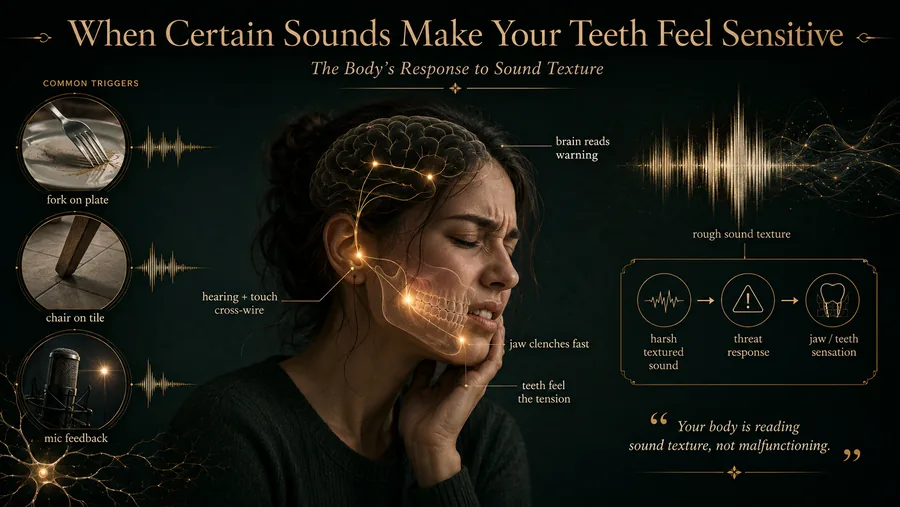
A fork drags across a plate. Someone scrapes a chair leg over tile. A microphone whines for half a second before the speaker catches it. And before you have decided anything, your shoulders rise, your jaw tightens, and you feel it in the strangest place: your teeth. Not your ears. Your teeth, going thin and electric, as if the sound walked straight into the enamel. That odd, specific reaction is your body reading sound texture, and it is far more common, and far more interesting, than you have been told.
Your teeth do not have ears. So why do they flinch?
The short version, if you’re skimming
- Some sounds carry a rough sound texture, and your brain is wired to treat that roughness as a warning.
- The teeth feeling is mostly cross-wiring: hearing and touch share more neural real estate than we assume.
- A lot of it is also your own face. You wince and clench before you notice, and you feel that as tooth pressure.
- In a smaller number of cases there is a real dental component worth a dentist’s eye.
- None of this means something is wrong with you. It means your body is paying attention.
Quick gut check: which of these is true for you right now?
Tick the ones that fit. Hold on to your answers, we’ll come back to them.
- ☐ A specific sound (cutlery, polystyrene, a certain voice) makes your teeth ache or tingle.
- ☐ You feel the cringe in your jaw and face, not really in your ears.
- ☐ The reaction arrives before you’ve consciously identified the sound.
- ☐ Soft, smooth sounds never do this. Only sharp, scraping, grating ones.
What sound texture actually is
We talk about sound as if it only has pitch and volume. It has more than that. It has grain. A flute and a fork on a plate can hit the same note, yet one feels smooth and the other feels like sandpaper on the inside of your skull. That quality is sound texture, and acousticians have a precise word for the rough end of it: acoustic roughness.
Roughness happens when a sound fluctuates very fast in loudness, roughly thirty to one hundred and fifty times a second. Your ear cannot keep up with flutters that quick, so instead of hearing them as separate beats, you feel them as a single grating, buzzing texture. Smooth sounds barely fluctuate. Scrapes, screeches, distorted speakers, and dragged metal are drenched in it.
Here is the part that matters. This rough sound texture is not a metaphor. Researchers led by Luc Arnal found that human screams live in exactly this rough band, and that roughness is what lets a scream bypass slow, deliberate thinking and trip the brain’s threat circuitry directly. So when a sound is rough, your nervous system has good evolutionary reason to treat it as a thing to escape, not a thing to analyze.
Try this: next time a sound sets you off, ask one question before you react. Is it loud, or is it rough? The answer is almost always rough.
Why certain sounds make your teeth hurt and your whole face brace
Now to the teeth. There are three things happening at once, and your body stacks them so fast they feel like one.
First, the alarm. In a well-known imaging study, Sukhbinder Kumar and colleagues played people unpleasant sounds and watched the amygdala, the brain’s threat detector, light up in step with the auditory cortex. The worse a sound was rated, the tighter that coupling. The most hated sounds clustered between two thousand and five thousand hertz, the exact range your hearing is most sensitive to. Your brain is not being dramatic. It is doing its oldest job.
Second, the cross-wiring. Hearing and touch are not as separate as they feel. In some people this is vivid enough to be called auditory-tactile synesthesia, where a sound reliably produces a bodily sensation, and recent work shows the frequency of the sound even predicts where on the body that sensation lands. Most of us have a quieter version of the same plumbing. A sharp, high sound can register as a felt thing in the face and teeth because the regions that process sound and the regions that process touch talk to each other constantly. Your teeth do not hear. Your brain just files the sensation there.
Third, and this is the one people miss, you do it to yourself. A grating sound triggers the acoustic startle reflex, and one of the fastest muscles to fire in the entire human body is the masseter, your jaw muscle. Before you are aware of anything, you grimace, your jaw clenches, your back teeth press together. That clench is what you then feel “in your teeth.” Half of the sensation is the sound. The other half is your own protective face.
If this resonates, I went deeper into the timing of it here: Why Your Body Reacts to Music Before Your Mind Understands It.
Keep reading
When it is actually your teeth, not just your brain
I want to be careful here, because there is a smaller, genuinely physical version of this. The dentin inside your teeth is full of microscopic fluid-filled tubules that run down to the nerve. If that dentin is exposed, from worn enamel, receding gums, or a cracked filling, fast pressure changes can disturb that fluid and irritate the nerve directly. In that case a sound, or even cold air, can produce a real twinge rather than a referred one.
So how do you tell the difference? A few honest signposts. If the feeling is sharp, localized to one or two specific teeth, and also shows up with cold drinks, biting, or sweetness, that points toward dentin sensitivity, and a dentist is the right next stop. If it is diffuse, tied only to certain textures of sound, and gone the moment the sound stops, it is far more likely the neural and muscular story above. This article examines the everyday version. It is educational, not a diagnosis, and persistent tooth pain always deserves a professional eye.
What to actually do about it
- Name it as sound texture, not volume. Turning a sound down often does little, because roughness, not loudness, is the trigger. Removing or masking the rough source helps far more.
- Unclench on purpose. Since a chunk of the sensation is your own jaw, a slow exhale and a deliberate softening of the masseter, tongue off the roof of the mouth, teeth slightly apart, can take the edge off in seconds.
- Give the rough sounds a buffer. Soft background sound, distance, or simply expecting the noise (the dentist’s drill, the train brakes) blunts the startle, because an anticipated sound startles you far less than an ambush.
If sound texture is costing you more than one article can fix, a discovery consultation is where we look at your specific triggers together.
If you like the way this connects body and sound, my occasional letter goes to the same place. The subscribe form is waiting at the bottom of this page.
The reframe: your body was reading, not malfunctioning
Here is what I keep coming back to. The teeth-on-edge feeling is usually treated as a glitch, a silly oversensitivity to put up with. I see it almost the opposite way. It is evidence of how finely your body reads sound texture, how it registers grain and warning long before your conscious mind has labeled a single thing. Sound was never only information for the ears. It is behavioral information for the whole body, and your flinch is that body answering honestly.
People don’t just hear sound. They recognize themselves in it, sometimes in the most literal, physical way: a sharpness in the teeth, a brace in the jaw, a self that responded before it was asked.
So I’ll leave you with the question. Which specific sound sets your teeth on edge, and where exactly do you feel it?
Keep reading: the sound and the body series
- Why Your Body Reacts to Music Before Your Mind Understands It
- Why Certain Songs Make You Feel Understood
- Why Do Certain Voices Instantly Calm Your Nervous System
- You Are Not Just Seen or Heard, You Are Neurologically Perceived
Frequently Asked Questions
Why do certain sounds make my teeth feel sensitive?
It is mostly your brain and your own face, not your teeth. Sharp, rough sounds trigger a threat response and an automatic jaw clench, and because hearing and touch share neural pathways, the brain often files that sensation in the teeth. A smaller number of cases involve real dentin sensitivity.
Is sound texture a real scientific idea?
Yes. The rough, grating quality of a sound is measurable as acoustic roughness, caused by very fast fluctuations in loudness. Research shows roughness is the feature that makes sounds like screams and scrapes feel alarming, separate from how loud they are.
Why do nails on a chalkboard feel so much worse than other loud sounds?
Because they sit in the two thousand to five thousand hertz range your hearing is most sensitive to, and they are acoustically rough. Imaging studies link that combination to heightened activity between the amygdala and the auditory cortex, which is why the reaction feels involuntary.
Should I see a dentist about it?
If the feeling is a sharp twinge in one or two specific teeth, or it also shows up with cold, sweet, or biting, yes, see a dentist to rule out exposed dentin or a cracked tooth. If it is diffuse and stops the instant the sound does, it is more likely the neural and muscular response.
Is this the same as misophonia?
Related but not identical. Misophonia is a strong emotional reaction to specific trigger sounds. The teeth-on-edge response is more about sound texture and reflexive bracing, where the grain of a sound matters more than its meaning, though the two can certainly overlap in the same person.
Can I train myself out of the reaction?
You can soften it. Because anticipated sounds startle you less, knowing a rough sound is coming helps, as does consciously relaxing your jaw and masking the rough source. The underlying sensitivity is wired in, but how much it grips you is partly trainable.

About the author
Dr. Shveata Mishra
Begin with the ritual
Get the free 5-Minute Sound Ritual.
A research-informed listening practice designed to help your nervous system settle, sent to your inbox as a PDF. You will also receive new writing on sound, emotion, and identity whenever an article is published.