

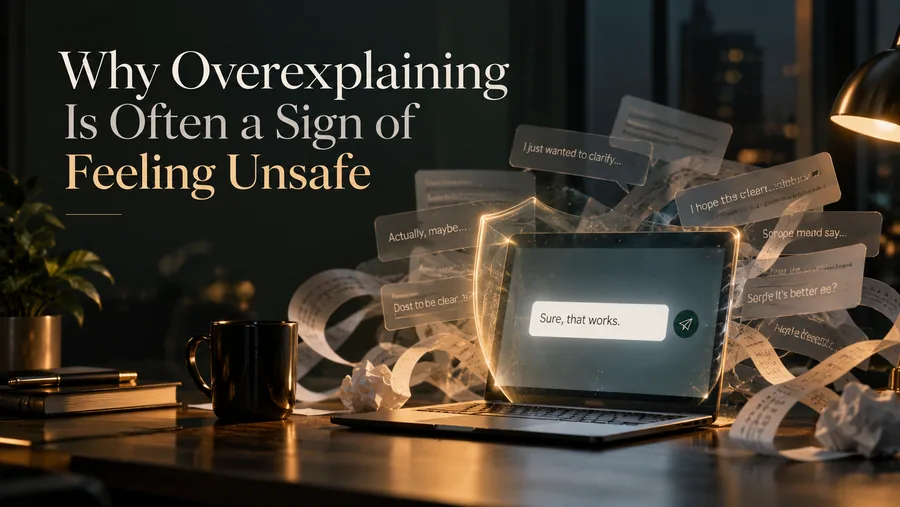
You cannot make it on Thursday. That is the whole message. Three words would do it.
What you actually send is a paragraph. The thing that came up, why it came up, why you could not have foreseen it, a note about how much you were looking forward to it, an alternative date, and a closing line hoping they understand. Then you read it back and add one more clause, because the fourth sentence sounded a little abrupt.
Nobody asked for any of that. And if you have ever wondered why you overexplain when a simple sentence would land better, the answer is usually not that you are bad at brevity. It is that somewhere along the line you learned a plain answer was not safe to give.
An explanation shares information. A justification requests permission. Most overexplaining is the second thing wearing the clothes of the first.
The short version, if you’re skimming
- Overexplaining is usually anticipatory. You are pre-defending against a challenge that has not happened.
- It is one of the behaviors clinicians group under appeasement or “fawning”, a shorthand for managing threat by placating rather than fighting or fleeing.
- That term is clinical language rather than a settled research category, and it is worth holding loosely.
- What is better established is the attachment picture: insecurity is associated with shame-prone responding and with strategies aimed at keeping others regulated.
- Why you overexplain is usually a statement about a past audience, not the present one.
Quick gut check: which of these is true for you right now?
Tick whatever fits. We come back to these.
- ☐ I add reasons to a “no” that nobody requested.
- ☐ I rehearse messages before sending them, including trivial ones.
- ☐ I feel a spike of anxiety when a reply is short.
- ☐ I apologize for things that are not apologies, like taking up time.
- ☐ Someone has told me they did not need the detail, and I gave it anyway next time.
Why you overexplain: the anticipated challenge
Start with the structure of the behavior, because it reveals what it is for.
Overexplaining is almost never a response to something that has happened. It is a response to something you expect to happen. The extra clauses are not clarifying your position. They are pre-emptively answering objections nobody has raised, from a person who has given no sign of raising them.
That tells you the audience in your head is not the person in front of you.
Somewhere there was a version of this conversation where a plain answer was not accepted. Where “I can’t” produced an interrogation, or a sulk, or a withdrawal of warmth, or a long silence you then had to repair. If that happened enough times, you stopped offering the plain answer and started shipping the defense pre-attached, because that was genuinely the cheaper option at the time.
It is worth saying plainly: this was adaptive. It is not a character flaw and it is not vanity. Whatever taught you to do it, you learned a real lesson about a real environment. The difficulty is that the strategy does not know the environment has changed. Why you overexplain today is often a faithful answer to a question nobody is still asking.
Try this: write the short version of your next awkward message. Then notice the physical resistance to sending it. That resistance is the whole subject of this article.
Keep reading
Appeasement, and how much weight the term will carry
Here I want to be careful, because this topic attracts more confident language than the evidence supports.
You will see overexplaining described as part of a “fawn response”, a fourth option alongside fight, flight and freeze, in which someone manages threat by placating. Clinically this is a widely used shorthand, and the description of the pattern will ring true for a lot of people: chronic people-pleasing, difficulty saying no, over-apologizing, hyperawareness of other people’s moods, and overexplaining the motivations behind ordinary actions.
But “fawn” is practitioner language rather than an established experimental category with the research base that fight-or-flight has. I use it here because it is a useful label for a recognizable cluster, not because it has been demonstrated as a distinct mechanism. If you find it clarifying, take it. If you find it over-claimed, you are not wrong.
What has more support is the attachment picture around it. Research on insecure attachment finds associations with dispositional shame and with shame-coping styles, including withdrawal and avoidance, which in turn relate to psychological distress. The relevant thread is that early relational inconsistency is associated with strategies built around managing the other person’s state, and overexplaining is a very efficient way of trying to do that.
So: the pattern is real and recognizable. The tidy four-part model is a convenience. Both things can be true, and neither changes why you overexplain in the moment.
What overexplaining actually costs
It looks harmless. It is not free, and the costs are specific.
- It transfers your anxiety. A long, hedged, over-justified message tells the recipient that something delicate is happening. They now have to work out what. You have made a simple logistics note into an emotional event.
- It invites the scrutiny it fears. Nine reasons read as less convincing than one. Excess justification signals that the position needs propping up, so the listener starts examining it. The defense produces the attack.
- It teaches people to manage you. If a plain request from you arrives wrapped in reassurance, people learn that you need handling, and they begin softening things, which reduces the honest information you get back.
- It is exhausting. Every interaction runs through an editing process with no natural stopping point. This is where it starts to look like the emotional fatigue I described in Why Emotional Exhaustion Makes Small Tasks Feel Heavy.
And there is a quieter cost. Overexplaining is a way of asking to be found reasonable. Doing it constantly means never finding out whether you would have been accepted without the argument. That unanswered question is the real cost of why you overexplain.
You are not giving them information. You are building a case, in a room where nobody has accused you of anything.
The tone underneath the words
This is the layer I pay most attention to, and it is usually missed.
Overexplaining is not only a text phenomenon. It has an acoustic signature: rising intonation at the ends of statements, so declarations arrive shaped like questions. Faster pace. Higher pitch. Filled pauses. A small upward lift on the last word of a sentence that effectively asks “is that all right?”
Listeners read that instantly, and mostly below awareness. The words say “I can’t make Thursday”. The prosody says “please do not be annoyed with me”. People respond to the second message, which is why overexplaining so often produces exactly the careful, slightly concerned reply you were trying to avoid.
This is the same channel I wrote about in False Calm and Performative Control, running the other direction. Composure hides distress. Overexplaining broadcasts it while the words insist everything is fine. Why you overexplain is audible long before it is readable.
What to actually do about it
Look back at your gut-check ticks. Three or more and this is a pattern rather than an occasional wobble.
- Send the short version once. Not always. Once, with someone safe, as an experiment. The point is to collect evidence that the plain answer survives.
- Cut the last sentence. Most overexplaining lives in the final clause, the one added after re-reading. It is almost always the reassurance-seeking one.
- Notice the tense. If you are answering an objection that has not been made, you are talking to someone from your past. Ask who.
- Let “no” be a complete sentence, with warmth. The warmth is genuine and the reasons are optional. Those are separable, and most people conflate them.
- Watch your intonation, not just your words. Ending statements downward changes how a plain answer is received more than any amount of rewording.
- Do not overcorrect into bluntness. The goal is not terseness. Why you overexplain is a safety question, and the answer is not to become someone who does not care how things land.
- Expect it to feel wrong at first. Understanding why you overexplain will not remove the discomfort of stopping. Only repeated evidence does that.
If this kind of writing on voice, emotion and human behavior is useful to you, the subscribe form at the bottom of the page will send new pieces your way.
The reframe: an old audience in a new room
The thing I would most want you to take from this is that overexplaining is not a communication deficit. It is a safety behavior, and safety behaviors are evidence that something once made safety necessary.
That reframing changes the task. You are not trying to be more concise, which is a writing problem and a boring one. You are testing an old prediction: that a plain answer from you will not be accepted. That prediction was formed with real data, from a real room, and has never been checked against the current one. Why you overexplain is a hypothesis you have never run the experiment on.
Why you overexplain is, in the end, a question about who you think is listening. The short version is only frightening if the audience in your head is someone who used to argue.
So it is worth asking directly: whose voice do you hear when you imagine sending the three-word reply?
Keep reading: the behavior and safety series
- False Calm and Performative Control: Why Composure Is Often Mistaken for Integrity
- The Psychology of Why Strong People Struggle to Ask for Help
- The Hidden Cost of Being “Low Maintenance” in Relationships
- The Negativity Bias: Why Criticism Stays Longer Than Praise
Frequently Asked Questions
Why do I overexplain everything?
Usually because the explanation is anticipatory. You are pre-answering objections nobody has raised, which suggests the audience you are addressing is not the person in front of you. Why you overexplain is generally a statement about a past environment rather than the present one.
Is overexplaining a trauma response?
It is often grouped under appeasement or “fawning” in clinical writing, alongside people-pleasing, over-apologizing and hyperawareness of others’ moods. That label is practitioner shorthand rather than a settled experimental category, so it is worth holding loosely even if the description fits.
What is the difference between explaining and justifying?
It is the distinction at the heart of why you overexplain. An explanation shares information. A justification requests permission. Most overexplaining is the second one presented as the first, which is why it feels compulsory rather than optional.
Does overexplaining actually make things worse?
Often yes. Excess justification signals that a position needs propping up, so listeners scrutinize it more. It also transfers your anxiety to the recipient and teaches people that you need careful handling.
Why does it show up in my voice too?
Because the pattern has an acoustic signature: rising intonation on statements, faster pace, higher pitch and filled pauses. Listeners read that instantly, so the words say one thing while the prosody asks whether it is all right.
How do I stop without becoming blunt?
Keep the warmth and make the reasons optional. Cut the final reassurance-seeking sentence, let statements end downward rather than upward, and send the short version once to someone safe as an experiment.

About the author
Dr. Shveata Mishra
Begin with the ritual
Get the free 5-Minute Sound Ritual.
A research-informed listening practice designed to help your nervous system settle, sent to your inbox as a PDF. You will also receive new writing on sound, emotion, and identity whenever an article is published.