

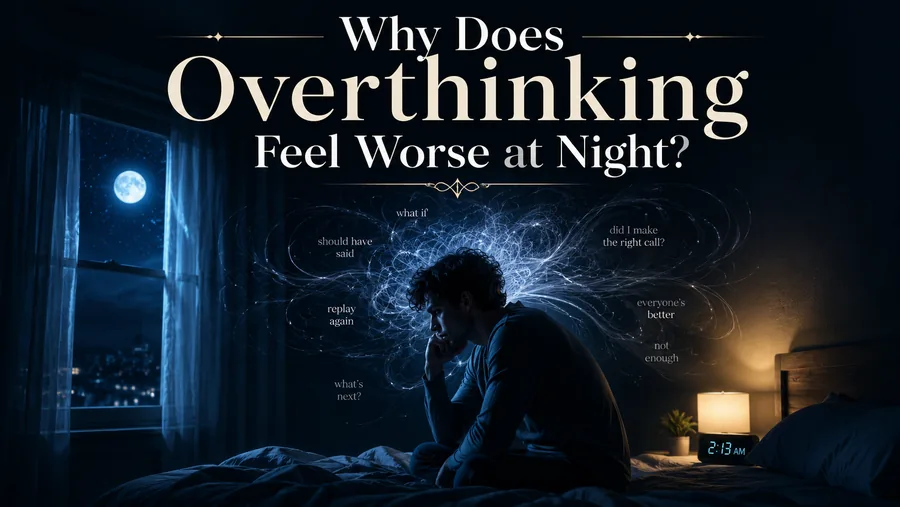
You got through the day. You answered the messages, sat in the meetings, fed people, made the calls, kept it together. Then the lights go off, your mind clears its throat, and the overthinking that felt totally manageable all day somehow comes roaring back. There’s a reason overthinking feels worse at night, and it isn’t that your worries are suddenly true.
The conversation you’d already moved on from? Suddenly unfinished. That email reads colder than you meant it. The little twinge in your chest you waved off at 3 p.m. has a whole backstory by midnight. One small uncertainty sets up a courtroom in your head, and somehow you’re the defendant and the jury both.
I hear about this constantly. People search for it at 1 a.m., from New York to London to Delhi to Melbourne, typing some version of the same question into the dark: why does overthinking feel worse at night?
Here’s the part that actually helps. Night isn’t showing you the truth more clearly. Most of the time, it’s just showing you a tired nervous system.
Overthinking after dark doesn’t mean you’re weak, dramatic, or broken. More often it’s fatigue, quiet, sleep pressure, leftover emotion, and a brain reaching for the only tool it has left at the end of a long day: thought.
Night thoughts sound like truth because the body is too tired to remember the context.
The short version, if you’re skimming
- Night strips away the distractions that kept your worries in proportion all day.
- A tired brain is worse at judging threat, so small problems start sounding enormous.
- Worry and rumination genuinely disrupt sleep. That’s measured, not in your head.
- Rumination feels like problem-solving, but it only circles. Reflection moves; rumination loops.
- The goal isn’t to win the 1 a.m. argument. It’s to give your nervous system enough safety to stop.
Quick gut check: which of these sounds like you at night?
Tick the ones that land. Hold onto them, we’ll come back to them.
- ☐ You replay a conversation that felt completely fine earlier.
- ☐ A small worry quietly grows into a worst-case story.
- ☐ You feel an urge to solve your entire life before you’re allowed to sleep.
- ☐ The silence feels less like rest and more like being exposed.
The Day Gives Your Mind Somewhere to Go
All day, your attention has a job. Work, errands, the group chat, a kid asking for something, the bus you’re about to miss, the next small decision. Even on an anxious day, the world keeps handing your brain instructions: answer this, go there, deal with that.
At night, all of that just stops.
Same mind, far fewer handholds. Nothing to interrupt the spiral, no task to disappear into, no hum of other people to fill the room. For a lot of us, bedtime is the first genuinely quiet moment of the whole day. And quiet isn’t always kind to a nervous system that’s been carrying stress since morning.
Silence isn’t always empty. Sometimes it’s just where everything you postponed comes to find you.
Overthinking Is Usually Protection That Backfires
Anxiety isn’t random. Underneath it, it’s trying to do one job: shrink uncertainty.
That doesn’t make it accurate. It routinely overestimates the danger and underestimates you. But the intent is protective, a part of you asking on loop, what did I miss, what if I can’t cope. Your body often registers that threat before your thinking brain has caught up, which is a whole topic of its own. If that resonates, I went deeper into it here: The Body Knows Before the Mind.
Overthinking can masquerade as problem-solving because it has the texture of effort. You review, you rehearse, you run the worst version one more time. It feels productive. It usually isn’t.
The distinction worth keeping is this: reflection gets you somewhere, while rumination keeps you pacing the same square of floor. At night, with the body tired and the distractions gone, rumination whispers a tempting lie, that if you just think about it long enough, you’ll finally feel safe.
You rarely think your way to safe. Safe tends to start in the body, the moment your nervous system gets enough steadiness to stop treating every open question as an emergency.
What the Research Actually Shows
I want to be careful and concrete here, because this is the part people quietly doubt about themselves.
Worry and rumination are reliably linked to worse sleep. A systematic review and meta-analysis of non-clinical groups found that higher perseverative cognition, the research term for repetitive worry and rumination, tracked with poorer sleep quality, shorter sleep, and taking longer to drift off. Sleep scientists even have a name for the thing happening in your skull at midnight: pre-sleep cognitive arousal. Translated, your brain is still planning, replaying, and monitoring long after the day technically clocked out.
None of this means overthinking is the only thing wrecking your sleep. Sleep gets pushed around by plenty, hormones, pain, caffeine, a bright screen, a noisy street, a baby, a deadline. But it does mean the racing mind is real and measurable. You’re not imagining it. A brain busy rehearsing threat simply struggles to let go into sleep.
And that’s why nighttime anxiety can feel like a different animal than the daytime kind. By day, worry runs in the background while you function. By night, worry takes the stage.
A Tired Brain Judges Badly
Your body runs systems that decide when you’re awake and when you crash. Sleep pressure builds the longer you’ve been up. Your circadian rhythm, the roughly 24-hour internal clock, quietly coordinates alertness, temperature, hormones, the lot.
By night, your body is already powering down. And that does something sneaky. It doesn’t only make you tired, it changes how you think.
A depleted brain gets rigid. The exact problem that felt like an ordinary Tuesday at 10 a.m. can feel like the end of the world at 1 a.m., not because anything changed, but because the part of you doing the judging is running on fumes. Sleep-loss research points the same way. In brain-imaging work from Matthew Walker’s lab, a single night of poor sleep left the amygdala, your brain’s threat alarm, markedly more reactive to negative images, and it weakened the line between the amygdala and the prefrontal cortex, the region that normally keeps fear in proportion. The networks that usually hold context, the ones that remind you this is survivable, go quiet. So the mind starts mistaking a thought for evidence.
Keep reading
Night Takes Away the Day’s Soundtrack
This is close to my own work, so let me sit here a second.
We don’t just hear sound. We recognize ourselves in it.
The day comes with a score: voices, traffic, a kettle, footsteps upstairs, the clatter of an ordinary life. Some of it is stressful, sure. But it also tells your nervous system where it is. At night that whole track cuts out, and the inner soundscape gets loud instead, your own breath, a heartbeat you can suddenly hear, the fridge, the particular silence of a phone that isn’t buzzing.
To a settled nervous system, that quiet feels like room to stretch. To an anxious one, it can feel like being watched.
That’s the real reason so many people reach for rain, a fan, brown noise, or one familiar instrumental track at night. Not because sound is magic. Because predictable sound hands the nervous system a steady cue to hold. It doesn’t delete the thought. It changes the room the thought is standing in.
What This Looks Like at 1 a.m.
It usually latches onto the most ordinary things.
You send a text at noon, no problem. By midnight you’ve reread it four times in your head and decided it came off cold. A small disagreement with someone you love turns, somewhere around 1 a.m., into proof the whole relationship is fragile. A flutter in your chest becomes a diagnosis. You glance at your finances, or your kid, or your career, and feel a sudden, total urgency to fix all of it before sunrise. Or some cringe-worthy moment from years ago floats up, and your body floods like it’s happening right now.
Some of these do point at something that genuinely deserves your attention. That’s true, and worth honoring. But attention and alarm aren’t the same thing, and your body at midnight can’t always tell them apart. A thought can be important and still not be urgent at 1 a.m.
Why It All Feels So Personal After Dark
By day, a problem is usually just a problem. After dark, the same problem starts speaking in absolutes. It stops sounding like a situation and starts sounding like a verdict on you.
"I made a mistake" becomes "I always ruin things."
"I don’t know what’s going to happen" becomes "I’m not safe."
"I feel alone tonight" becomes "I’ll always be alone."
The tired mind thinks in black and white. It drops the context, forgets the people who have your back, and turns a passing state into a permanent fact. This is exactly where a little emotional intelligence earns its keep. Not every thought deserves a debate. Some just need to be recognized for what they are, state-dependent. Your 1 a.m. mind is still yours. It’s just not your wisest one.
A Night Thought Is a Signal, Not a Sentence
One shift changes more than almost anything else: stop treating every night thought as a final ruling.
A night thought might be a real signal, but it’s rarely the whole story. Underneath the words, it’s usually saying something much plainer:
- I’m tired.
- I never got to process today.
- I need a little reassurance.
- I need less input, not more.
- I need the comfort of a routine.
- I need to make this decision, just not right now, and not like this.
- I need an actual human, not another round of arguing with myself.
See it that way and you don’t have to shame yourself for it or do what it demands. You can let the feeling be real without handing it the keys to your whole night.
What Actually Helps When Overthinking Feels Worse at Night
The goal isn’t to force your mind quiet. Push silence on a racing brain and it usually just gets louder. Aim lower, and kinder, instead.
- Drop the demand for an answer tonight. If a thought feels urgent, give it one line: "This matters, and I’ll meet it tomorrow." You’re not abandoning it, you’re booking it a better time, when you actually have the resources to do it justice.
- Turn down the sensory volume. Dim the lights, cool the room, slow your movements, stop checking your phone. You’re sending your body a single message: the day is closing.
- If you have been wired for a while, stop fighting the bed. Lying there arguing with the ceiling quietly teaches your body that bed means battleground. When sleep has not come after a while, get up, keep the lights low, do something dull, and go back when your eyes feel genuinely heavy. It is one of the most studied moves sleep clinicians use for exactly this.
- Give silence a soft edge if it feels too sharp. Steady, predictable, lyric-free sound can help, because lyrics drag the mind back into words and analysis. The best night sound is the one your nervous system doesn’t have to work to decode.
- Don’t make big emotional calls in the dark. Don’t put your relationship, your career, or your health on trial at the most exhausted hour you’ve got. Morning doesn’t fix everything. But morning almost always hands you back your context.
Try this tonight: the next time a thought insists it’s an emergency, write it down in one sentence, set the phone face down, and tell yourself, out loud if you can, "Not now. Morning." Then let your body just be tired.
If this is the kind of thing you want more of, the subscribe box at the bottom of the page is where I send these, one slow, science-backed read at a time, no 1 a.m. panic required.
When It’s More Than a Restless Night
Nighttime overthinking is common, and most of the time it eases with rest and a little steadiness. But if it’s frequent, severe, or tangled up with panic, depression, trauma, ongoing insomnia, compulsive checking, or any thought of harming yourself, that deserves real support from a professional. You don’t have to white-knuckle it alone.
And if your thoughts ever turn unsafe, or you feel you might hurt yourself, please reach out right now, not in the morning. In the US, call or text 988 for the Suicide & Crisis Lifeline. Anywhere else, contact your local emergency number or a crisis line in your country. You don’t have to wait for sunrise to ask for help.
The Bottom Line
Overthinking feels worse at night because the whole stage changes. The room goes quiet, the body runs low, sleep pressure climbs, the day’s structure falls away, and everything you didn’t have time to feel comes up for air. Your mind responds the only way it knows how, by thinking harder. But thinking harder and seeing clearly aren’t the same thing, especially at 1 a.m.
The thoughts that visit you at night may deserve your care. They rarely deserve your obedience. So don’t let the most exhausted version of you cast the deciding vote on your life. Let the night be information, not a verdict. Let the body settle before you go asking the mind for wisdom.
We don’t just hear sound. We recognize ourselves in it. And at night, when the outside world finally goes quiet, what you’re hearing is often just the current state of your own nervous system, tired, tender, and asking for steadiness. That isn’t proof something is wrong with you. It’s proof you’re human.
Not every thought needs an answer before sleep. Some need the morning. Some need another person. And some simply need your nervous system to feel safe enough to finally let the day go.
So, honest question, and feel free to leave it in the comments: what’s the thought that tends to show up for you at 1 a.m.? Naming it in daylight is often the first place it starts to lose its grip.
Keep reading: the nervous-system series
- The Body Knows Before the Mind: How Your Nervous System Detects Threat Before Logic Catches Up
- Why Certain Voices Instantly Calm Your Nervous System
- The Acoustic Anatomy: Audio Anchors for a Peaceful Mind
- Why Your Body Reacts to Music Before Your Mind Understands It
Frequently Asked Questions
Why does overthinking get worse at night?
Overthinking tends to get worse at night because the distractions drop away, the body is tired, sleep pressure is high, and quiet makes your inner thoughts feel a lot louder than they did all day.
Is nighttime overthinking a sign of anxiety?
It can be. Nighttime overthinking shows up often in anxiety, stress, insomnia, and plain uncertainty, especially when the racing thoughts become frequent or genuinely distressing.
Why do my problems feel bigger before sleep?
Because a tired brain loses perspective. Fatigue cranks up the emotional intensity and makes temporary fears sound permanent, so the same problem feels heavier at midnight than it will at breakfast.
What should I do when I can’t stop thinking at night?
Write the worry down, pick one small next step for tomorrow, lower the lights and the stimulation, and lean on a calm routine or soft, predictable sound if the silence feels too sharp.
Why can’t I stop thinking when I try to sleep?
When you lie down, the day goes quiet and the distractions vanish. If the day’s stress never got processed, your mind keeps scanning for unfinished problems, even though your body is begging for rest.
Can sound help calm overthinking at night?
For a lot of people, yes. Soft, predictable, lyric-free sound can give the nervous system a steady cue to settle around, though it’s a support, not a cure for anxiety.

About the author
Dr. Shveata Mishra
Begin with the ritual
Get the free 5-Minute Sound Ritual.
A research-informed listening practice designed to help your nervous system settle, sent to your inbox as a PDF. You will also receive new writing on sound, emotion, and identity whenever an article is published.