

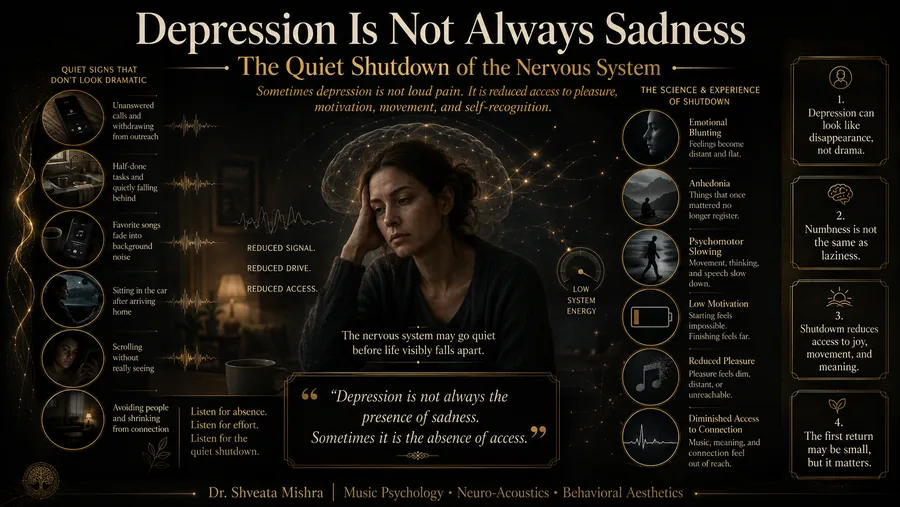
The short version: depression without sadness is real. Sometimes depression does not arrive as crying but as a quiet loss of access to energy, pleasure, music, and connection. If you keep functioning while feeling blank, this article is for you. It is educational, not a diagnosis, and there is a “when to seek help” section at the end.
Some depressions do not announce themselves with tears.
They arrive as a phone left unanswered. A kitchen half cleaned. A favorite song that suddenly feels like background noise. A person who can still attend meetings, pay bills, and say “I’m fine” with a voice that has lost its center.
One of the most misunderstood things about depression is that it is not always an emotion becoming louder. Sometimes it is a nervous system becoming quieter. This is what depression without sadness can look like.
Depression is not always the presence of sadness. Sometimes it is the absence of access.
Access to pleasure, motivation, appetite, memory, music, movement, language, hope, and the ordinary feeling of being inside your own life.
This is why many people miss depression without sadness in themselves. They are waiting to feel visibly broken. Instead, they feel blank. They do not fall apart. They just stop reaching.
Depression Without Sadness Often Looks Like Disappearing
Human beings rarely vanish all at once. More often, they disappear in small, socially acceptable ways.
They reply later. They stop sending the first message. They sit in the car after reaching home because walking through the front door feels like one more demand. They scroll without absorbing anything. They stop choosing music because choosing has become strangely tiring.
This can happen in New York, London, Toronto, Delhi, Mumbai, or anywhere human beings are expected to keep functioning while privately running out of life force.
A person may still look responsible. They may keep their job, care for children, study, maintain a public face, and remain pleasant enough that no one feels alarmed. Yet inside, something has reduced the volume on aliveness.
They do not necessarily think, “I am depressed.” They think, “Why am I so tired?” “Why does nothing feel worth starting?” “Why do I want everyone to leave me alone, even the people I love?” “Why does music feel irritating, empty, or too intimate?”
These are not character flaws. They are clues.
What Science Actually Says
Clinically, depression is broader than sadness. According to the National Institute of Mental Health, major depression can involve depressed mood, but it can also involve loss of interest or pleasure, fatigue, poor concentration, sleep and appetite changes, feelings of worthlessness, irritability, withdrawal, physical aches, or thoughts of death. For diagnosis, symptoms typically persist most of the day, nearly every day, for at least two weeks and interfere with life.
That matters because many people are suffering while telling themselves, “But I am not sad enough.”
Depression is not a single chemical imbalance or a failure of positive thinking. It is shaped by biology, psychology, relationships, culture, health, sleep, stress, grief, trauma, medication effects, and environment.
When people describe depression as a “shutdown,” that is not a formal medical diagnosis. It is a human description of patterns clinicians and researchers do recognize: emotional blunting, anhedonia, psychomotor slowing, withdrawal, low energy, and changes in arousal.
Anhedonia is the reduced ability to feel pleasure or interest. It is not laziness. Neuroimaging research on anhedonia links it to changes in the brain’s systems for reward, anticipation, and motivation, the very machinery that normally turns possibility into pull.
Psychomotor slowing is another important part of depression for some people. Thoughts feel slower. Speech may become quieter. Movement can feel heavy. Starting a task may feel physically expensive. This is not simply “not trying.” Research connects psychomotor symptoms in depression with brain circuits involved in movement, motivation, emotion, and cognitive control. If the smallest tasks have started to feel disproportionately heavy, this related piece may help: why emotional exhaustion makes small tasks feel heavy.
The autonomic nervous system can also be involved. A meta-analysis of heart rate variability in major depression, a measure often used to estimate autonomic flexibility, found that people with major depression tend to show lower HRV on average than healthy comparison groups. HRV is not a depression test, and it should never be treated as one. But it supports a larger point: depression is not only in thoughts. It can be a whole-body state.
The body may conserve. The face may flatten. The voice may lose range. The person may feel less able to mobilize toward life.
Keep reading
Why “Just Cheer Up” Misses The Entire Point
When depression without sadness looks like shutdown, the usual advice often lands badly: “Go out more.” “Think positive.” “Be grateful.” “Just exercise.” “Stop isolating.”
There may be truth hidden inside some suggestions, but truth without timing can become cruelty. A shutdown state is not persuaded by pressure. Pressure often confirms the person’s internal fear that they are failing at being human.
What helps first is recognition.
Recognition sounds like: “I can see you are not yourself.” “This looks hard to initiate.” “Let us make the next step smaller.” “You are not lazy because your system has gone quiet.”
This does not mean we romanticize depression or leave people alone inside it. It means we stop mistaking depletion for defiance.
What Depression Does To Sound
As a music psychologist and neuro-acoustics specialist, I pay close attention to what happens when a person’s relationship with sound changes.
Humans do not just hear sound. They recognize themselves in it.
A voice can tell us we are safe before the words do. A rhythm can help the body find timing. A song can return a forgotten version of the self.
But in depression, sound can change its emotional meaning.
The song that once brought comfort may feel distant. A lively playlist may feel like an accusation. Silence may feel heavy, but noise may feel unbearable. Even choosing what to play can become one more decision the brain cannot afford. I have written more about that specific experience here: why your favorite music suddenly feels irritating.
This is not because music has lost its power. It may be because the listener’s access to emotion, reward, and regulation has been disrupted.
Neuroscience of music and reward shows that pleasurable music can engage networks involved in emotion, anticipation, reward, memory, and bodily arousal. This is one reason music can feel so personal. It is meeting systems involved in meaning, prediction, movement, and self-recognition.
When someone says, “Even music does not feel like anything anymore,” that is not a small detail. It tells us how far away the person may feel from themselves.
The Gentle Role Of Music And Neuro-Acoustic Care
Music is not a replacement for therapy, medication, medical assessment, crisis care, or social support. But carefully used sound can sometimes become a bridge back to contact.
In clinical research, music therapy delivered by trained professionals, usually alongside usual care, has shown short-term benefits for some people with depression. The responsible claim is that music may support emotional expression, regulation, connection, and functioning when used thoughtfully.
For someone in a shutdown state, the first useful sound is often not the most uplifting song. It may be the most tolerable sound.
That could mean:
- one familiar track that is not emotionally overwhelming
- a steady rhythm that helps the body begin a simple task
- a human voice through a podcast, prayer, audiobook, or message
- silence, if sound itself has become too much
The point is not to force happiness. The point is to offer the nervous system a cue it can actually receive. Sometimes recovery begins not with joy, but with the smallest return of rhythm. If you want a gentler, more structured way to use sound here, see sound and the nervous system: 5 audio anchors for a steadier mind.
Real-Life Signs People Often Miss
Depression without sadness may look like a successful professional who delivers at work and then cannot answer one personal message at night.
It may look like a parent who loves their child but feels no pleasure in the moments they used to cherish. It may look like a student whose grades drop because attention and initiation have become unreliable. It may look like an older adult who says, “I do not feel sad. I just do not feel anything.”
It may look like irritability, sound sensitivity, social withdrawal, or the person who keeps saying they are tired while everyone treats tiredness as a scheduling issue.
The Shift: From “What Is Wrong With Me?” To “What Has Become Unavailable?”
One of the most compassionate shifts we can make is to change the question. Instead of asking, “Why am I like this?” ask, “What has become unavailable to me?”
Sit with each of these for a moment:
- Is pleasure unavailable?
- Is movement unavailable?
- Is decision-making unavailable?
- Is social energy unavailable?
- Is music unavailable?
- Is the future unavailable?
This question does not diagnose. It listens. It turns shame into information.
Depression without sadness often convinces people that reduced capacity is proof of reduced worth. That is one of its most dangerous lies. Capacity changes. Worth does not.
If you are watching someone you love go quiet, do not wait only for tears. Listen for absence. Listen for the effort inside ordinary tasks.
And if this is you, please know this: your numbness is not evidence that you are unreachable. It may be evidence that you have been carrying more than your system can metabolize alone.
When To Seek Help
If low mood, emptiness, loss of interest, fatigue, withdrawal, sleep or appetite changes, or difficulty functioning persist for two weeks or more, it is worth speaking with a qualified mental health professional or health-care provider.
If you are having thoughts of death, self-harm, or suicide, seek urgent support now through local emergency services, the nearest emergency department, or a crisis line. In the US and Canada you can call or text 988. Anywhere else, you can find a local helpline through Find A Helpline. You do not need to make the pain sound dramatic before you deserve help.
Support can include psychotherapy, medication, medical evaluation, social support, and sometimes structured music therapy or other creative therapies. The right path depends on the person, severity, context, and risk.
Depression without sadness is treatable, but the first signs of return may be small. The first sign may not be happiness. It may be answering one message, eating something simple, stepping outside for three minutes, or hearing a song and noticing that one line reached you.
It may be the nervous system saying, very quietly, “I am still here.”
Read Next
- Why Emotional Exhaustion Makes Small Tasks Feel Heavy
- Why Do Certain Voices Instantly Calm Your Nervous System?
- Why Certain Songs Make You Feel Understood
Frequently Asked Questions
Can you have depression without sadness?
Yes. Depression without sadness is common. Depression can involve sadness, but it can also show up as emptiness, emotional numbness, irritability, fatigue, loss of interest, reduced pleasure, poor concentration, sleep changes, appetite changes, or withdrawal.
What does nervous system shutdown mean in depression?
“Nervous system shutdown” is not a formal diagnosis. It is a plain-language way to describe low energy, withdrawal, emotional blunting, psychomotor slowing, and reduced capacity. A clinician can help determine whether these symptoms are part of depression, burnout, trauma, a medical issue, medication effects, or another condition.
Why does music feel different when someone is depressed?
Music relies on emotion, memory, attention, anticipation, and reward. Depression can affect these systems, so a favorite song may feel flat, irritating, too intense, or unreachable. It can be a sign that access to pleasure and self-recognition is reduced.
Can music therapy help depression?
Music therapy may help some people with depression, especially when delivered by a trained music therapist alongside usual care. Research suggests possible short-term benefits, but music therapy is not a substitute for urgent care, psychotherapy, medication, or medical support when needed.

About the author
Dr. Shveata Mishra
Begin with the ritual
Get the free 5-Minute Sound Ritual.
A research-informed listening practice designed to help your nervous system settle, sent to your inbox as a PDF. You will also receive new writing on sound, emotion, and identity whenever an article is published.