

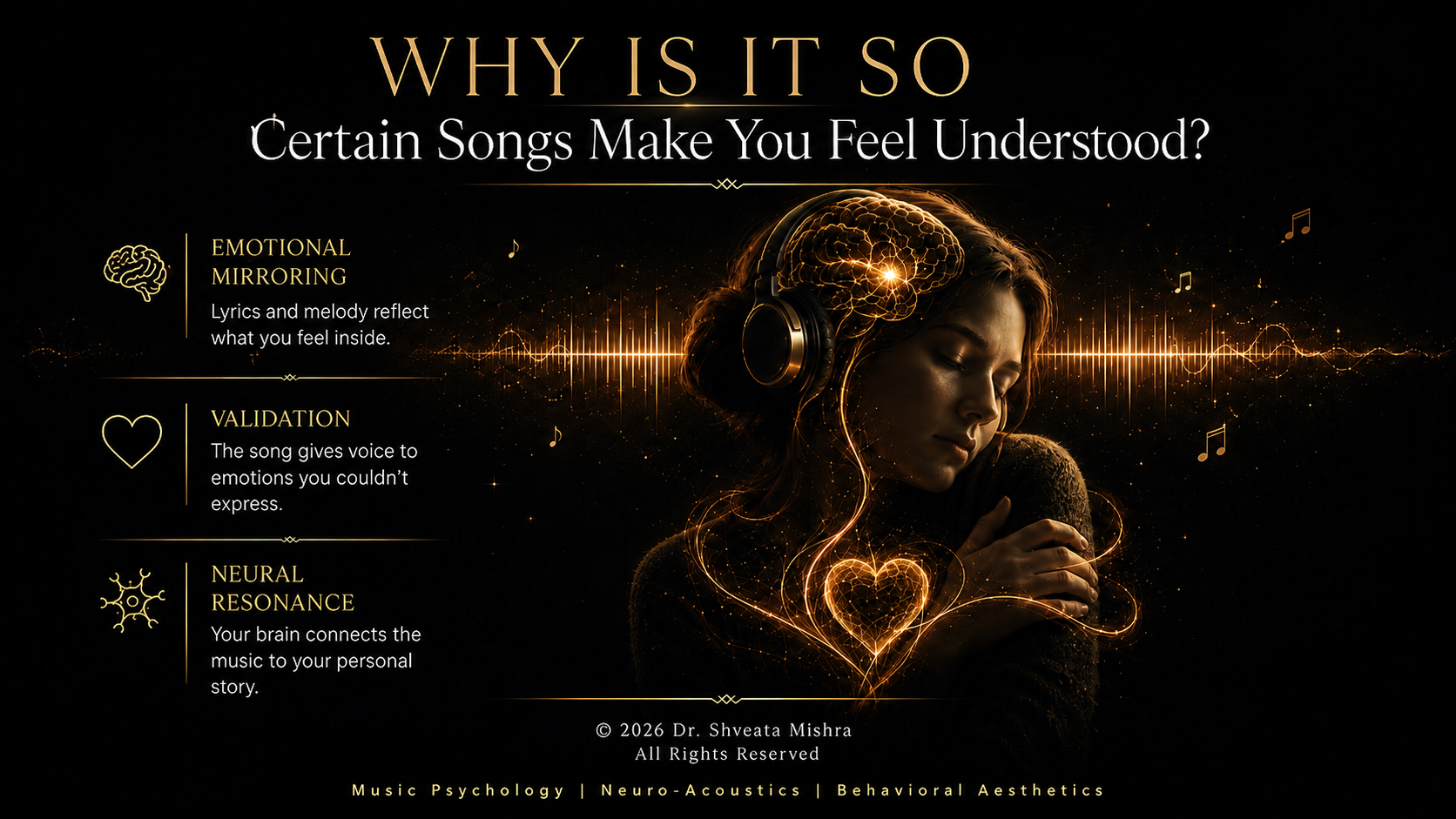
There are songs you like, and then there are songs that seem to know where you are.
Not because they describe your life perfectly. Not because every lyric matches your story. But because something in the voice, rhythm, silence, or emotional timing feels uncannily accurate.
You hear one line and think, "That is exactly it."
You hear a chord change and feel your body soften.
You hear a voice hold a note for half a second longer than expected, and suddenly a feeling you had not explained to anyone feels recognized.
If you have ever wondered why certain songs make you feel understood, the answer is not simply that music is emotional. It is that music can mirror patterns already living inside memory, identity, and the nervous system.
A song does not need to know you personally to feel personal.
It only has to touch something in you that was waiting to be named.
A song feels powerful when it does not explain your emotion, but recognizes its shape.
Why Certain Songs Make You Feel Understood So Quickly
Music often reaches us before language catches up.
In conversation, we usually need explanation. We have to choose words, organize thoughts, and hope the other person understands what we mean.
Music works differently.
It can carry emotional meaning through:
- tone
- rhythm
- tempo
- silence
- repetition
- vocal texture
- tension and release
- memory association
That is why a song can feel emotionally accurate before you have translated the feeling into a sentence.
The mind may later say, "This song understands me."
But the body often recognizes the feeling first.
The Psychology of Emotional Recognition in Music
Feeling understood is not only about being agreed with. It is about emotional recognition.
A person feels understood when something outside them reflects something true inside them. That can happen in a conversation, a book, a film scene, a prayer, a place, or a song.
Music is especially powerful because it does not depend only on literal meaning. It can reflect the emotional rhythm of an experience.
A slow, unresolved melody may match grief.
A steady beat may match determination.
A quiet voice may match loneliness.
A rising chorus may match hope returning after a difficult time.
This is why two people can hear the same song and have very different reactions. The music does not arrive in an empty mind. It arrives inside a personal history.
When the sound matches something already present in you, the experience can feel like recognition.
It can feel like being met.
Why Lyrics Can Feel Like They Were Written For You
Lyrics feel personal when they give language to something you have felt but not fully said.
Sometimes the words are specific. A line describes a kind of heartbreak, longing, exhaustion, faith, anger, or hope that feels close to your own experience.
But often, the lyric is not specific at all.
It is open enough for your life to enter it.
That is one reason songs become so widely meaningful. A lyric may be written from one person’s story, but listeners bring their own memory to it. The song becomes a shared emotional container.
People often say:
- "This song says what I could not say."
- "I did not know I felt this until I heard it."
- "It feels like someone put my emotions into words."
- "This song came at exactly the right time."
Those responses are not dramatic. They are examples of emotional labeling, memory activation, and personal meaning working together.
The lyric feels like it understands you because it helps you understand yourself.
Music, Memory, and the Self You Were Then
Songs do not only connect to feelings. They connect to time.
A song can carry a room, a season, a city, a relationship, a loss, a recovery, or a younger version of yourself.
That is why certain songs make you feel understood years after you first heard them. The song may not only match your current emotion. It may reconnect you with an earlier emotional self.
You may hear an old song and suddenly remember:
- who you were becoming
- what you were trying to survive
- who mattered to you then
- what you hoped would happen
- what you did not yet know how to say
Music is one of the strongest carriers of autobiographical memory because it is sensory, emotional, rhythmic, and repeatable.
When a song returns, it can bring back more than facts.
It can bring back atmosphere.
Why Sad Songs Can Feel Comforting
One of the most searched and most misunderstood questions in music psychology is why sad songs can feel good.
People do not always listen to sad music because they want to feel worse.
Often, they listen because the sadness in the music feels organized, held, and shared.
When you are sad, an overly cheerful song can feel emotionally distant. A sad song may feel closer to the truth of your internal state. It can reduce the sense of being alone with an emotion.
This does not mean sad music is always helpful. If a song keeps you stuck in rumination, it may not be the right sound for that moment.
But when sad music feels regulating, it is often because it creates emotional companionship.
It tells the nervous system: this feeling has a shape, and you are not the only one who has felt it.
Sometimes music comforts us because it does not rush us out of what we feel.
Why Certain Voices Feel Deeply Personal
Sometimes it is not the lyric that makes a song feel understood. It is the voice.
The human voice carries emotional information quickly. Breath, strain, warmth, roughness, restraint, softness, timing, and intensity can all change how a song lands in the body.
A technically perfect voice may impress you, but a human voice with emotional truth may reach you.
This is why some listeners feel attached to singers whose voices sound vulnerable, tired, intimate, prayerful, wounded, or quietly strong. The voice communicates more than melody. It communicates a nervous-system state.
You may not analyze it consciously. You simply feel, "I know this emotional place."
How Songs Become Part of Identity
At some point, certain songs stop feeling external. They become part of how you remember yourself.
People use music to mark who they were, who they loved, what they survived, and what they are trying to become. A playlist can become a private archive of identity.
This is why people return to the same songs during transition:
- after a breakup
- during grief
- while moving cities or countries
- during burnout
- while rebuilding confidence
- while trying to feel close to faith, purpose, or self
The song becomes emotionally useful because it holds continuity.
When life feels uncertain, familiar music can remind the self, "I have been here before. I have felt deeply before. I am still here."
When a Song Feels Too Accurate
Sometimes a song feels so accurate that it is almost uncomfortable.
It may name a feeling you were avoiding. It may bring tears before you know why. It may remind you of someone you thought you had moved past. It may reveal exhaustion you had been managing quietly.
That does not mean the song is doing something mystical or dangerous.
It means music can lower the distance between feeling and awareness.
When that happens, it can be useful to pause and ask:
- What did this song touch in me?
- Is this feeling from now, or from an older chapter?
- Do I feel comforted, activated, heavy, or clear?
- Do I need to keep listening, change the sound, or sit in silence?
Music can be a form of emotional information.
The important question is not only, "Do I like this song?"
It is also, "What is this song helping me notice?"
What the Research Says, In Plain Language
Research in music psychology and neuroscience supports what many listeners already know from experience: music is closely connected to emotion, memory, anticipation, reward, movement, and bodily response.
Music can evoke autobiographical memories, especially when a song is tied to a meaningful period of life. It can also support emotional regulation, social connection, and identity reflection.
In simple language, music does not live in one small corner of the brain.
It engages broad systems involved in:
- emotion
- memory
- attention
- reward
- prediction
- movement
- bodily arousal
- social meaning
This is why music can feel so intimate.
It is not only being processed as sound.
It is being interpreted through the history of the person listening.
What This Means for the Way You Listen
When a song makes you feel understood, it may be giving language to emotion, matching the rhythm of your nervous system, reconnecting you to memory, or holding a version of yourself you have not fully let go of.
It may also be helping you recognize something true without forcing you to explain it immediately.
That is why music can feel so personal even when millions of people hear the same song.
The sound is shared.
The recognition is private.
Humans do not just hear sound. They recognize themselves in it.
And sometimes, one song gives us the rare relief of feeling known without having to speak.
FAQ
Short answers for readers who want the science in plain language.
Why do certain songs make you feel understood?
Certain songs make you feel understood because their lyrics, rhythm, voice, or emotional tone can mirror feelings already present in memory and the nervous system.
Why does music make me emotional so quickly?
Music can make you emotional quickly because it engages systems involved in emotion, memory, anticipation, reward, and bodily response.
Why do sad songs feel comforting?
Sad songs can feel comforting when they match your emotional state without rushing you out of it, reducing isolation and creating a sense of being accompanied.
Why do lyrics feel like they were written for me?
Lyrics can feel personal when they give language to something you have experienced but not fully named.
Why do songs remind me of specific people?
Songs can become linked with context, emotion, place, relationships, and repetition. Later, hearing them may reactivate those associations.
Is emotional connection to music scientifically real?
Yes. Music psychology and neuroscience show that music interacts with emotion, memory, prediction, reward, movement, and bodily arousal.