

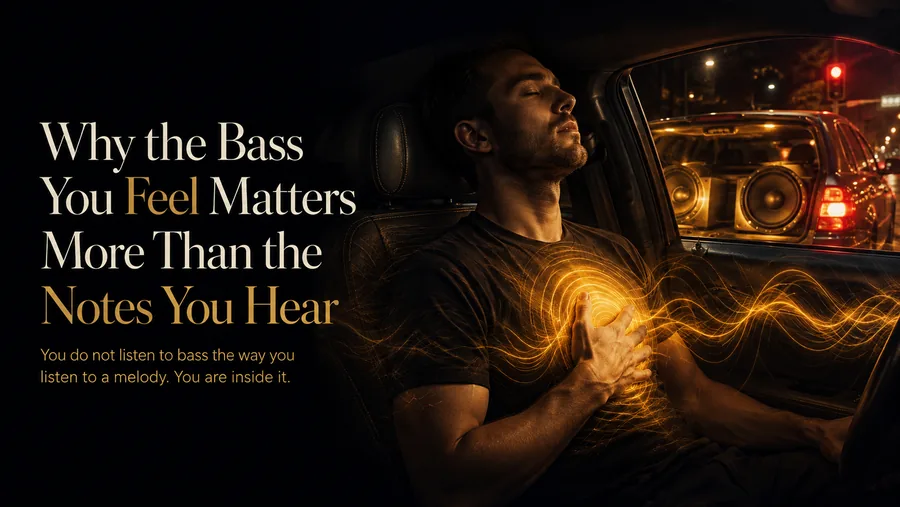
You are at a red light. The car beside you is playing something you cannot quite identify, and yet you have already responded to it. Not to the melody. Not to the words. To the low pulse coming up through the door panel and into your ribs. That is the bass in your chest, and your body registered it before your mind got around to naming the song. Most of us describe music by what we hear. A large part of what music does to us is something we feel.
You do not listen to bass the way you listen to a melody. You are inside it.
The short version, if you’re skimming
- Low frequencies carry far more physical energy than high ones, so they move air, furniture, and your torso. That is the literal reason you feel bass in your chest.
- Your skin and your balance organ both respond to low sound. Hearing is not the only sense involved.
- At a live concert, bass so low that the audience could not consciously detect it still increased how much people danced by about 12 percent.
- The brain reads timing more accurately in low-pitched sounds than high ones, which is why bass instruments keep the rhythm in almost every musical culture.
- The felt layer of music is behavioural information. It moves you, calms you, or overwhelms you without ever passing through conscious judgement.
Quick gut check: which of these is true for you?
Tick the ones that fit. We will come back to them.
- ☐ You turn a song up not to hear it better, but to feel it more.
- ☐ Certain rooms, cars, or venues make a familiar track feel like a different song.
- ☐ Heavy bass in a club or a cinema makes you either euphoric or slightly panicky, rarely neutral.
- ☐ You have caught yourself moving to a beat you were not paying attention to.
Why you feel bass in your chest, and not the violins
Start with the physics, because it is unglamorous and it explains a lot. A 40 Hz tone has a wavelength of roughly 8.5 metres. A 4,000 Hz tone measures about 8.5 centimetres. Long waves carry more energy, bend around obstacles instead of being blocked by them, and pass through walls, doors, and people. This is why the neighbour’s party reaches you as thud thud thud with no discernible tune attached.
Your torso is a good target for that energy. It is a flexible cavity full of air and soft tissue, and it responds to low-frequency pressure the way a drum shell responds to the head being struck. Add the skin. Pacinian corpuscles, the deep vibration receptors sitting under your skin and around your joints, are tuned to exactly this territory, most responsive to vibrations in the low hundreds of hertz. They are not hearing. They are touch.
So when you feel bass in your chest, you are experiencing at least three things at once: sound arriving through the ears, vibration arriving through the skin, and pressure arriving through the body wall. Researchers call the result a multimodal percept. You call it that song hitting.
Try this: play a bass-heavy track twice, once on earbuds and once through a speaker in a small room. Same file, same volume setting. Notice how differently your body sits in each version.
The ear is not the only organ listening
Here is the part that surprises people. Your vestibular system, the balance apparatus in the inner ear that tells you which way is up, also responds to loud low-frequency sound. One of the vestibular organs, the saccule, retains an ancestral sensitivity to vibration.
The classic demonstration came from N. P. Todd and F. W. Cody, who measured vestibular responses to loud dance music and found that above roughly 90 decibels the balance organ starts firing along with the ear. They connected this to what they called the “rock and roll threshold”, the observation that people prefer loud music loud, and that something changes qualitatively once it crosses that line. The frequency range of a club sound system sits neatly in the saccule’s zone of maximum sensitivity.
Think about what that means. Above a certain level, bass stops being purely an auditory event and becomes a signal to the system that governs balance and self-motion. Your body is being told, in a language older than melody, that you are moving. No wonder standing still gets difficult. The bass in your chest is also, quietly, a message to your sense of balance.
The dance floor experiment that settled the argument
In 2022, a team at McMaster University ran a study that reads like a prank and holds up as science. During a live electronic music concert, they installed very low frequency speakers, roughly 8 to 37 Hz, and switched them on and off in blocks while motion-capture headbands tracked how much the audience moved.
People danced about 12 percent more when the very low frequencies were on. A follow-up test suggested the audience could not consciously detect whether the speakers were running. They were not thinking ooh, more bass. They simply moved more, most likely through vestibular and tactile channels rather than hearing.
I find this finding quietly radical. A complex social behaviour, dancing in public with strangers, was nudged by a sensory input nobody in the room could name. That is the whole argument of this article in one experiment.
The bass in your chest does not ask your opinion. It makes its case to the body and lets the mind catch up.
Keep reading
Why the low notes are the ones keeping time
There is a reason bass guitars, kick drums, tablas, and double basses lay down rhythm while flutes and violins carry tunes. It is not tradition. It appears to be physiology.
Michael Hove, Laurel Trainor and colleagues showed that the brain detects timing errors more accurately in a low-pitched stream than a high-pitched one, and their modelling traced the advantage all the way back to the cochlea, the spiral organ of the inner ear. Low sounds are simply better timekeepers as far as your auditory system is concerned. Across musical cultures, composers arrived at the same arrangement independently, because the ear was voting the whole time.
Put the two findings together and the picture sharpens. The low end tells your body when. The high end tells your mind what. The bass in your chest is the metronome you never consciously counted. If you have ever wondered why a song with a beautiful melody can still feel flat, listen to what the low end is or is not doing underneath it.
If the body-first nature of this interests you, I went further into it here: Why Your Body Reacts to Music Before Your Mind Understands It.
Bass as behavioural information
This is where my own work sits. Within the Neuro-Acoustic Behavioral Aesthetics™ framework, I treat sound not as decoration but as behavioural information: input that shapes what a person does, feels, and identifies with, usually below the level of decision.
The bass in your chest is a strong example. It arrives as sensation rather than content, which means it skips the part of you that evaluates and critiques. That is why bass-forward music does such specific social work. It synchronises a crowd without instruction. It makes a car feel like a private room. It gives adolescents a way to occupy their own bodies loudly, at a stage of life when identity is being negotiated in public. The genre matters less than the physics.
People don’t just hear sound. They recognize themselves in it. Sometimes the recognition is in the ribs, not the ears.
It also explains a common frustration. Two people can listen to the same track and disagree completely about whether it is good, because they are not receiving the same signal. One is listening on laptop speakers that cannot reproduce anything below 150 Hz. The other is feeling it. The notes are identical. The experience is not.
When the bass you feel becomes too much
The same physics that makes low sound pleasurable makes it costly at high doses. The bass in your chest is welcome when you chose it and corrosive when you did not. Vibration you cannot escape is one of the most reliably distressing sensory experiences there is, which is why persistent low-frequency noise from a nightclub or a generator wears people down in a way that birdsong at the same decibel level never would. You cannot close your skin.
Loud bass also carries the ordinary risks of loud sound. The pleasure is real, the hearing damage is also real, and the dose is what separates them. I have written about that trade-off in more detail in Loud Music, Nervous System Arousal, and the Hidden Cost of Sound Intensity.
And some people are simply more reactive to felt sound than others. If texture and vibration land unusually hard for you, that is a recognised pattern, not a quirk.
What to actually do with this
- Choose the room, not just the track. Bass response is mostly a property of your space and your speakers. The same song in a small room with a hard floor is a different physical event.
- Sit closer to a wall or a corner if you want more. Low frequencies build up at boundaries. Move a metre and the felt bass changes more than any equaliser setting will.
- Use earbuds honestly. Most in-ear models simulate low end rather than delivering it to your body. If a track feels emotionally thin, that may be a hardware limit rather than a taste change.
- Match the low end to the task. Bass-forward music supports movement, workouts, cleaning, and driving. For focus work it often competes with thinking, because the body keeps answering it.
- Respect the dose. If you want the felt experience regularly, protect the mechanism that delivers it. Earplugs at gigs preserve the bass in your chest and cut the damage.
If reading your own sensory life this way is useful to you, the subscribe form at the bottom of this page sends the next piece straight to you.
A reframe before you go
We are taught to talk about music as though it were information delivered to the ears for the mind to appreciate. Notes, lyrics, key changes, taste. All of that is real, and none of it explains why a stranger’s car at a red light can make your chest respond before you have identified the song.
The bass in your chest is not a lesser part of listening. It is the older part. It is the layer that reaches you through skin, bone, and balance, and it shapes behaviour long before judgement gets involved. When you say a song moved you, sometimes that is a metaphor. Often it is a description.
So tell me: which song do you turn up not to hear better, but to feel properly, and where in your body does it land?
Keep reading: the sound and the body series
- Why Your Body Reacts to Music Before Your Mind Understands It
- Loud Music, Nervous System Arousal, and the Hidden Cost of Sound Intensity
- When Certain Sounds Make Your Teeth Feel Sensitive: The Body’s Response to Sound Texture
- Sound and the Nervous System: 5 Audio Anchors for a Steadier Mind
Frequently Asked Questions
Why do I feel bass in my chest but not high notes?
Low frequencies have long wavelengths and carry more physical energy, so they move air and soft tissue rather than being absorbed or blocked. Your torso is a flexible, air-filled cavity that responds to that pressure. High frequencies are short, weak, and easily stopped, so they reach the ears and stop there.
Is feeling bass in your body actually hearing?
Not entirely. The sensation combines hearing with vibration detected through the skin by deep touch receptors, plus a contribution from the vestibular balance organs at high volumes. Researchers describe it as a multimodal auditory and tactile experience rather than pure hearing.
Why does bass make you want to move?
Low sound reaches the systems involved in balance, self-motion, and touch, and the brain also tracks timing more accurately in low-pitched sounds. In one live concert study, very low frequency bass that the audience could not consciously hear still increased dancing by roughly 12 percent.
Can bass you cannot hear still affect you?
Yes. Frequencies at or below the threshold of conscious hearing can still be registered through vestibular and tactile channels and can influence movement and arousal. This is different from claiming that inaudible sound has healing properties, which the evidence does not support.
Is loud bass bad for you?
Volume is the issue, not the frequency. Sustained loud music carries a genuine risk of hearing damage regardless of how pleasurable it feels, and inescapable low-frequency noise from neighbours or machinery is a well-documented source of distress. The bass in your chest is worth protecting, so wear earplugs at concerts and keep the dose sensible.
Why does the same song feel completely different on different speakers?
Because most of what you feel lives below about 150 Hz, and small speakers and many earbuds cannot reproduce that range with any real energy. The notes reach you identically. The bass in your chest never arrives, so the emotional impression changes with the hardware rather than with the music.

About the author
Dr. Shveata Mishra
Begin with the ritual
Get the free 5-Minute Sound Ritual.
A research-informed listening practice designed to help your nervous system settle, sent to your inbox as a PDF. You will also receive new writing on sound, emotion, and identity whenever an article is published.