

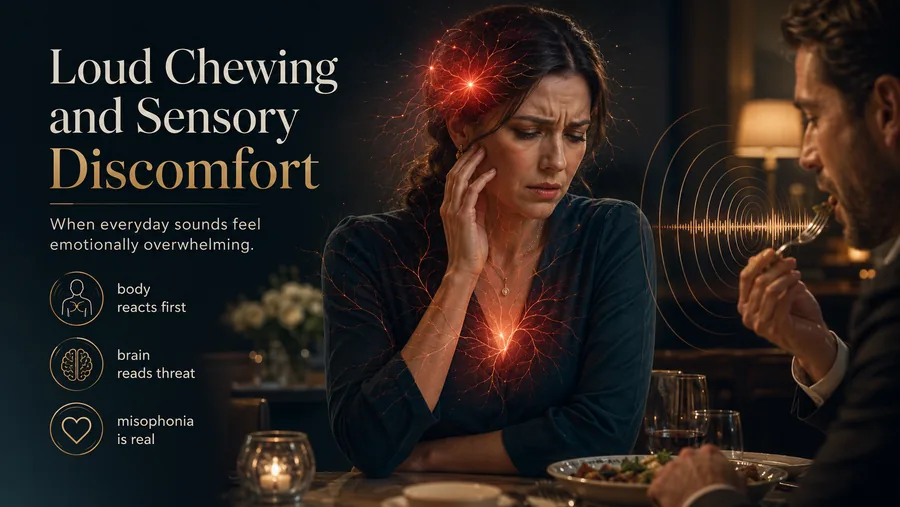
You are at the dinner table. The food is good, the company is fine, and then it starts. The wet, rhythmic sound of someone chewing. Within seconds you are not annoyed, you are furious, and a small part of you is wondering what is wrong with you. If that scene feels uncomfortably familiar, there is a name for what you are experiencing, and it is not a character flaw. It is called misophonia, and the latest research suggests your reaction begins in the brain long before you can reason your way out of it.
The body reacts first. The judgment about whether the reaction is “reasonable” arrives second, and far too late.
The short version, if you’re skimming
- Misophonia is a strong, involuntary emotional reaction (anger, panic, the urge to flee) to specific everyday sounds, often chewing, breathing, sniffing, or tapping.
- It is not oversensitive hearing. People with misophonia hear normally; their brains process certain sounds as threats.
- Brain imaging links it to the anterior insula, a hub that ties sound to emotion and body sensation.
- A 2021 study points to the brain’s movement system, suggesting trigger sounds make you involuntarily “mirror” the action you are hearing.
- It is common, and it is real. Naming it is the first step toward managing it.
Quick gut check: which of these is true for you right now?
Tick the ones that fit. Hold on to your answers, we’ll come back to them.
- ☐ A specific sound (chewing, slurping, a pen clicking) sends a wave of anger through you almost instantly.
- ☐ You have changed where you sit, eat, or work to avoid one particular person’s sounds.
- ☐ Even seeing someone about to do the thing is enough to set you off.
- ☐ You feel guilty afterward, because the size of your reaction does not match the size of the sound.
What misophonia actually is
Misophonia, which translates loosely as “hatred of sound,” describes an adverse emotional reaction to ordinary, often repetitive sounds. The classic triggers are bodily and human: chewing, lip-smacking, slurping, heavy breathing, sniffing, throat-clearing. For some people the list extends to keyboard tapping, pen clicking, or the crinkle of a wrapper. The sound itself is usually quiet. That is the part outsiders struggle to understand.
This is the crucial distinction. Misophonia is not the same as hyperacusis, where ordinary volumes feel painfully loud. People with misophonia tend to hear perfectly well. The problem is not the loudness, it is the meaning their brain assigns to a particular sound. One person’s barely audible chewing is another person’s alarm bell.
Try this: the next time a sound grips you, name it out loud in your head, “this is a misophonia response.” Labeling a reaction is one of the few things that gives the thinking brain a way back in.
Why a quiet sound can feel like an emergency
Here is what the research has started to show, and it reframes everything. When people with misophonia hear a trigger sound, brain scans show an exaggerated response in the anterior insular cortex. That region sits at the center of what scientists call the salience network, the system that decides what deserves your attention right now and stitches sound together with emotion and with what you feel in your body.
So the sound does not stay a sound. It gets fast-tracked into the circuitry that handles importance, feeling, and bodily state. That is why the response is so physical: a jump in heart rate, heat in the chest, the muscles bracing. This is autonomic arousal, the same fight-or-flight machinery that fires when something genuinely threatens you. The body does not wait for your opinion. It has already decided.
That gap between the body’s reaction and your conscious judgment is the heart of the distress. You are not choosing to be enraged by a sandwich. Your nervous system got there first, and your reasoning is left holding an explanation it never agreed to.
Keep reading
The surprising clue: your brain may be “mirroring” the mouth
The most intriguing recent finding moves the story away from hearing altogether. In a 2021 study in the Journal of Neuroscience, researchers examined the brains of people with misophonia and found something unexpected. The trigger sounds were strongly linked to the orofacial motor cortex, the part of the brain that controls the movements of the mouth and face.
The proposed explanation is “hyper-mirroring.” We all quietly simulate the actions of others when we watch or hear them; it is part of how we understand one another. In misophonia, that mirroring appears to run stronger and more specific to trigger sounds. In plainer language: when you hear someone chew, your brain may be involuntarily rehearsing the act of chewing in someone else’s mouth, as if their jaw has briefly hijacked yours. No wonder it feels invasive. On some level, it is.
If this resonates, I went deeper into how the body reads the physical character of sound here: When Certain Sounds Make Your Teeth Feel Sensitive: The Body’s Response to Sound Texture.
Why this is not “just being difficult”
People with misophonia often carry a quiet shame, because the world reads their reaction as rudeness or fragility. It is neither. Misophonia is involuntary, it is measurable, and surveys suggest a meaningful slice of the population experiences it to some degree. It can also wear down relationships and make shared meals, open offices, and long car rides genuinely hard.
This is the lens my work keeps returning to. Sound is never only acoustic information. It is behavioral information, woven into emotion, attachment, and identity. A trigger sound is so disruptive precisely because it is rarely a stranger’s sound that hurts most. It is usually someone close, at the table, in the bed, in the next chair. The intimacy is part of the wound.
People don’t just hear sound. They recognize themselves in it. And sometimes, painfully, they recognize a threat where there is only a meal.
What to actually do about it
- Name it, don’t fight it. Recognizing “this is a misophonia response” gives the reasoning brain a foothold instead of leaving you flooded and ashamed.
- Lower the stakes around the trigger. Soft background sound, an instrumental track, or gentle earplugs in predictable settings can take the edge off without isolating you.
- Tell the people close to you what is happening. Framing it as a wiring difference, not a verdict on them, protects the relationship more than silent endurance does.
- Seek qualified support if it disrupts daily life. Approaches like cognitive behavioral therapy are being studied for misophonia. This article is educational and is not a substitute for medical or psychological care.
If you find these pieces useful, the subscribe form at the bottom of the page is where I send new writing on sound, emotion, and identity.
A gentler way to hold it
The reframe I want to leave you with is this: your reaction to loud chewing is not evidence that you are intolerant. It is evidence of how tightly your brain binds sound to emotion and to your own body. That binding is usually a gift. It is why a song can return you to a person, why a voice can settle you, why silence can feel like safety. Misophonia is that same sensitivity, turned in a direction that hurts.
You are not broken for flinching at a sound no one else seems to notice. You are listening with your whole nervous system. The work is not to feel less, it is to understand what your body is telling you and to build a little space between the sound and the storm.
Which everyday sound undoes you the fastest, and who is usually making it? Tell me in the comments. Naming it together makes it smaller.
Keep reading: the sound and emotion series
- When Certain Sounds Make Your Teeth Feel Sensitive: The Body’s Response to Sound Texture
- Loud Music, Nervous System Arousal, and the Hidden Cost of Sound Intensity
- Why Emotional Exhaustion Changes the Way You Hear the World
- The Hidden Psychology of Why Silence Feels Difficult Today
Frequently Asked Questions
Is misophonia a real condition or just being fussy?
It is a real, measurable response. Brain imaging shows people with misophonia have exaggerated activity in emotion and salience regions when they hear trigger sounds, so the reaction is involuntary, not a preference or a personality fault.
Why does loud chewing specifically make me so angry?
Chewing, slurping, and breathing are among the most common misophonia triggers because they are repetitive, bodily, and tied to other people. Research suggests your brain may involuntarily “mirror” the mouth movements behind the sound, which can feel invasive and provoke anger or the urge to escape.
Is misophonia the same as having sensitive hearing?
No. That condition is called hyperacusis, where normal volumes feel painfully loud. In misophonia hearing is typically normal; the issue is the emotional meaning the brain attaches to specific sounds, not their volume.
Can misophonia get better?
Many people learn to manage it. Strategies range from background sound and clear communication with loved ones to structured approaches like cognitive behavioral therapy, which is being studied for misophonia. A qualified professional can help you find what fits.
Why do the sounds my own family makes bother me most?
Triggers are often strongest with people we are close to and exposed to repeatedly. Because sound is bound up with emotion and attachment, a familiar person’s chewing carries more emotional weight, which can intensify the response.
Is it normal to feel guilty about my reaction?
Yes, and it is common. The guilt usually comes from the mismatch between a small sound and a large reaction. Understanding that misophonia is a brain-based, involuntary response can ease some of that self-blame.

About the author
Dr. Shveata Mishra
Begin with the ritual
Get the free 5-Minute Sound Ritual.
A research-informed listening practice designed to help your nervous system settle, sent to your inbox as a PDF. You will also receive new writing on sound, emotion, and identity whenever an article is published.