

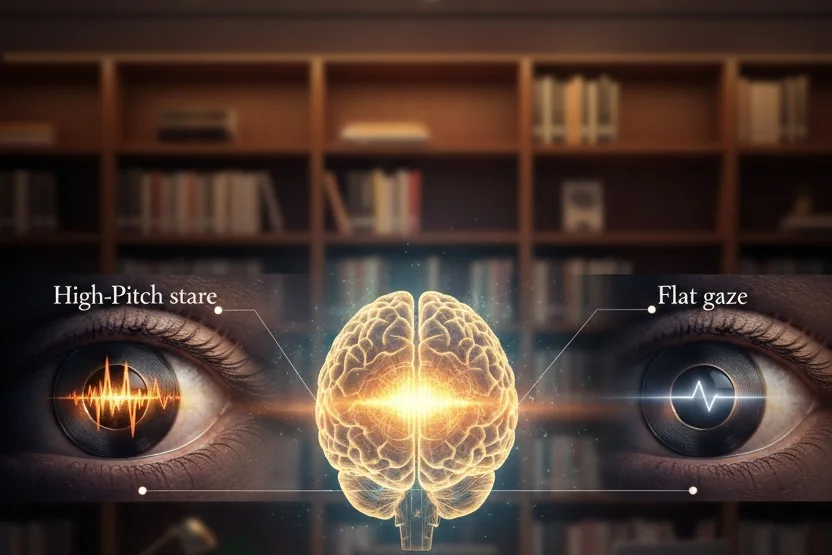
You walk into the room before you open your mouth. The other person glances up, and in well under a second, something in them has already decided whether you feel safe, sharp, or switched off. They are not reading your résumé. They are reading your eyes. What your eyes reveal in that first moment is not your eye colour or your lashes. It is the live state of your nervous system, broadcast through pupil, blink, and the small tremor of your gaze.
Before you say a word, your eyes have already spoken. The only question is what they said.
The short version, if you’re skimming
- What your eyes reveal is your nervous system in real time. Pupil size, blink rate, and tiny movements shift with stress and calm, mostly outside your control.
- Other people read this in milliseconds, which is why a wired gaze can feel intrusive and a flat one can feel absent, before either of you has said anything.
- I sort the gaze into three states: Sharp (over-aroused), Flat (depleted), and Resonant (regulated). None is a character flaw. Each is a nervous-system weather report.
- You cannot fake a steady gaze for long. You can change the state underneath it, and the eyes follow. That is the part you actually control.
- A few honest, science-backed habits (slow blinking, humming, steady focal gazing, real morning daylight) move you toward the resonant end.
Quick gut check: which of these is true for you right now?
Tick the ones that fit. Hold on to your answers, we’ll come back to them.
- ☐ People sometimes ask if you’re okay when you feel completely fine.
- ☐ In high-stakes moments your eyes feel busy, darting, hard to settle.
- ☐ By evening your eyes feel heavy and a little switched off, even when you’re not sleepy.
- ☐ You’ve met someone whose steady gaze made you feel oddly safe, and you couldn’t say why.
What Your Eyes Reveal Before You Say a Word
The eye is not a passive camera. The optic nerve is brain tissue, an outgrowth of the central nervous system, and the muscles that move your eyes and size your pupils answer to the same autonomic wiring that runs your heart rate and your breath. So your eyes leak. They leak your internal state in real time. What your eyes reveal, in other words, is physiology, not personality.
Two signals do most of the talking. The first is the pupil. Pupil size tracks arousal through the locus coeruleus, the brainstem’s noradrenaline hub: when you’re alert, stressed, excited, or afraid, your pupils widen, and they shrink again as you settle. This is involuntary. You can’t consciously dilate your pupils to look interested, which is exactly why the signal is trusted. Researchers can now read global brain states, arousal included, straight off pupil and eye-movement data.
The second signal is movement. Under load, your gaze makes more of the tiny flicks called saccades, your blink rate climbs, and your fixation turns jumpy. In calm, focused states the opposite happens: fewer blinks, steadier holds. Saccade and pupil dynamics are reliable enough that they’re used as an index of fatigue and arousal in the lab. The person across the table isn’t running that analysis on purpose. Their social brain does it for them, in milliseconds, and hands them a feeling: trust, or unease.
Try this: on your next video call, watch your own preview window for ten seconds and count your blinks. That number is a live arousal gauge.
That’s the heart of it. What your eyes reveal is not a fixed trait. It’s a state, and states can be changed.
The Three Gazes: Sharp, Flat, and Resonant
In my work in behavioural aesthetics, I find it useful to name three gaze states, three recurring patterns in what your eyes reveal. They map loosely onto the old Indian categories of tivra (sharp), tamasic (dull), and sattvic (clear), which is no accident. Long before brain scanners, people were reading these states off each other’s faces.
The Sharp gaze (over-aroused)
This is the visual signature of a sympathetic nervous system running hot. The look: frequent blinking, darting movement, a piercing quality that can feel intrusive rather than warm. It often shows up as a nervous brightness, eyes that can’t quite lock on. What it broadcasts is urgency, and sometimes anxiety. In a meeting it can quietly put the other person on guard, because their nervous system tends to mirror yours.
The Flat gaze (depleted)
This is the low-energy end: heavy lids, a cloudy or absent quality, light that doesn’t seem to land. It tends to arrive with fatigue or burnout, or simply a long, wrung-out day after the calls and the commute and the group chats. It’s the visual equivalent of a monotone voice. It isn’t coldness or disinterest, though it reads that way, which is the unfair part. (A flat gaze is a fatigue signal, not a diagnosis. If it’s constant and comes with low mood, that’s worth a real conversation with a professional, not a breathing exercise.)
The Resonant gaze (regulated)
This is the steady, present gaze you’ve felt from a few people in your life. Not staring, not performing. Just settled. It tends to appear when arousal is moderate and the body is regulated, the state where heart-rate variability is high and attention is relaxed but engaged. It reads as safety and authority at the same time, which is a rare pairing. We tend to call it charisma. Underneath, it’s mostly regulation.
If this resonates, I went deeper into how the body leaks truth through another channel here: How to Read Vocal Cues of Honesty and Deception.
Keep reading
How to Tune Your Gaze
Here’s the honest part. You can’t will your pupils to behave or paint on a resonant gaze, and you can’t directly control what your eyes reveal. What you can do is change the state underneath, and let the eyes follow. Four practices, all grounded, none magical.
Slow the blink. Stress speeds the blink up, and the link runs both ways: deliberately slowing your eyes sends a down-shift signal back. Before a high-stakes moment, close your eyes for a slow count of three, then open them over a count of five. Repeat a few times. You’re nudging yourself off the sharp end.
Hum for a minute (Bhramari). A low, closed-mouth hum is one of the simplest ways to raise parasympathetic, rest-and-digest tone. The vibration is part of it, and humming also raises nasal nitric oxide roughly fifteenfold, which supports easy nasal airflow. It is not vibrating your optic nerve, despite what you may have read somewhere. It is calming the system your eyes report on.
Practise steady focal gazing (Trataka). The yogic practice of softly resting your gaze on a single point, a candle flame at arm’s length, has modest but real support: small studies link short daily sessions to better sustained attention and less digital eye strain. Treat it as attention training, not a cure for anything, and keep the sessions brief.
Get morning daylight, safely. Bright light early in the day supports healthy alertness and a steady circadian rhythm, which feeds the rested, clear quality of a calm gaze. One firm rule: never look at the sun. Sun gazing can burn the retina permanently within seconds, and eye doctors agree it is not safe at any time of day, sunrise included. You want the ambient brightness of being outdoors, not the sun itself.
You don’t design your gaze by trying to look a certain way. You design the state, and the eyes tell the truth.
What to Actually Do About It
- Treat your eyes as a gauge, not a mask. What your eyes reveal is information about your state, not a verdict on your character, so when they feel sharp or flat, read the signal, then change the state.
- Reset before, not during. Do the slow blinks or a minute of humming in the lift or the car, so you walk in already regulated.
- Protect the input. Less doom-scrolling before a big moment, more real daylight, more actual sleep. The clear, lit gaze is mostly a well-rested nervous system.
- Drop the performance. Steady is not the same as intense. You’re aiming for settled and present, not a hard stare.
If this is the kind of thing you like to think about, the science of sound, the body, and how we read each other, the subscribe form at the bottom of this page is where I send the next one.
Your Eyes Are Always Speaking
Go back to your gut check. Whichever boxes you ticked, notice that none of them is about who you are. They’re about the state you were in. That’s the freeing part. A sharp gaze doesn’t make you an anxious person, and a flat one doesn’t make you cold. What your eyes reveal is weather, not climate, and weather changes.
Every time you walk into a room, your eyes play the first note before you speak. You don’t get to mute them. You do get to tune them. So here’s my question for you: whose resonant gaze has stayed with you, and what do you think they were actually doing to earn it?
Keep reading: the sound, body, and identity series
- Why Certain Voices Instantly Calm Your Nervous System
- The Acoustic Anatomy: How to Architect a Peaceful Mind
- The Emotional Wallpaper: Why Your Background Music Is Architecting Your Nervous System
- How to Read Vocal Cues of Honesty and Deception
Frequently Asked Questions
What do your eyes reveal about your emotions?
Mostly your level of arousal, not one specific feeling. Pupil size, blink rate, and small eye movements shift with stress, excitement, and calm, and these are largely involuntary, which is why people read them as honest signals of how you’re actually doing.
Can people really tell when you’re anxious just from your eyes?
Often, yes, though not consciously. A fast blink rate and a darting, hard-to-settle gaze are visible signs of a revved-up nervous system, and the people around you tend to pick them up as a vague feeling of unease rather than a precise read.
How do I make my eye contact look calm and confident?
You can’t fake it for long, so change the state first. Slow your blinking, hum quietly for a minute, and breathe out longer than you breathe in before the moment. A calmer nervous system produces a steadier gaze on its own. Aim for settled and present, not an intense stare.
Is Trataka (candle gazing) actually good for your eyes?
The research is limited but encouraging: short, regular sessions of steady focal gazing are linked to better sustained attention and less digital eye strain. Treat it as attention training, keep the sessions brief, and stop if your eyes feel irritated.
Does humming really calm the nervous system?
Humming raises parasympathetic, rest-and-digest tone and increases nasal nitric oxide about fifteenfold, which supports easy breathing. The exact calming mechanism is still being studied, but the down-shifting effect is real and it takes only about a minute.
Is it safe to look at the morning sun to brighten your eyes?
No. Looking directly at the sun, sunrise included, can cause permanent retinal damage within seconds, and eye specialists advise against it at any time of day. You get the benefit of morning light simply by being outdoors in the ambient brightness, never by gazing at the sun.

About the author
Dr. Shveata Mishra
Begin with the ritual
Get the free 5-Minute Sound Ritual.
A research-informed listening practice designed to help your nervous system settle, sent to your inbox as a PDF. You will also receive new writing on sound, emotion, and identity whenever an article is published.